

The theory stated plainly: television and film drowned out literature as a medium, which has contributed a steady decline in literacy and writing over the last 60 years. Top talent shifted away from writing and into finance/tech. At first, technological innovation incentivised the creation of new content, which enabled the golden age of film/television, much of which drew on an existing body of literature. As technology stagnated and streaming rose, the market shifted and content became more risk averse and derivative. Essentially:
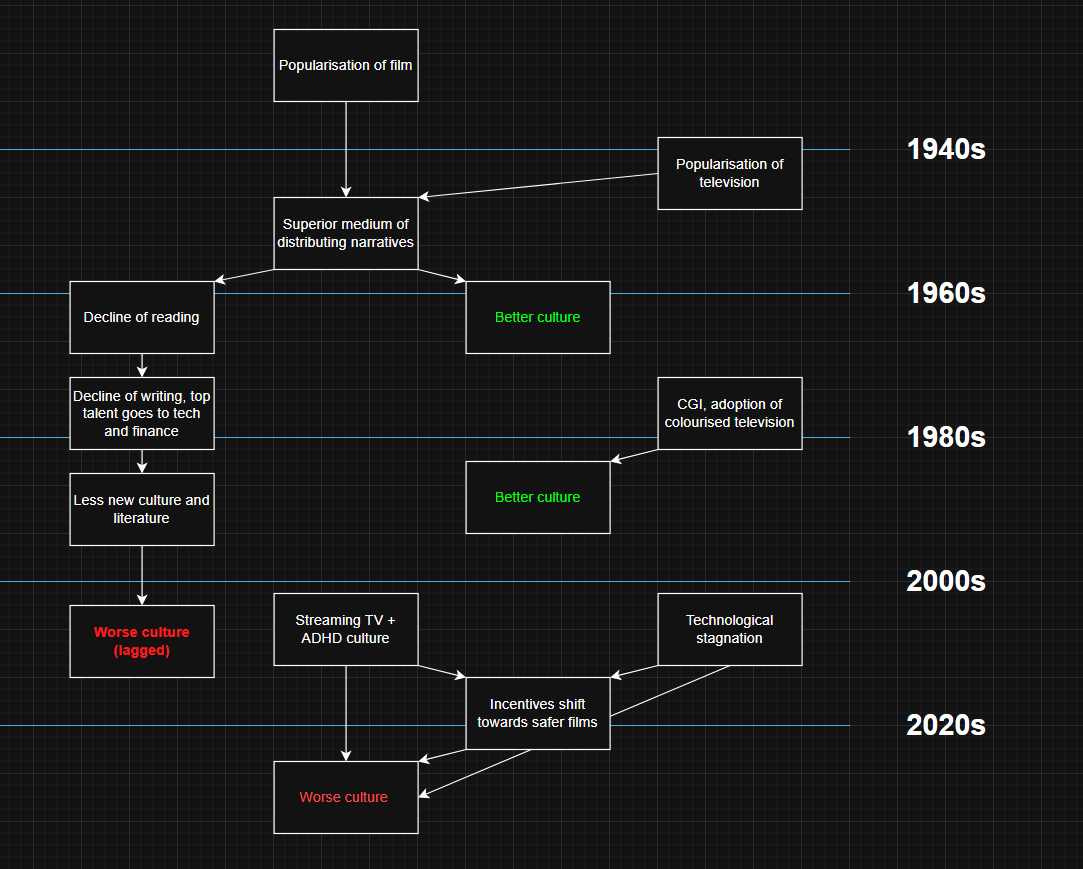
The theory
Empirically, self-reported reading for pleasure has declined in both adults and teenagers over the last 50 years. People also rarely finish the books they read, which can be inferred from the fact people tend to be much more likely to quote passages from the beginning of a book. Using this data, it’s possible to estimate the percentage of people who actually finish books:
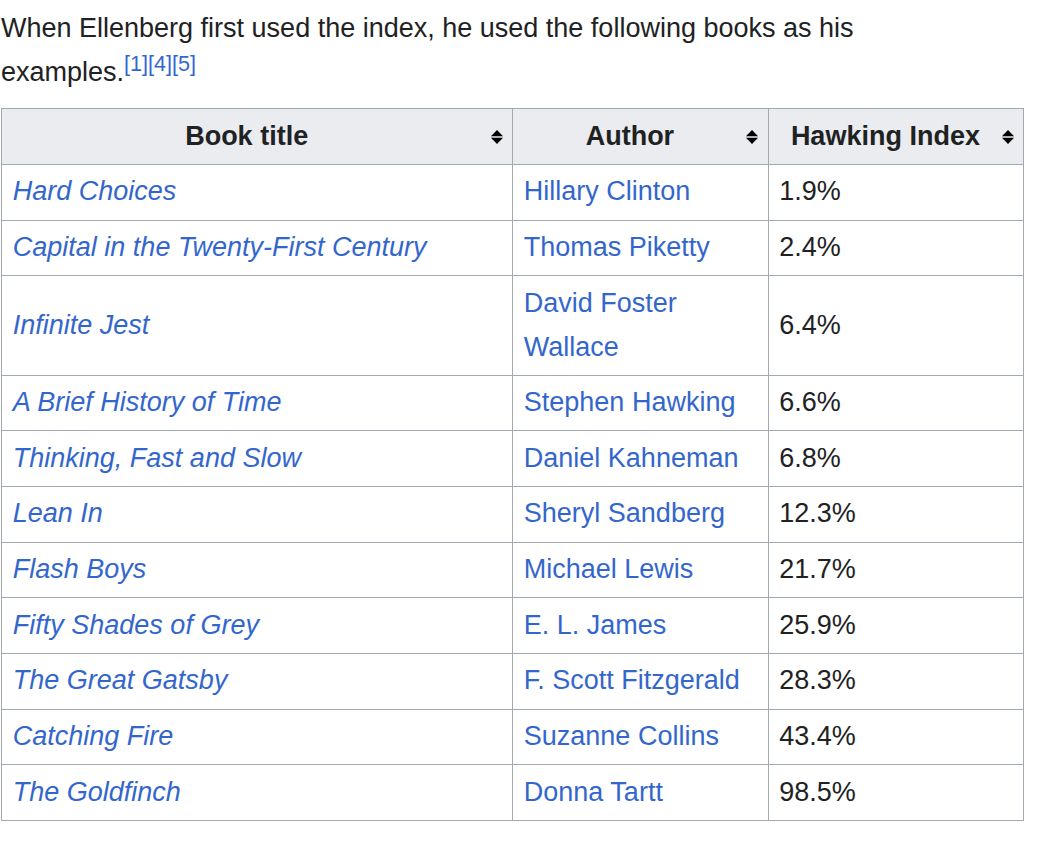
If less people are reading, that means that less people are writing, not just due to the lower demand, but also the fact that the skillsets overlap. More importantly, the demographic of individuals who tend to write the most books that become classics — White men — have vanished from major writing awards:
It’s easy enough to trace the decline of young white men in American letters—just browse The New York Times’s “Notable Fiction” list. In 2012 the Times included seven white American men under the age of 43 (the cut-off for a millennial today); in 2013 there were six, in 2014 there were six.
And then the doors shut.
By 2021, there was not one white male millennial on the “Notable Fiction” list. There were none again in 2022, and just one apiece in 2023 and 2024 (since 2021, just 2 of 72 millennials featured were white American men). There were no white male millennials featured in Vulture’s 2024 year-end fiction list, none in Vanity Fair’s, none in The Atlantic’s. Esquire, a magazine ostensibly geared towards male millennials, has featured 53 millennial fiction writers on its year-end book lists since 2020. Only one was a white American man.
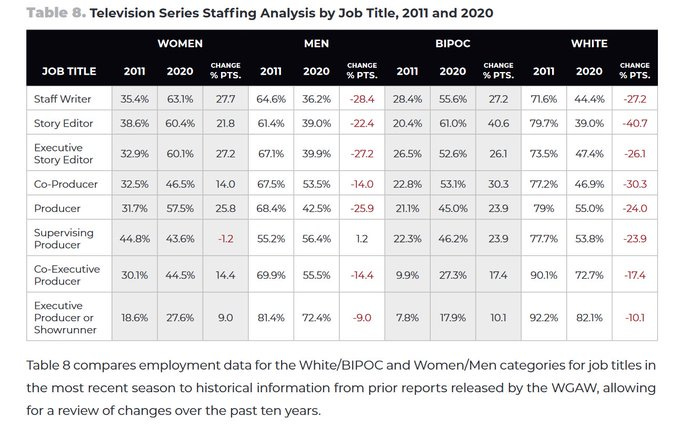
This is also true for writing in American television:
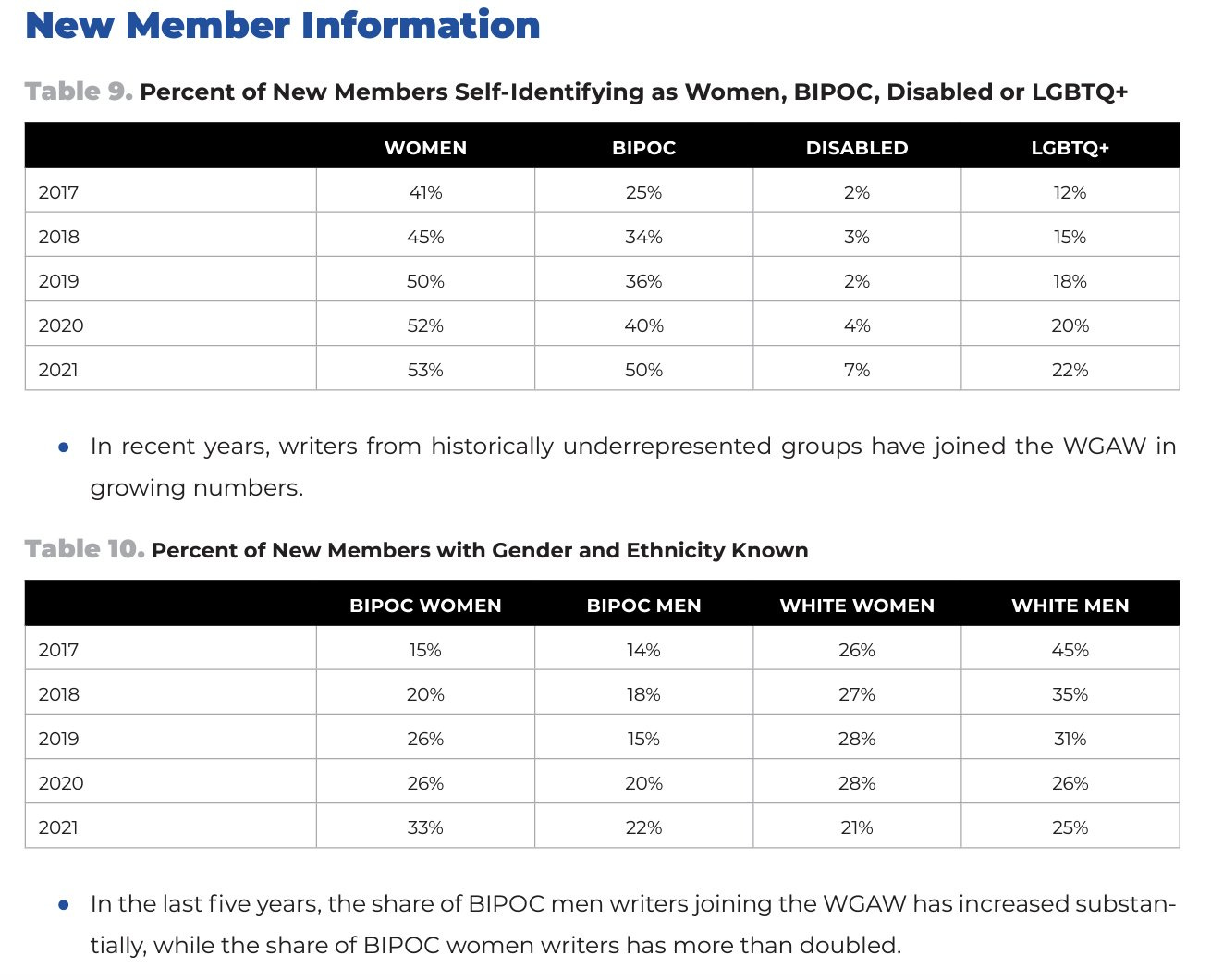
…And the film industry:
Some of this is just politics, but I think a lot of it is changes in incentives. The kind of introverted, smart, artistic people (regardless of gender or race) who would have written stuff like A Song of Ice and Fire are not writing anymore. I think most of them went into tech (particularly AI, software, or game development), finance, influencing, or ghostwriting — fields that offer more lucrative opportunities, regardless of how glamorous they are. This talent reallocation has been going on for a long time, maybe as early as the late 18th Century, but it’s intensified with the development of television and the internet.
The kind of talent that makes somebody a good writer does overlap with the talent that makes them a good stock trader or coder. Far from perfectly, but well enough to the point that most people who could write a good novel would also likely be a passable white collar employee. I think that Tolkien-tier talents probably would be doing something creative regardless of their situation, but the same is not true for people who are a tier below him.
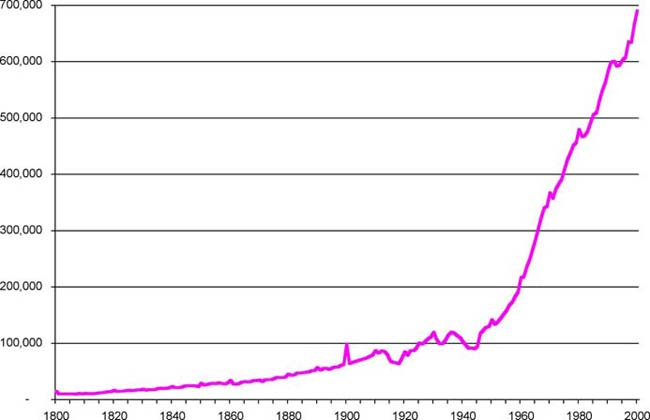
It’s also far more difficult to get discovered as a new writer now: people are writing more books, people are reading them less, and the low hanging fruits have been picked. There has been an (at least) 23x increase in books published from 1940 to 2025:
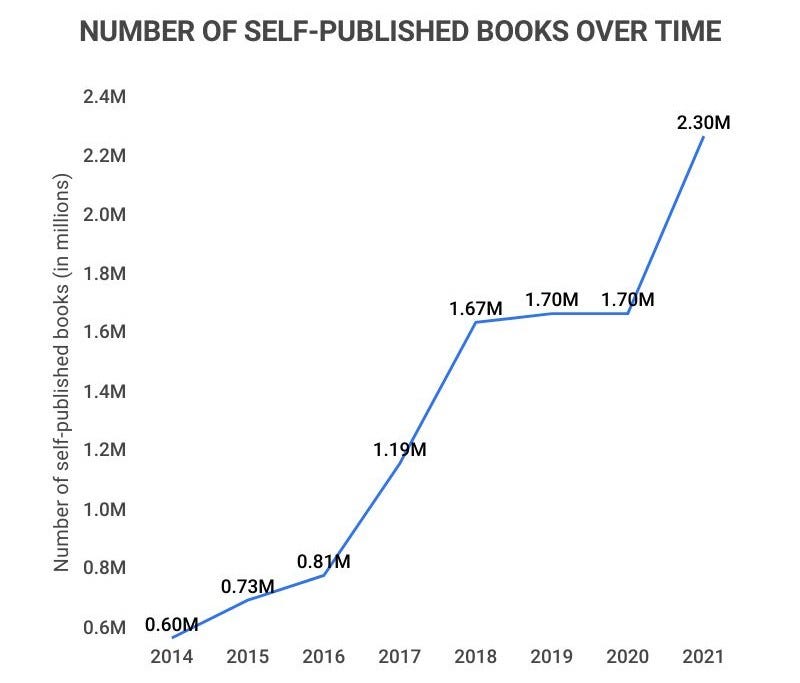
Essentially, even if the talent that makes great fiction was actually writing novels, we can’t discover which ones they are if nobody reads them, and espeically when there are so many of them. Novels also allow for more thematically complex, coherent, and long stories that are more able to exemplify what good narrative is.
I personally might not like the novel as a form of art, but it allows a single artistic mind to enforce their will onto the world. All great vision, all great stories — come from great and industrious geniuses, not institutions or groups. I suspect that part of it is due to the fact creative talent has a right tailed distribution: someone like Aldous Huxley is 10x more generative than the typical 99th percentile creative talent, but also because of the nature of thinking — it comes from one mind.
Because of the monocausal nature of creativity, top creative talent is less likely to find working at an institution attractive. It’s also true that, regardless of field, the best tend to go do their own thing anyway; there is nobody to slow them down or take the surplus of their labour. As such, the top creative talent that was previously writing novels or short stories is unlikely to have gone into the film industry. Can you imagine Franz Kafka working in Hollywood?
You do see good directing talent come out of the film industry — Lynch, Polanski, and Nolan for example. Regardless of their talents and responsibilities, they are unable to generate the same kind of lasting and unique stories that novelists like Tolkien write. They are subservient to their sources of capital, and contrained by their writers, special effects teams, and actors.
If there is less good literature, then that decline inevitably flows from books to film and television, because films and television rely on it for inspiration. A bunch of B tier talent with no drive and overarching vision are not going to make anything interesting. There are a few exceptions of high quality original television, like Breaking Bad1, but the rule remains. Literature also influences film and television beyond mere adaptation.
Culture didn’t tank as soon as people started reading less — the effect is lagged. Technology first made culture better by giving us superior methods of distributing narratives (films and television, based on people’s revealed preferences). As they improved they incentivised the creation of newer, bolder, and better content — CGI gave us Pirates of the Caribbean, technicolour gave us Robin Hood, and multi-camera setups gave us I Love Lucy.
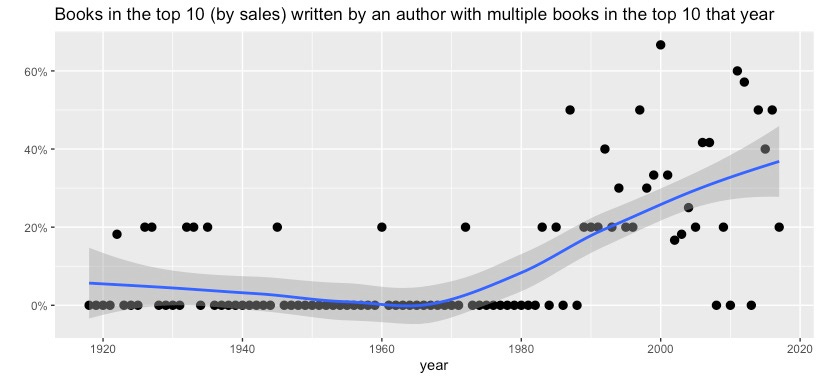
Now that technological innovation is slowing down, there are less incentives to create new and impressive things in film. There is also less great literature to adapt into film, as the classics have gotten adapted already and nobody is writing anything to match them. Eventually, businesses start opting for safer ventures like sequels or remakes due to financial incentives and a lack of good content to test for adaptation. Graphically speaking:
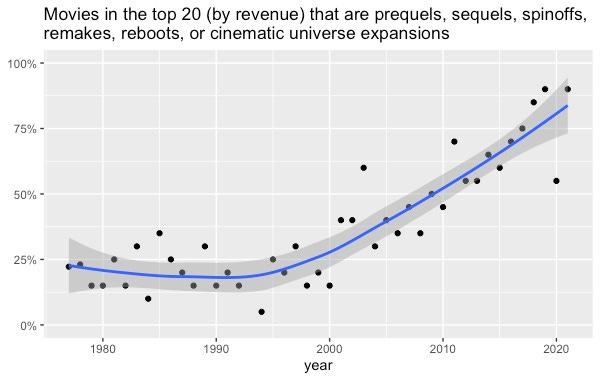
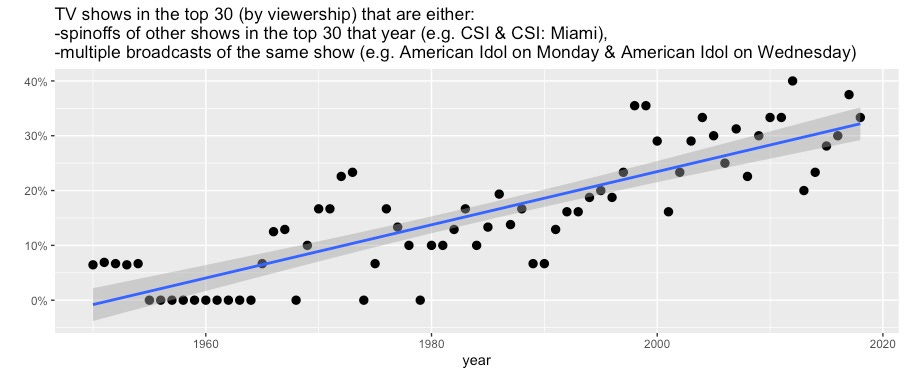
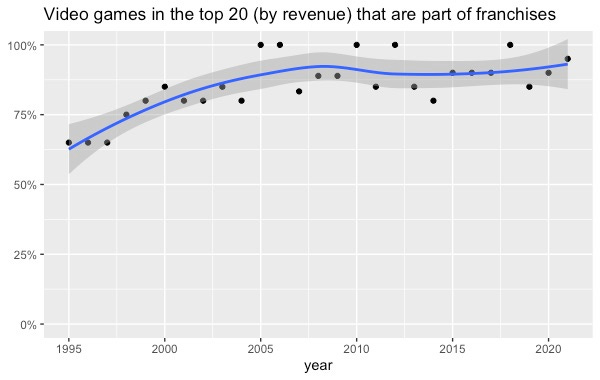
Sequelitis is also massively overstated as a problem, and is better understood as a symptom instead of a cause of decline. Many game sequels, like Half Life 2, Skyrim, Devil May Cry 3, and Vampire the Masquerade were more popular and higher quality than their predecessors. I think that people like to latch on to the sequel problem because it is a legible proxy for cultural decline, which is something that people feel deep in their bones, but find difficult to justify with words or numbers.
If we are talking about television in particular, I think that streaming also contributed to the decline. Platforms like Netflix give people the opportunity to watch anything whenever they want, so television series have to try harder to catch people’s attention. Anecdotally, I’ve noticed that the pace of TV, both Japanese and Western, seems to have drastically increased after 2012, which removes all emotional impact.
Streaming also gutted mid budget films, because the industry could still expect to make some money off of DVD sales if things didn’t go well in theatres. This leaves only indie low budget films or Hollywood blockbusters; very little of the former is any good, and the latter must devalue themselves and appeal to the lowest common denominator to get any profit.
So, that’s it. Those are the causes of cultural decline in narrative-based art forms.
I have conflicting thoughts on the direction of other art. Fashion has gotten worse, mostly because people are too lazy to put any effort into their clothing. I think music has gotten better, if you ignore what rises to the top — electronic music is a richer form of expression than anything that came before it. Multiplayer games have gotten more balanced over time, but most of them are awful anyway. Drawing has improved over time due to algorithmic feeds and software.
Narrative-based art clearly stands out as getting far worse than other forms of art, which are either getting better or worse for their own idiosyncratic reasons. This, in my opinion, shows that narrative-based art must be declining for reasons beyond mere cultural changes, which should theoretially have a global infuence on all art.
Regarding the algorithms: around the 2000s, new data analytic software and compute made it easy for corporations to statistically analyse the predictors of best-selling media, and then try to fit new content to the data. Because algorithms can only adjust to existing preferences, some argue that they promote cultural stagnation.
I find this narrative unconvincing. Algorithmic recommendations could result in people watching more of what they already like and alter the natural ‘rise to the top’ that occurs with good new content, but this would only decrease the correlation between what is popular and what is good. The problem I see is not so much that good content isn’t rising to the top of the popularity hierarchy, it is just straight up not being made.
If I look at the medium I know best, anime, there is not much algorithmic curation because of widespread piracy and there being (relatively) little new content. Most anime are derived from light novels and manga, which are also not subject to artificial curation.
Anime, like other forms of narrative, started to fall off somewhere between the late 00s and early 10s. If you tally down all of the good anime from each period, the decline seems pretty clear:
1988-1999: Evangelion, Ghost in the Shell, Princess Mononoke, Perfect Blue, Cowboy Bebop, Serial Experiments Lain, Berserk, Great Teacher Onizuka, One Piece, Akira, Hunter x Hunter, Vampire Hunter D, Legend of the Galactic Heroes, Blue Gender
2000-2012: Death Note, Fullmetal Alchemist, Steins;Gate, Spirited Away, Satoshi Kon’s films, Shinsekai Yori, Code Geass, Welcome to the NHK!, Tatami Galaxy, Psycho Pass Fate/Zero, Texhnolyze Bakemonogatari, Kaiba, Nana, Attack on Titan, Ergo Proxy, Samurai Champloo, Howl’s Moving Castle, Ouran High School Host Club, Haruhi Suzumiya, Darker than Black, FLCL, Baccano!, Penguindrum, Monster, Ghost in the Shell: Stand Alone Complex, Gurren Lagann, Soul Eater, Fate/Stay Night, GITS Innocence, Avatar the Last Airbender
2013-2025: Mushoku Tensei, Made in Abyss, A Silent Voice, Re:Zero, Your Name, Aggretsuko, My Dress up Darling, Spy X Family, RWBY….
And that’s basically it. I’ve heard Frieren is good but I haven’t gotten into it yet.
I also play a lot of narrative-based games, and I think the decline has started to set in for games too, despite sales largely being a function of word of mouth. The decline is not as stark as it is for other mediums of storytelling, there are definitely some good post-2013 releases like Undertale, Disco Elysium, TCOAAL, and Nier.
Some argue that this decline is due to cultural forces, usually postmodernism or wokeism, constraining the development of art. I couldn’t disagree more, the most popular and impressive artists find ways to dance around social conventions regardless of time. In fact, I think that artists get punished more for being too acquiescent to politics — I count many more instances of studios getting rejected by audiences for being too woke than not being woke enough. Political and religious constraints on art are nothing new.
The timing of this decline in narrative also concords with the advent of the mass internet and smartphones. I, however, think it’s unlikely phones actually caused this. Within the West, games/film/TV have always been the entertainment of the lower classes. The mass internet and piracy expanded this audience internationally, but I doubt that writers and producers are interested in appealing to 14 year old Indonesians who pirate films on their $100 android phones.
I should also restate my view that shifts in average IQ in the last century do not explain… Anything at all. Evidence of people getting dumber or smarter in our times is generally not that good, and it doesn’t survive sophisticated corrections for measurement invariance. Uncorrelated has a nice projection of the world IQ over time:

Cultural progress is not an intrinsic fact of the world. For about 1,500 years, Europe has been telling itself the same stories, worshipping the same religions, and making the same art. Then everything changed when the printing press, camera, and computer attacked. I’d also venture that increases in global intelligence and population enabled the creation of surplus and novel culture. In that respect, it would be better to see cultural decline as a regression to the mean and not a historical contingency.
I personally don’t like most original American live-action television because it’s not that ambitious in terms of storytelling or concept, but it’s clear that’s not a majority opinion, and there are some normal television series I like, such as Black Mirror or House MD.
"People also rarely finish the books they read, which can be inferred from the fact people tend to be much more likely to quote passages from the beginning of a book."
Authors are often told to put the most important things they have to say at the beginning! So the beginning might end up being much more quotable.
The Wire sucks