

Edit: I forgot to multiply the number of male 18 year olds by 2, so it’s actually 7-10%, not 15-20%.
Inspired by Marc Andreessen speaking about how DEI and immigration are leading to large amounts of talent getting left out of elite universities, I tried to estimate the percentage of >125 IQ individuals who did not go to an elite university.
To do this, I leveraged a dataset of 1534 American universities (from around 2017) that had data on the ACT percentiles of the students, the number of freshmen at the university, and such. I ranked each university1 based on the test scores of their students, their acceptance rate, and graduation rate at 4 years; labelling the top 25 all elite universities. If the university did not state how many of their freshmen were of foreign origin, I assumed that 11% of the freshmen were (the mean at top 25 universities). Non-american students and individuals who did not graduate in six years were removed from the analysis.
The bell curve of ACT2 scores of these elite students was inferred from the 25th and 75th percentiles:

The simulation estimates there are 3,000 students with perfect ACT scores at these universities, which might be more than the number who get them in an entire year. When one takes into account that only 40% of students at these universities submit ACT scores, there should only be 1,255 perfect scorers in total, which seems reasonable.
Then, I simulated the average IQs of all 18 year olds in the USA at that time (~2,231,100 (edit — corrected to 4.300.0003, which is the value the UN gives) and the ones who were accepted into the elite universities by assuming that the freshmen were selected based on their test scores (correlating at .84 with IQ) and other factors that weren’t correlated with IQ. This is a false assumption, but it’s tenable given that the average IQ of Harvard students (125-129, depending on how the Flynn Effect is corrected for) is more or less what would be expected from their average SAT score + regression to the mean.
These were the results of the simulation, zoomed in on the bottom right:
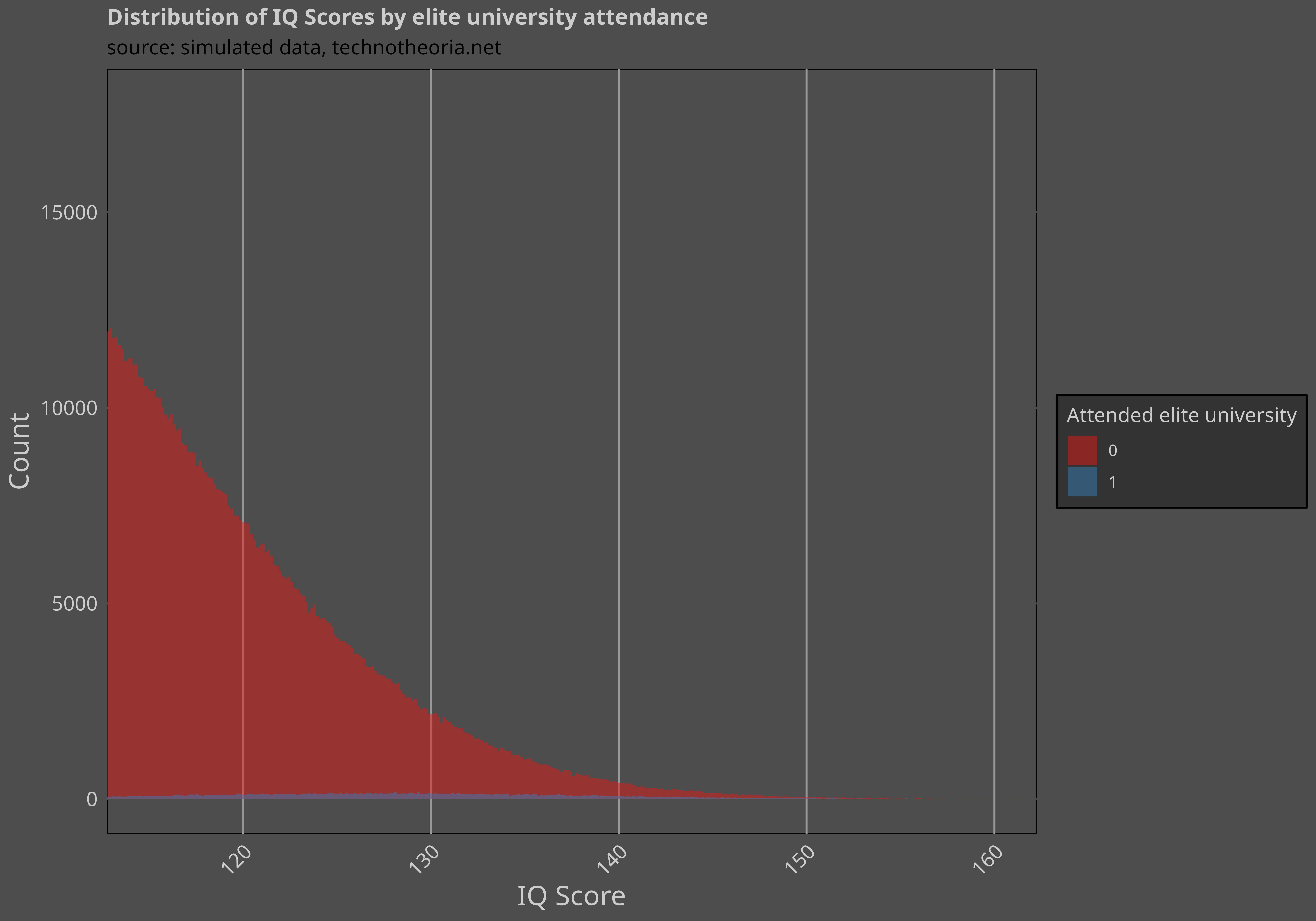
American graduates of undergraduate programs at elite universities had an average IQ of 127, while those who attended other universities (or none at all) had an average of 99.54. Students from elite universities are much better on average, but because there are 100x more normal people, they outnumber elite university graduates at the far tails of ability. People with an IQ of 170 or above were predicted to have 50/50 odds of graduating from an elite university, though I am not sure whether the model works for people at the far tails of ability.
In total, 8.15% of the simulated >125 IQ individuals attended an elite university for undergrad. Given that only about half of people pursue education beyond a bachelor’s, many graduate students at elite universities attended an elite undergraduate university, and that foreign students are common in elite grad programs, I would not expect the percentage of Americal adults who attended an elite university altogether to be very different.
This may seem intuitively low, but the napkin math agrees: if 5% of people have IQs above 125, 50% of elite university students have IQs above 125, and ~.7% (27,000/4,000,000) of 18 year olds are freshmen at elite universities, then 7% of people with IQs above 125 will have attended an elite undergrad.
Talent and IQ do not correlate perfectly, maybe not even strongly, but the noncognitive aspects of talent are too hard to measure; nonacademic ratings based on interviews, recommendations, essays, and such predict absolutely nothing. Any selection beyond this is self-selection.
Cause of the problem
DEI is a scapegoat. There are race preferences at universtities, but they aren’t that strong: most black/hispanic students who get into elite universities have SAT/ACT scores comparable to white/asian students. Foreign students crowding out natives without proportional increases in enrollment is bad, but the problem of excluded talent was large even back in 2017, when only 11% of students at top universities were foreigners.
People have highlighted the problem of elite universities not accepting enough students — which is complicated. If they accept more students with their current admissions system, then they will only have a larger but more diluted pool of students. If they accept more students and alter their admissions system to make it so the academic quality of the students doesn’t drop, then they will have to deal with various interest groups (e.g. minorities, athletes, legacies, people with wrong ideas about college admissions — mostly the latter) who do not want the admissions system to change. Building new facilities and housing is also challenging.
If markets were perfectly efficient5, then Harvard not accepting enough qualified students would result in other universities accepting them and reaping the rewards of their success. Which doesn’t happen in real life because of three realities: all elite universities are subject to the same incentives, prestige changes slowly, and there are too many universities with high quality students to keep track of. I count a total of 51 universities where 75% of students scored a 29 or above on the ACT.
I would write about this at more length and rigor, but talking about issues is useless.
Code, since I had made an error previously:
set.seed(1)
getwd()
setwd(’~’)
setwd(’/home/ouroborus/Documents/rfolder/trash’)

IPEDS_data$ACT25 <- IPEDS_data$`ACT Composite 25th percentile score`
IPEDS_data$ACT75 <- IPEDS_data$`ACT Composite 75th percentile score`
IPEDS_data$SATR25 <- IPEDS_data$`SAT Critical Reading 25th percentile score`
IPEDS_data$SATR75 <- IPEDS_data$`SAT Critical Reading 75th percentile score`
IPEDS_data$SATM25 <- IPEDS_data$`SAT Math 25th percentile score`
IPEDS_data$SATM75 <- IPEDS_data$`SAT Math 75th percentile score`
IPEDS_data$SATW25 <- IPEDS_data$`SAT Writing 25th percentile score`
IPEDS_data$SATW75 <- IPEDS_data$`SAT Writing 75th percentile score`
IPEDS_data$Graduation_Rate_4 <- IPEDS_data$`Graduation rate - Bachelor degree within 4 years, total`
IPEDS_data$Religious_affiliation <- IPEDS_data$`Religious affiliation`
IPEDS_data$Women <- IPEDS_data$`Percent of undergraduate enrollment that are women`

IPEDS_data$ACTscore <- getpc(IPEDS_data %>% select(ACT25, ACT75), dofa=F, fillmissing=F, normalizeit=T)
IPEDS_data$SATscore <- getpc(IPEDS_data %>% select(SATR25, SATR75, SATM25, SATM75, SATW25, SATW75), dofa=F, fillmissing=F, normalizeit=T)
IPEDS_data$Academic_Score <- getpc(IPEDS_data %>% select(ACTscore, SATscore), dofa=F, fillmissing=F, normalizeit=T)
IPEDS_data$app_rate <- IPEDS_data$`Admissions total`/IPEDS_data$`Applicants total`


IPEDS_data$score <- getpc(IPEDS_data %>% select(Academic_Score, Graduation_Rate_4, app_rate))
IPEDS_data$rank <- ranker(IPEDS_data$score)
unis <- IPEDS_data %>% select(rank, Name, score)

GG_scatter(IPEDS_data, ‘Academic_Score’, ‘app_rate’, case_names=’Name’)


eliteunis <- IPEDS_data %>% filter(rank < 26)

eliteunis$actmean <- (eliteunis$ACT25 + eliteunis$ACT75)/2
eliteunis$actsd <- ((-eliteunis$ACT25 + eliteunis$actmean)/qnorm(.75) + (eliteunis$ACT75 - eliteunis$actmean)/qnorm(.75))/2
eliteunis$submitted_act <- eliteunis$`Percent of freshmen submitting ACT scores`
eliteunis$submitted_sat <- eliteunis$`Percent of freshmen submitting SAT scores`
eliteunis$freshmen <- eliteunis$`Estimated freshman enrollment, full time`
eliteunis$undergrad <- eliteunis$`Undergraduate enrollment`
eliteunis$gradplus <- eliteunis$`Graduate enrollment`
eliteunis$foreign_freshmen <- eliteunis$`Number of first-time undergraduates - foreign countries`
eliteunis$american_freshmen <- eliteunis$freshmen - eliteunis$foreign_freshmen

eliteunis$foreign_ratio <- eliteunis$foreign_freshmen/eliteunis$freshmen
eliteunis$american_freshmen[is.na(eliteunis$american_freshmen)] <- eliteunis$freshmen[is.na(eliteunis$american_freshmen)]*(1-mean(eliteunis$foreign_ratio, na.rm=T))

qnorm(.25)


all_elites <- c()

for(i in 1:nrow(eliteunis)) {
  numofgrads <- eliteunis$american_freshmen[i]*eliteunis$`Graduation rate - Bachelor degree within 6 years, total`[i]/100


  innervec <- rnorm(n=numofgrads, mean=eliteunis$actmean[i], sd=eliteunis$actsd[i])

  all_elites <- append(all_elites, innervec)
}

GG_denhist(all_elites)
describe2(all_elites)
elite_students <- data.frame(ACT = all_elites)

elite_students$ACT[elite_students$ACT>35.4999] <- 36

perfect <- elite_students %>% filter(ACT==36)

GG_denhist(elite_students$ACT)
###########################
all_americans <- rnorm(4300000, mean=19.8, sd=5.7)


american_students <- data.frame(ACT = all_americans)
american_students$IQ <- normalise(american_students$ACT*0.84 + rnorm(4300000, mean=19.8, sd=5.7)*sqrt(1-0.84^2))*15+100

GG_scatter(american_students[1:10000,], ‘ACT’,’IQ’)

american_students$ACT[american_students$ACT>35.4999] <- 36


american_students$selection_factor <- american_students$ACT + rnorm(4300000, mean=19.8, sd=5.7)*0.665
describe2(american_students$selection_factor)

simulated_elites <- american_students %>% filter(selection_factor > 50)
simulated_proles <- american_students %>% filter(selection_factor < 50)

american_students$elite <- 0
american_students$elite[american_students$selection_factor>50] <- 1

describe2(simulated_elites$ACT)
describe2(elite_students$ACT)

describe2(simulated_elites$IQ)
describe2(simulated_proles$IQ)

GG_denhist(simulated_elites$IQ)
GG_denhist(simulated_proles$IQ)

GG_denhist(american_students, var=’IQ’, group=’elite’)

###############
plus125_elites <- simulated_elites %>% filter(IQ > 125)
plus125_proles <- simulated_proles %>% filter(IQ > 125)


aaaa <- simulated_elites %>% filter(IQ > 170)
aaaa2 <- simulated_proles %>% filter(IQ > 170)

nrow(plus125_elites)/(nrow(plus125_elites)+nrow(plus125_proles))

26000/4300000
##################
american_students$elite <- as.factor(american_students$elite)

p <- ggplot(american_students, aes(x = IQ, fill = elite)) +
  geom_histogram(
    position = “identity”,   # Overlays the groups
    alpha    = 0.5,          # Semi-transparent for overlap visibility
    bins     = 1000            # Adjust bins as needed
  ) +
  scale_fill_brewer(palette = “Set1”, name = “Attended elite university”) +
  labs(
    title = “Distribution of IQ Scores by elite university attendance”,
    subtitle = “source: simulated data, technotheoria.net”,
    x = “IQ Score”,
    y = “Count”
  ) +
  coord_cartesian(xlim = c(115, 160)) +  # Zoom in on x-axis from 115 to 160
  theme_minimal() +
  theme(
    axis.text.x = element_text(angle = 45, hjust = 1, size = 11),
    axis.text.y = element_text(size = 11),
    axis.title.x = element_text(size = 15),
    axis.title.y = element_text(size = 15),
    plot.background = element_rect(fill = “gray30”),
    panel.background = element_rect(fill = “gray30”),
    panel.grid.major = element_line(color = “gray30”),
    panel.grid.minor = element_blank(),
    panel.grid.major.x = element_line(color = “gray60”),
    plot.title = element_text(size = 12, face = “bold”, color = “gray80”),
    strip.text = element_text(size = 12, face = “bold”, color = “gray80”),
    axis.text = element_text(color = “gray80”),
    axis.title = element_text(color = “gray80”),
    legend.background = element_rect(fill = “gray20”),
    legend.text = element_text(color = “gray80”),
    legend.title = element_text(color = “gray80”),
    plot.margin = margin(t = 5, r = 5, b = 5, l = 5, “pt”)
  )
p
ggsave(plot=p, filename=’plots/exampleplot.jpg’, width=10, height=7, dpi=888)

unis <- eliteunis %>% select(rank, Name,actmean,actsd, undergrad, gradplus, freshmen, american_freshmen, foreign_freshmen)
mean(eliteunis$submitted_act)/100*nrow(perfect)

top75 <- IPEDS_data %>% select(rank, Name,ACT25, ACT75, score) %>% filter(rank<76)

lower <-  IPEDS_data %>% select(rank, Name,ACT25, ACT75, score, Graduation_Rate_4, app_rate, Academic_Score) %>% filter(ACT25 > 28)

sum(eliteunis$american_freshmen)
The list. Georgetown and Notre Dame got left out because of missing values. You could argue that more universities deserve to be at the top, but I think that dilutes the meaning of “elite”. 25 is generous enough as is.

Chosen because the SAT percentiles came in reading/writing/maths. Doing so should slightly inflate the competence of the students, as most do not submit ACT scores.
Proofs:

Variable descriptions:

Markets are never perfectly efficient. Which everybody knows; the real question is whether markets are efficient enough to the point that we can assume they are perfectly efficient even if they are not. And we can’t do that either.
Elite university sucks. It destroys your soul, ruins your health, messes up your internal reward systems.
The only redeeming feature is being able to meet other cool, interesting, weird (but often broken) people.
But that gets old quickly and doesn't lead to a great life on its own.
You're correct, DEI is a scapegoat. I think the real answer is that it's just a bad value proposition at this point in time and those with high IQ's recognize this. The cost of attending vs. what the degree guarantees have never had a less favorable relationship in history. It just isn't worth it anymore.