

Three years ago, I wrote a deep dive into body count. To summarise:
It is linked to divorce + marital dissatisfaction. Likely for both sexes, though it’s less clear for men because a lot of analysis is female-specific. The link is not particularly strong, especially after 0-1 bodies.
Confounding — people with high body counts tend to have traits less suited to long-term relationships — is a reason why.
Causality — body count causing people to be that way — is unlikely.

All still true.
Now here’s the problem. My take at the time was that it would be more effective to analyse people’s romantic histories on a case-by-case basis instead of the number. That was wrong.
Beyond the question of body count vs case-by-case analysis, I think a better dichotomy is the mechanics of a person’s romantic history vs the interpetation of it. The mechanics describe how many people somebody has been with, how long their relationships lasted, and how they met them. The interpretation is why those things happened.
My argument, broadly speaking, is that mechanics beat interpretations. The mechanics are harder to fake, and the whys are often too overdetermined to be of any use, even when they are genuine.
Narratives
People have a tendency to renarrate their personal histories. They will try to divert blame from themselves towards circumstances, other people, or facets of themselves that they don’t feel identified with. As such, you should expect that when somebody tells you their romantic history, it will be retold in a fashion that is favourable to them (often other people too, so they don’t look mean or gauche).
Numbers can’t be retold. As much as people meme about women lying about body count, I don’t think it’s common. That famous polygraph study people like to cite is garbage1. Women/men both report roughly the same number of sexual partners when attached to a (fake?) polygraph in comparison to when they are not.
Putting the stats aside, I think that people are simply less likely to lie about raw numbers because it’s easier to get caught doing so. Things like romantic history, which are overdetermined2, are much more easy to “lie” about because there sometimes isn’t even a right answer to what caused a breakup.
Given that, body count gives you a mediocrely reliable indicator of how likely a person is able to maintain a positive relationship; romantic history is important but its interpretation can be easily spun. Both are useful, but should be doubted.
There are situations where the narrative is useful. Like “my boyfriend died” is a pretty good excuse for breaking up. “We grew apart” could mean 99 different things.
Psychological stickiness and stereotypes about body count
The barebones model of romantic relationships is that you meet people, and if you like them, you get into a romantic relationship. Then, if you really like them, you get married.
A few nuances: sometimes people change. Never at a deep level, but on an emergent one they definitely do. Jobs, incomes, bodies, ages, beliefs, interests, attitudes, and whatnot can vary across time. So, sometimes, people go from liking somebody to not liking them. This can also manifest in terms of subverted expectations: you expect somebody to become a higher earner or more mature as they age, but they do not. Other times, you like the person you are with, but somebody else appears who looks more appealing.
Sometimes, when these things happen, people break up and try to find somebody else. Other people are more “psychologically sticky”. They are more willing to stay with their current partners, even when it appears they are starting to falter or change in ways they don’t like.
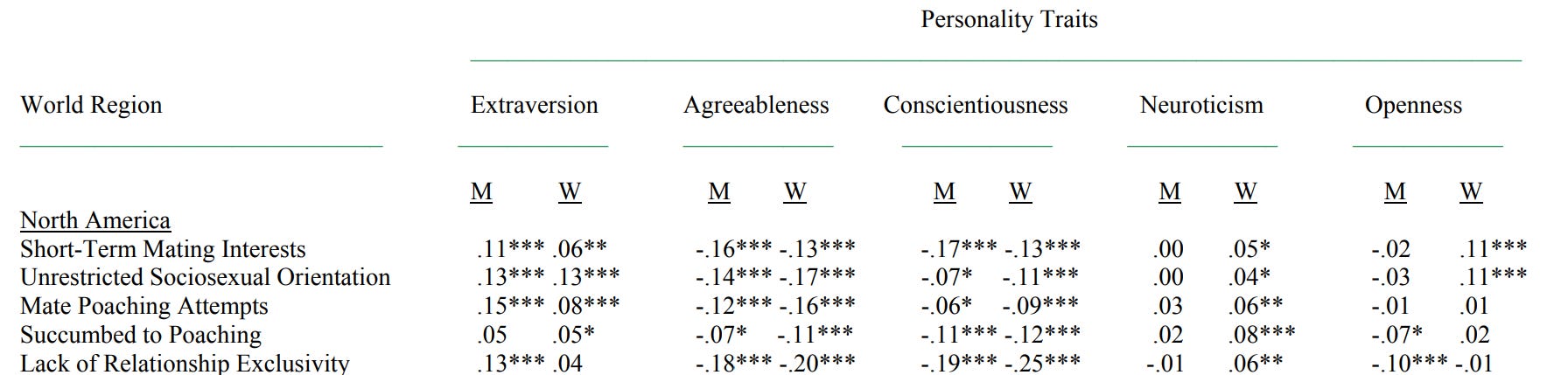
What psychological stickiness looks like in the real world is probably some combination of higher conscientiousness, close-mindedness, introversion, agreeableness, and conflict tolerance (though the last two things anticorrelate)3. It’s an emergent trait, not a latent one.
There’s two catches.
One of them is that psychological stickiness works. It might be inherently desirable or undesirable for reasons beyond making relationships last longer, but it does the job.
The other is that there is a sex-loading. Men put more weight on appearance; women put more weight on social standing and earnings. Both of these things can change, but social standing and earnings change more unpredictably than appearance does. As such, it follows that there is more to be gained for men to select for psychological stickiness than women.
Beyond that, women care more about social proof than men. If a guy thinks a girl is great and no other guy does, then that’s probably a bonus for him. If a girl thinks a guy is great and no other girl does, she might start to doubt whether that guy is actually as good as she thinks he is. As such, for men, body count as a double edged sword: high n count means social proof + low stickiness, but low n count means no social proof + high stickiness.
Other explanations for the double standard do not make sense. False paternity does happen, but it’s extremely rare in Western countries (like 1-2%). Women are more at risk of STDs than men are. Most of the associations between n-count and personality exist for both men and women. Some of the discourse is poisoned by irrational disgust responses and religiosity, but I find it hard to believe that is all there is too it.
A third catch I forgot to mention: some couples should definitely break up.
Beyond the stickiness component, adults with no romantic history often have traits that are unfavourable as well. From an informal survey on male incels4: about a third have autism, 86% have experienced bullying, and half claim to be extremely lonely.
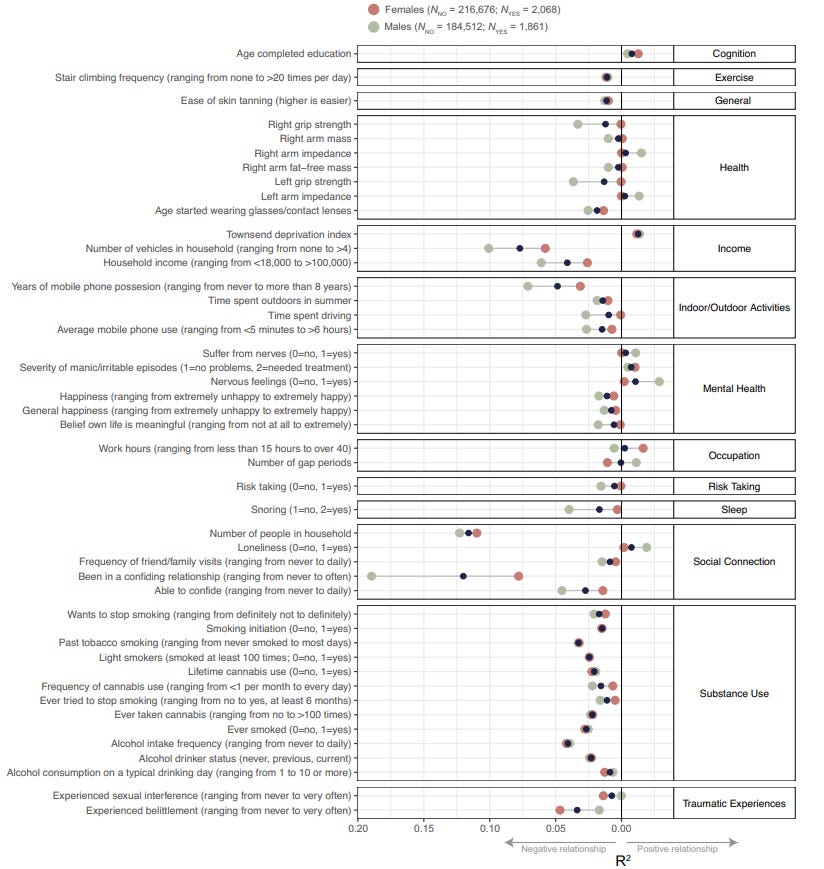
People also checked which people tended to be sexless in the UK Biobank (age range of 40-70) — it correlated the most with not having a car, low income, and not using recreational drugs. Relationships were similar in men and women, but when they differed, they did so in a sex-stereotypic fashion. The effect sizes are typically weak.
Genetically, being an incel correlated with higher IQ5, income, being autistic, lack of PTSD/ADHD, drug abstinence, introversion, and a tendency to not take risks6. The genetic correlations are much stronger than the phenotypic ones.
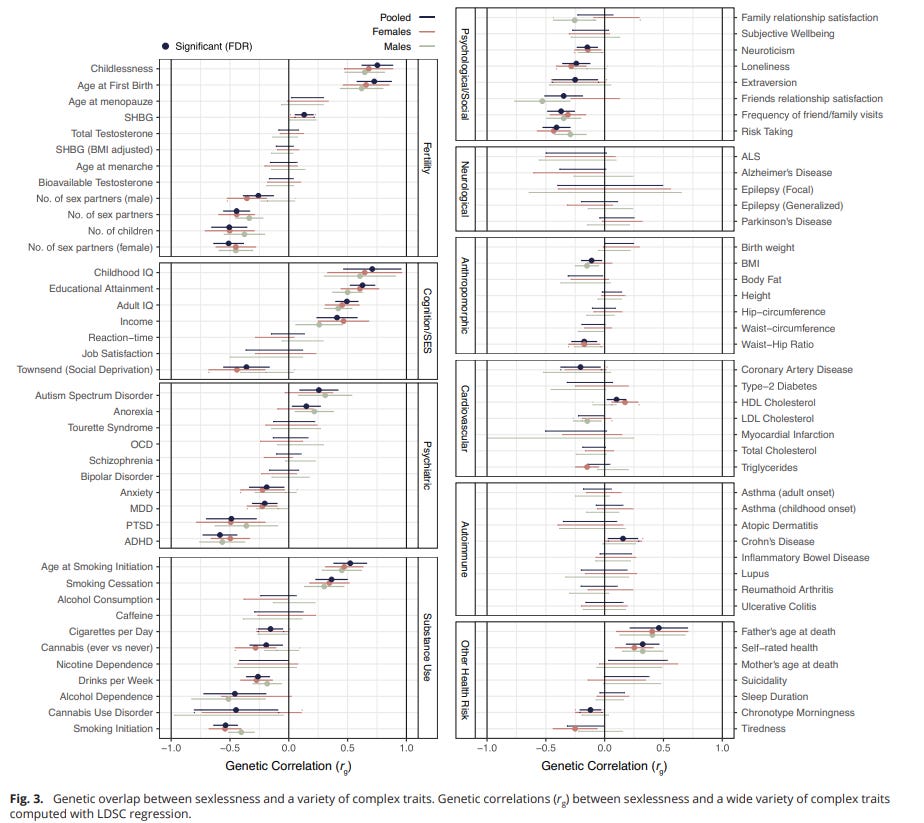
Which is interesting. Phenotypically, not having sex seems to correlate with lower social standing or a lack of social capital; genetically, it seems to be more downstream of neurotype than any actual pathology.
It makes sense intuitively. People are presented with different romantic options as they live — some bad, some good. People who are less likely to engage with them are either refusing to accept the bad options, or just don’t have many to begin with. The lack of options is downstream of both circumstance and genes, the refusal to accept the bad options is more genetic.
On many occassions, when romantic options arise, sometimes there isn’t a right or wrong choice regarding whether to take them. Maybe they look a little iffy, but have upsides, or the relationship could progress to a better point in the future. Some personality types are more likely to default to no than yes.
In summary, stereotypes regarding body counts (0 = introvert, low social capital, autistic; high = psychologically unstable, high novelty seeking) are generally true. There’s a few false ones, like male incels being more right wing; in real data, they have a slight skew to the left.
I will say — I am an incel, and the demographic/genetic/phenotypic profile of what an incel is fits me to a comical degree…
Stickiness and satisfaction
See:
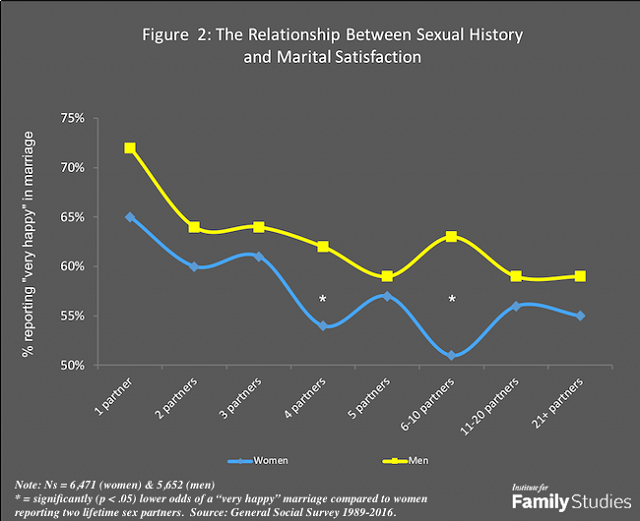
The problem with this chart is that most, if not all, of the effect of body count on marital satisfaction comes from deeper psychological confounding. Not the antisticky strategy or the actual body count itself. The causality itself might also be out of order; a tendency to be dissatisfied itself could be a mechanism by which people become less psychologically sticky.
Actually, why not, let us assume that 100% of the association is due to deep psychological factors. That means that selecting people before getting into relationships or having sex with them does work as well as selecting after… If we trust the stated7 preferences of course.
Allow me to explain. Let us say there is a world where there is tons of massive valuable information to learn about people after you get into a relationship with them. Then, we would expect people who had higher body counts before getting married to have more satisfied and stable relationships. The opposite turns out to be true. It is still possible for people to fake personalities and behaviours in the short term, but it never works in the long term. The drives find a way to manifest.
In the data, you also see that people who get married extremely young or quickly are more likely to get divorced. This statistic is much more complicated than it looks — beyond the surface level confounding issue, there is also the problem that people are just more likely to switch partners when they are younger, and it’s less costly to do so.
I wouldn’t bet gold on this part of the argument, but I would be wary of assuming that there is much to learn about a person beyond the first few months of dating. They might just end up being exactly the person you think they are, and if they do have issues or traits that are harder to see up front, it is safe to assume that applies to other people as well.
Another thing
Regarding girls who go wild and accumulate 10+ bodies over the course of 3 months for some random reason — I actually don’t think this is that big of a deal. Only if they are young though; the younger they were, the less it matters. If those phases speak to anything, they speak to immaturity or just retardation, which are easy to see in people.
I am not arguing people should go ‘be a real muffugin man who wifes up whores’.
I am saying that your autism should not stop you from marrying the love of your life.
Caused by multiple factors, difficult to ascertain.
Free will does not exist, so all celibates are incels by definition.
Jason Malloy did a deep dive on this and came to the conclusion higher IQ people are simply less interested in sex. It tracked to masturbation as well.
Nonsensical variable, people often confuse the tendency to take risks with the tendency to just engage in irrational behaviour.
I wrote revealed here for some reason.
Informative article, I would suggest not deleting it.
Please don’t delete I just posted on upscroll because it is a very informative piece … Hope you get more followers and supporters as a result of sharing 🙏