

There isn’t a settled answer to this question, but my intuition is that its lower than commonly believed.
The convention is for protein doses to be weight normalised, which is fine as a heuristic, I suppose. It falls apart when it comes to individuals. A 6'5’’ 170lb new lifter with a large frame will need a higher dose of protein than a 5’9’’ 170lb man who has been training for 5 years, as the taller man will be gaining more muscle mass.
II.
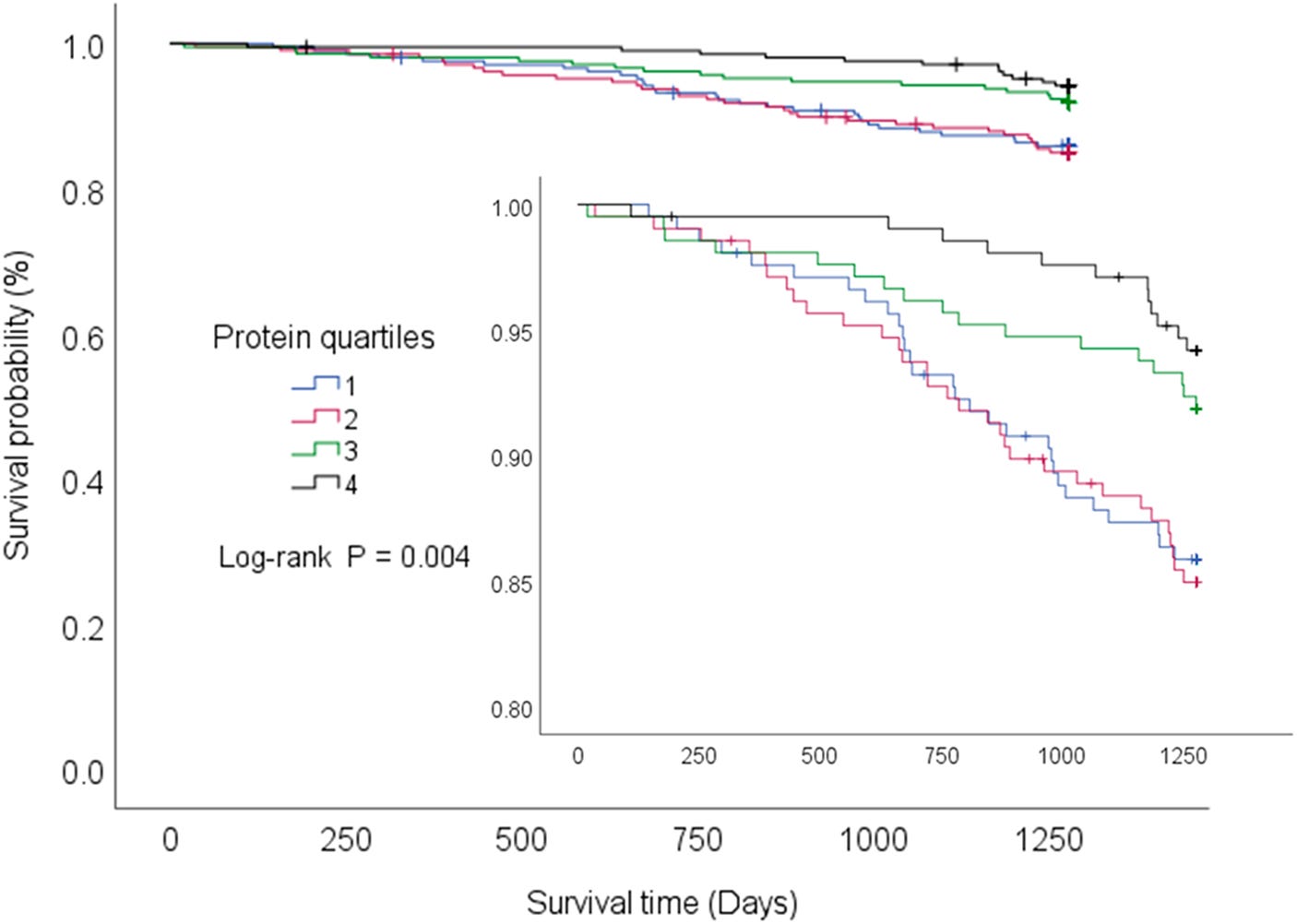
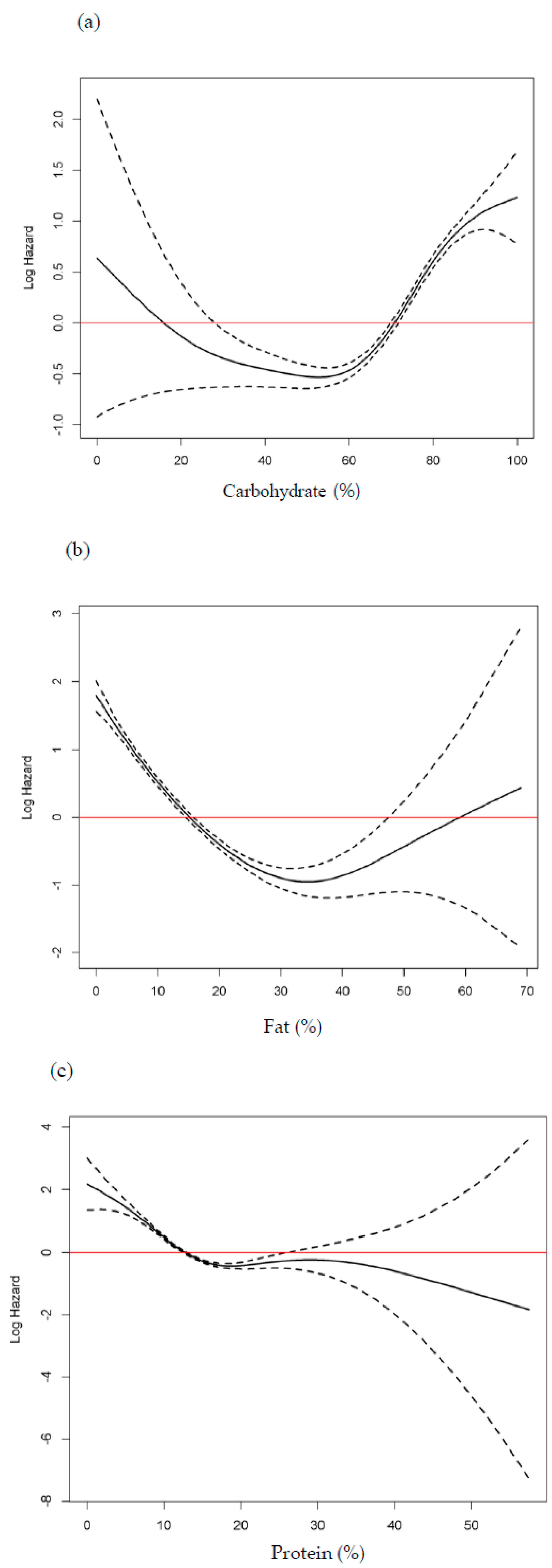
First, there is the question of how much protein our body naturally uses. If we look at mortality curves, protein intake taps out at around 15-18% of the body’s calorie intake1, about 106g per day for the average person:
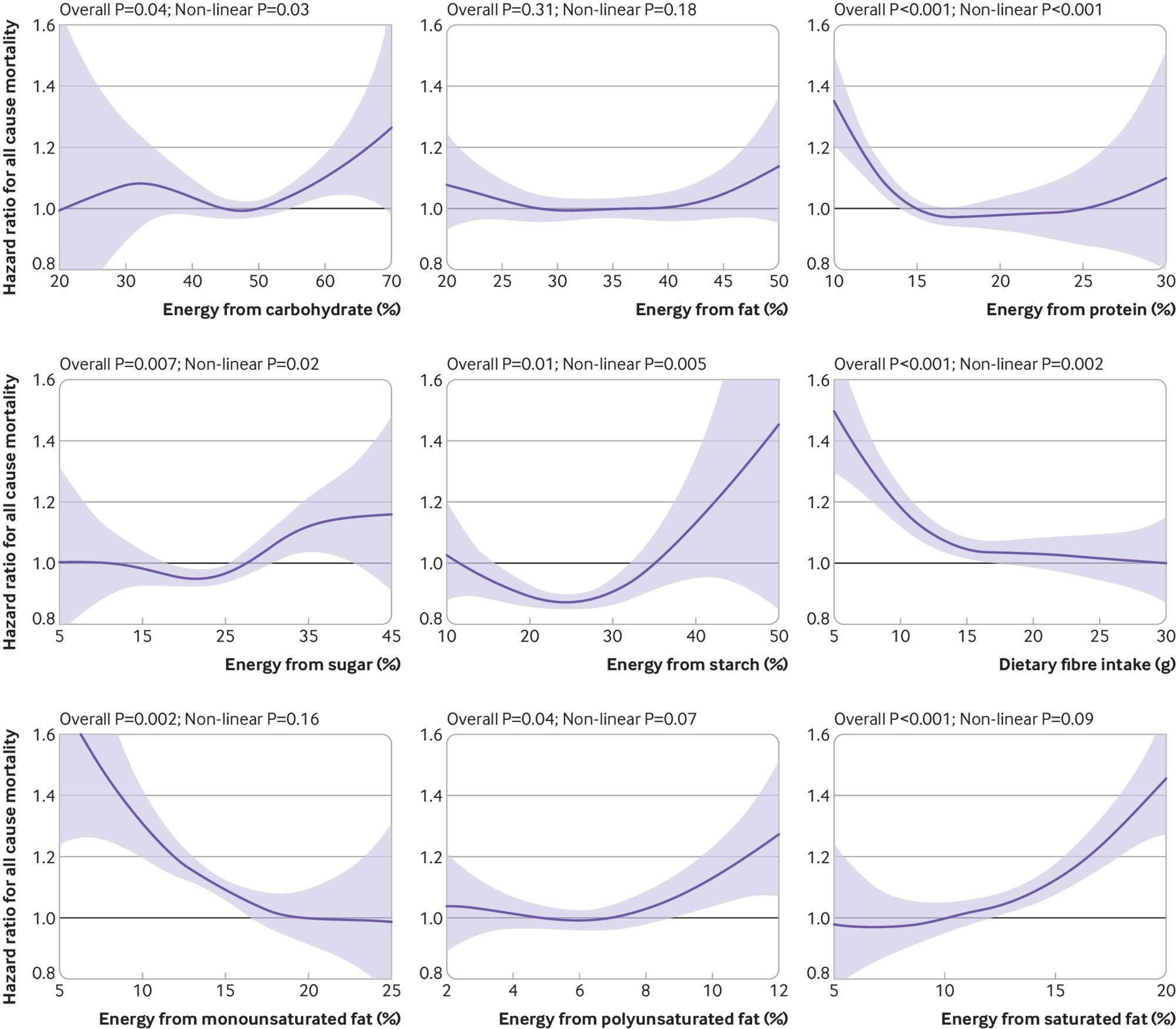
Maintaining muscle mass will be useful for longevity, but less so than repairing the gut or carrying out the body’s instructions. A fraction of that longevity-maintenance dose will go to increasing muscle mass, but I doubt increasing protein intake beyond that does absolutely nothing.
The dosage can also be estimated mechanistically. The maximum possible amount of muscle that can be gained in a year varies by drug use, training level, and genetics; I’d peg it to be about 5kg in people who are not using PEDs; Mentzer says a realistic estimate for most people is 2.5kg per year. I should note that traditional estimates of maximum muscle mass gains are inflated by the usage of noisy body fat measures and using lean mass as a proxy for muscle mass.
Muscle is about 20% protein by mass, so a person who is gaining 5kg of muscle in a year will be gaining 2.7g of muscle protein per day. Based on tracing studies, only about 15% of injested amino acids are deposited in the muscles. Add that 2.7/0.15 to 106, and that gives us an estimate of 124g.
This estimate doesn’t account for the metabolic overhead of amino acids being used for other reasons besides hypertrophy in muscle, the fact that existing muscle fibers need to be repaired, and that some of the protein in the longevity-maintenance dose of 106g does get used in hypertrophy.
II.
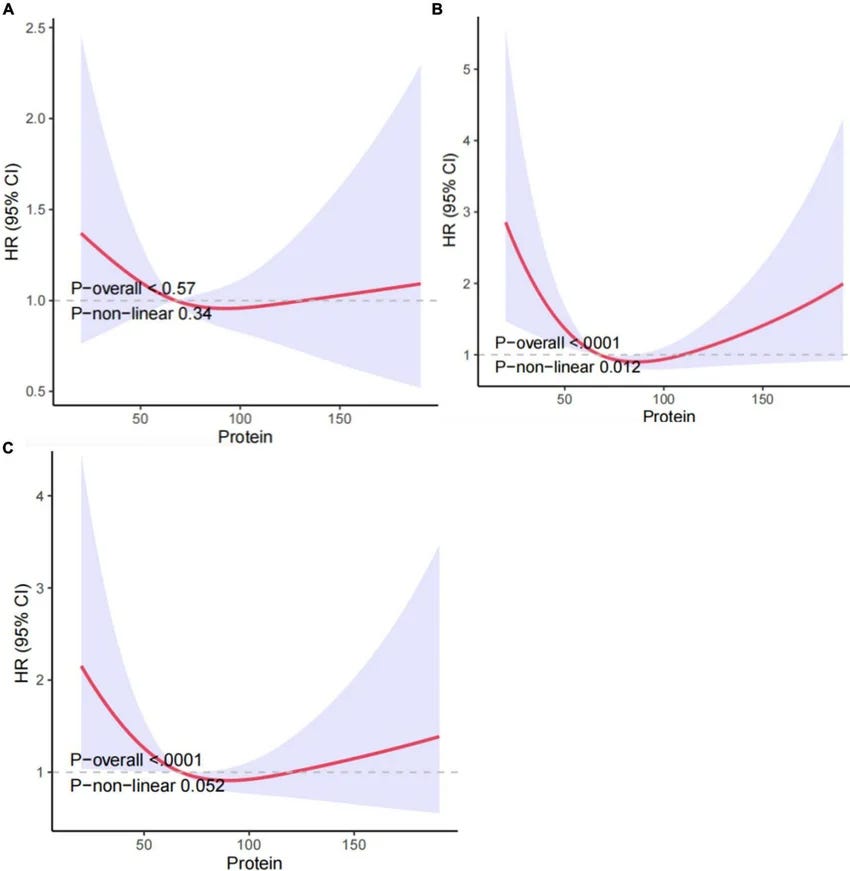
We can also look at this empirically. The largest meta-analysis to date does find a positive effect of high protein diet on gains in lean body mass, and that the effect depends on the dose and the study. The average intervention period in the study was about 4.5 months, and they found an aggregate effect of protein supplementation on lean mass of 0.5kg.
The grouping is a little convoluted. Essentially:
A: all studies, no adjustments
B: resistance training studies only, no adjustments
C: no resistance training studies only, no adjustments
D: all studies, adjustments for age, sex, intervention period, and resistance training (not sure what this means in this context)
E: resistance training studies only, adjustments for age, sex, intervention period, and resistance training
F: no resistance training studies only, adjustments for age, sex, intervention period, and resistance training
G: all studies, adjustments for age, sex, intervention period, and resistance training, weight change
H: resistance training studies only, adjustments for age, sex, intervention period, and resistance training, weight change
I: no resistance training studies only, adjustments for age, sex, intervention period, and resistance training, weight change
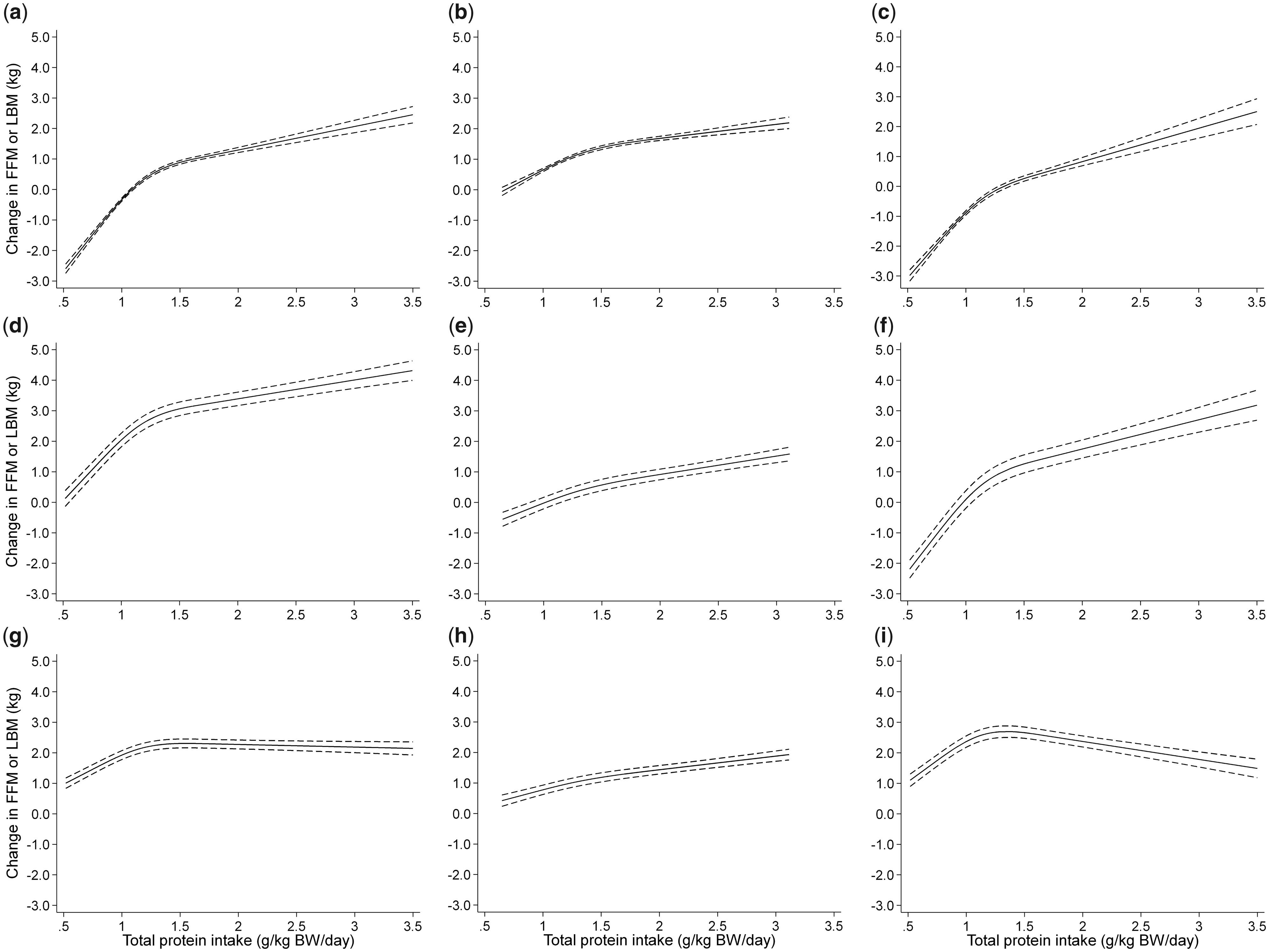
Controlling for weight change here is probably a bad idea here, which is what charts g/h/i do, because its evaluating change in mean fat free mass as an outcome. So it’s answering a different question: how much lean mass is lost relative to how much weight is.
In the studies that involve resistance training, we do not see any tapering off in effects at high doses. It’s possible that this is due to differences in effects between people: that new lifters and people with large frames gain muscle mass faster, so they require relatively more protein. Or, it could be the case that more is better no matter what. It’s hard to tell.
As such, the most informative charts are e and f. It turns out that the effect of protein intake attenuates in people who are weightlifting; it’s probably more valuable in people who are cutting.
VV.
And then we have the biomechanical studies. The one that spawned the ‘muscle saturates at 30g of protein’ meme is… actually, pretty well designed.
They had 48 volunteers assigned to 4 different doses (0, 10, 20, and 40g) of protein after engaging in a leg workout; they had eaten a breakfast with protein in it prior to this. Going from 0→40g of protein intake stimulated muscle synthesis as much as resistance exercise.
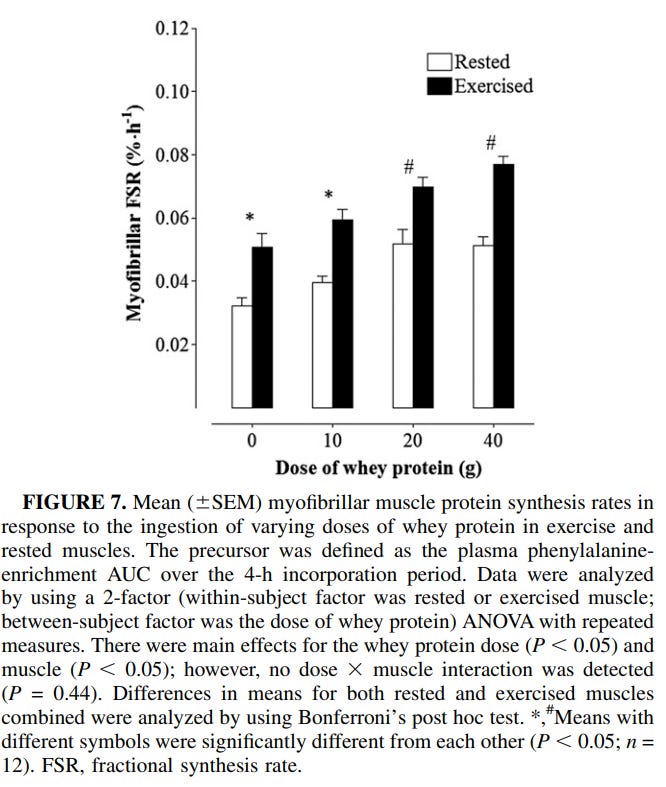
The difference between the 20g and 40g doses wasn’t statistically significant, but I think this is a simple power failure. A similar study which evaluated the difference between 20g and 40g doses of protein did find a small improvement in going from 20 to 40:
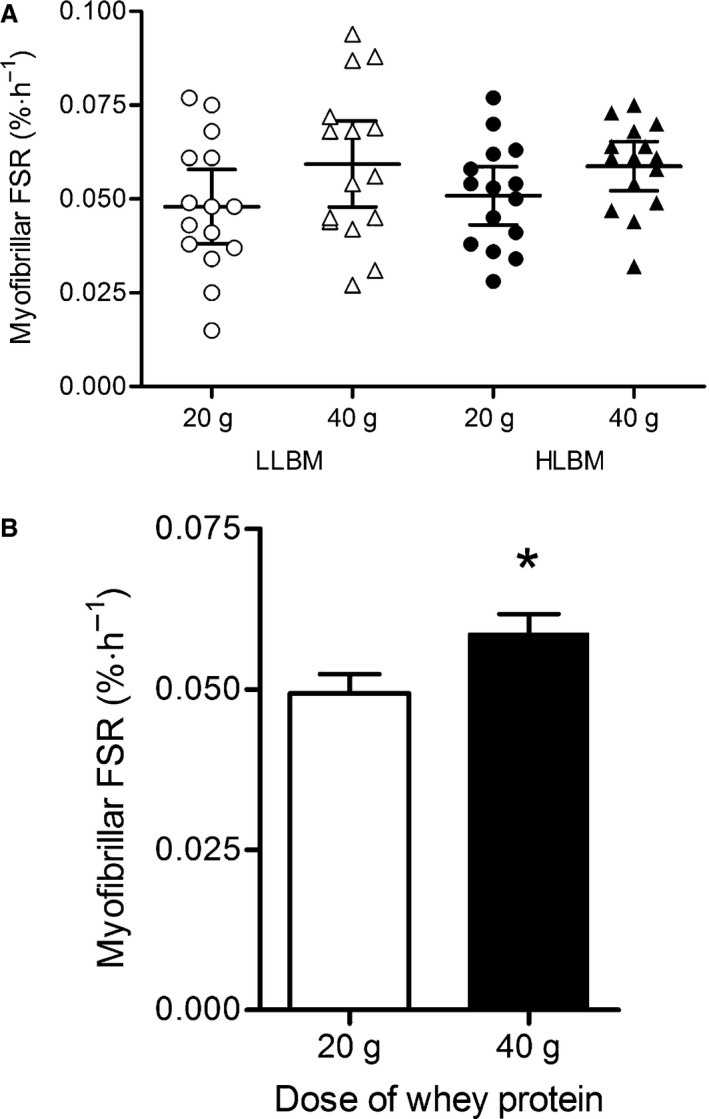
The charts are slightly overselling the effect of protein on hypertrophy. Resistance training will increase muscle synthesis over a longer period of time than protein. It’s also likely that the effect of protein on muscle synthesis taps out after a certain periodic or daily dose.
I’ve also heard about the idea of an anabolic window, where protein ingested near a workout is more hypertrophic than that ingested farther away from it. The idea seems sensible, but the magnitude of the effect and the size of this window are unknown, as of yet. Both [1, 2] of the most recent meta-analyses on the issue have found nulls, when total protein intake is controlled for. My intuition is that the effect does exist, but the window is far larger than commonly thought, like maybe 12-72 hours in terms of size.
Summary
From what I can tell, protein intake does contribute to increased levels of muscle synthesis, but it’s probably not as necessary or effective as is commonly thought. Studies that evaluate the effect of protein intake post-exercise are more encouraging in their results, but do not
The heuristic I would use, when it comes to optimal protein intake for preserving and increasing muscle mass, is calculating the calories the body spends in a day, multiplying by 0.15 (maintenance) and dividing by 4 (g→calorie) to get the longevity-maintenance dose. Then, I would add the 2g of protein added to the muscle every day, divide by 0.15 as not all dietary protein is funneled into muscles, and multiply as 3x to account for metabolic overhead and inefficiency.
For me, that would be a total of 115g of protein per day.
Why Savoire Faire instead of Endurance or Physical Instrument?
In my IRL experience as a trainer, protein is oversold on building muscle and undersold on staying lean. It’s a harder battle to convince someone who wants to get leaner to eat more protein rather than less. The thermic effect is misunderstood and not iterated enough.