

I told my family I was on retatrutide like 3 months ago. My siblings thought I was totally insane and my mom thought I was anorexic. My dad1 was not supportive of my decision, until I mentioned that I gained weight (→70kg2, 1.71m tall) and that my knee/ankle pain came back.
My mom was kind of right though. I had an eating disorder. Just… a different one: I was eating too much and unable to stop myself from doing so. I wasn’t even technically overweight, but I was heavier than I would like to be for the sake of aesthetics, health, and pain management. Like, semantically, it’s disordered, and it has to do with eating. So it’s an eating disorder.
The cure to obesity is just… dieting. Mass in = mass out. Exercise can help, but it’s less effective because the body downregulates energy consumption to compensate, and it’s harder to adhere to consistently, especially if you are just doing it to lose weight.
The catch is that dieting sucks, and I’m tired of pretending otherwise. Personally I’ve found that it’s easiest to eat less when you buy foods that are filling (high protein/fiber) and less palatable/tasty. Eating those foods every day is boring.
I guess I could make a list of ~1000 different foods, categorise them by taste/nutrients/cost/obesenogenics/health, and then write an excel function that gives me the optimal diet that is not too obesinogenic, tasteless, or expensive.
But I don’t want to do that. I don’t want to turn my life into a spreadsheet that commands me to buy a list of foods and eat them at specific times so that I can stay at a healthy weight without having to eat potatoes and salad every day. I just want to go to the supermarket and buy stuff I actually want to eat. That’s the dream, and GLPs are the ultimate cheat code.
II.
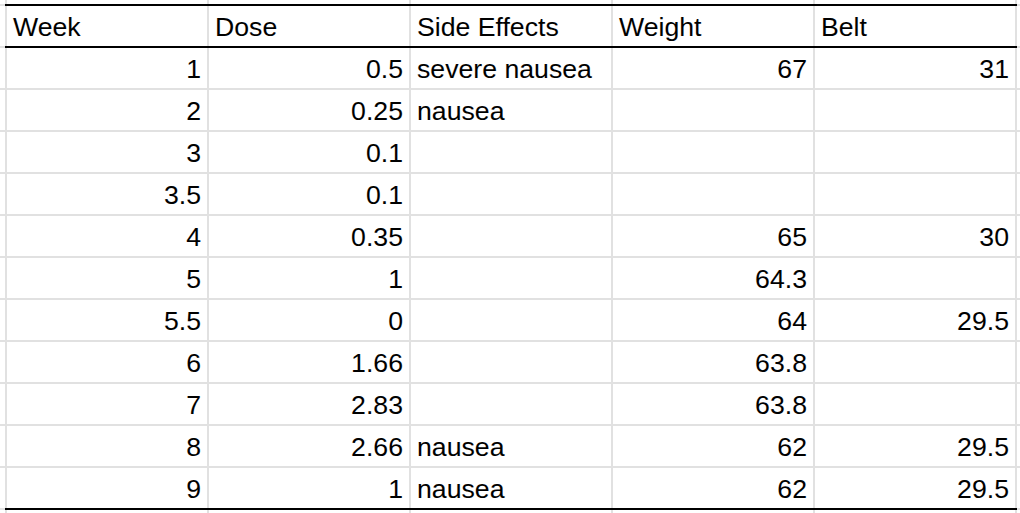
So I bought some retatrutide and injected 0.5mg — like 10x less than the average person takes. And I got super nauseous for the entire day, and most of the week; I took it after eating which apparently is a bad idea. So I took 0.25mg on an empty stomach and I still felt nauseous throughout the week.
Eventually, after microdosing for a few weeks, my body adapted to the drug. And I was like “ok, I guess it’s time to start titrating up, most people are fine on doses much higher than what you are taking”. I scaled up to 3mg and I started tweaking, deadass. My heart had trouble handling workouts and I regularly felt nauseous.
The catch? The stuff really worked. I lost weight. The pain went away.
Life is just better on GLPs.
There is no cost to being thin. When I buy food, I don’t need to think about whether I am going to eat it compulsively and gain weight. Any time I am hungry, I can eat with zero worries about becoming overweight again. All of the background noise, habits, and thoughts that accumulated in my brain for the purposes of being lean were no longer useful, and went away. Before taking retatrutide, I had to tolerate the discomfort of being a little hungry to lose weight. Now, I don’t. Genuinely life changing.
Once I had dropped down to 62kg, I recorded myself doing knuckle pushups, and looked at the video. First thought that came to my mind: are those my ribs???

I thought it over, and realised: ok, maybe it might be time to stop taking retatrutide.
Most people report that, after they stop using GLP drugs, that their hunger comes back and they naturally regain weight. So I decided to titrate down to 0.25mg, and eventually even started taking 0.125mg.
A few days or weeks later, I am in the bathroom, I look into the mirror, and I am staring back at a balenciaga model. A fraction of a second later, I realise that was me. I didn’t look bad, or even good for that matter. Just different, I guess.

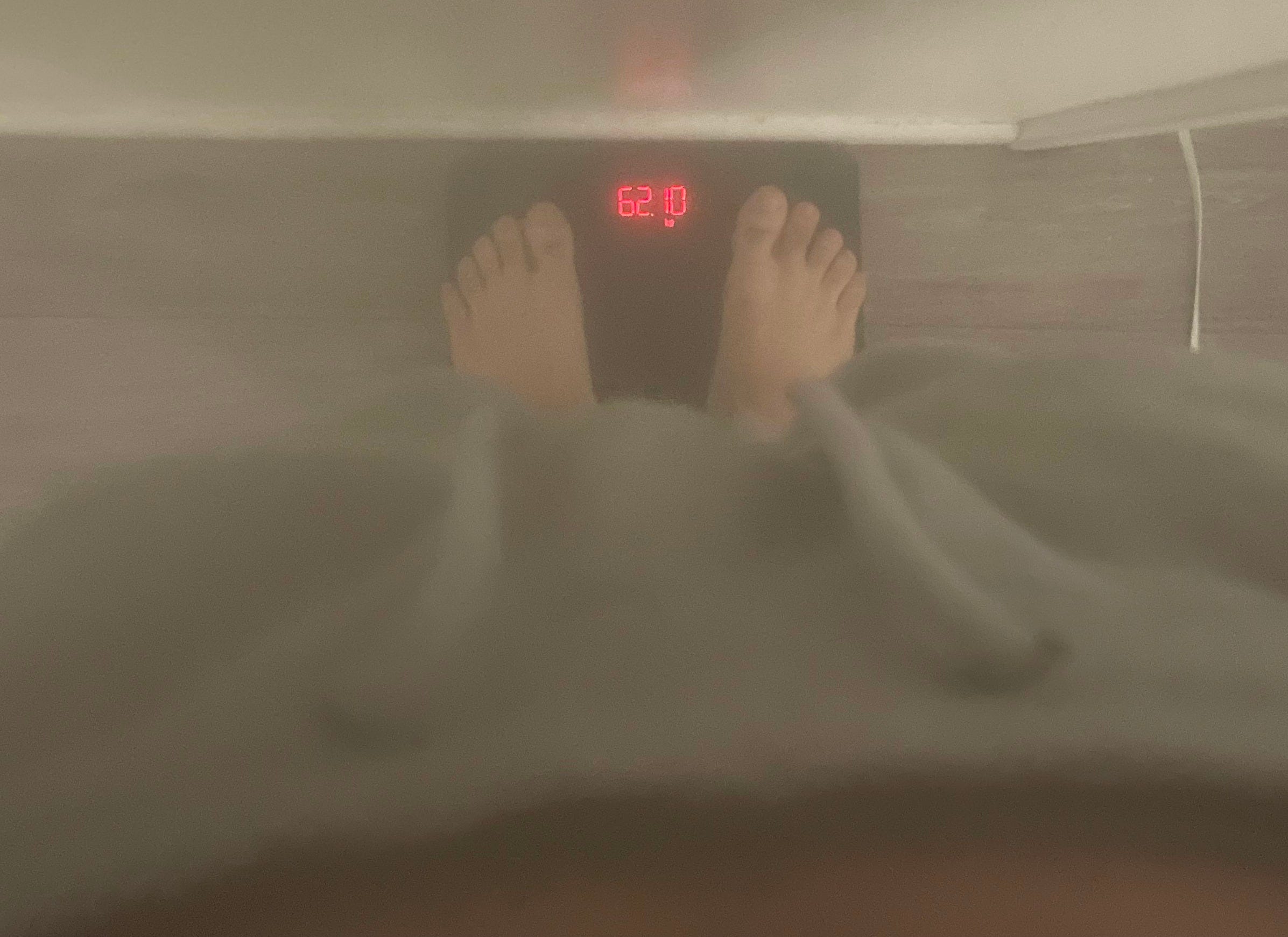
So, eventually, I decide to quit retatrutide and start bulking at 62kg. 3 weeks later, and it looks like… I still weigh 62kg.
You can’t be serious man.
IV.
On the side effects3: the entire internet and my family told me that GLPs were dangerous, that I would become a skeleton, that my muscles would disappear, that my pain would get worse, that my bones would fall apart, that my gut would get destroyed, and that my grey market reta would be either counterfeit or laced with fent.
Did any of that happen? No.
My experience with using any drug or medication is basically the same: people always massively inflate the risks, particularly of addiction or mortality; nothing ever happens, as they. But the frequency and severity of undesirable, transient side effects is somehow underestimated; like if you look at scientific publications or trials on any drug, the most common outcome is that they report most people don’t have any side effects at all, and the ones they have are benign. But then, when I actually take a drug, I almost always have 2-4 different side effects and sometimes even a severe one.
Both me and my dad are unusually sensitive to drugs, but I have a feeling that statistics tend to underestimate the frequency of side effects, either because the participants don’t notice them or because the researchers don’t bother looking. Specifically, for GLP drugs, I don’t think the trials are checking for psychological and hedonic side effects, and it seems like most people who take them report feeling flatter or more controlled in terms of personality.
Hot take: almost all of the side effects of GLP drugs can be chalked up to what they do to the gastrointestinal system, and what weight loss does to people.
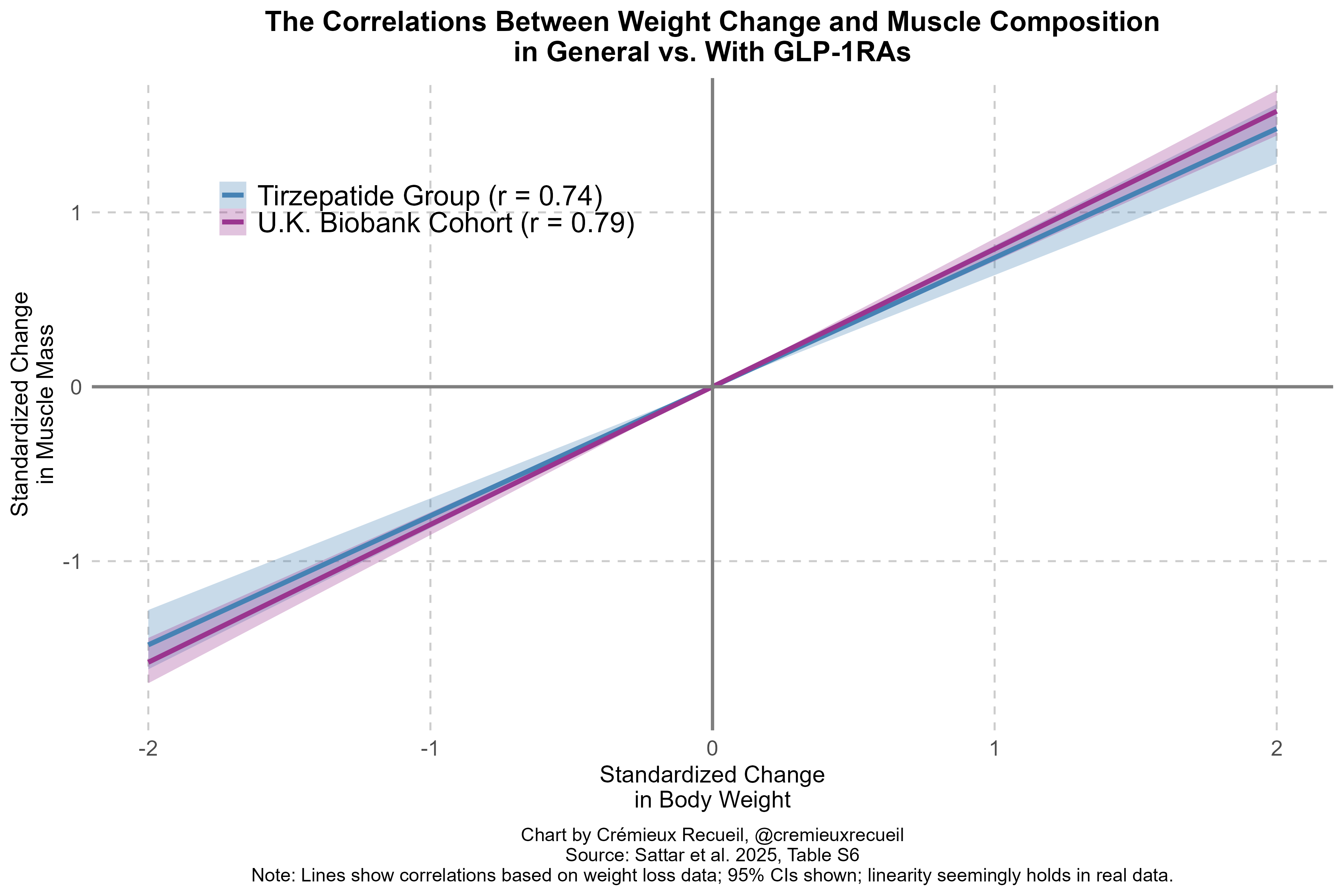
People have complained that GLPs cause muscle loss, bone loss, and “ozempic face” — a gaunt face with less fat on it. Well, that’s what happens when people eat less calories than they use. Your body loses mass everywhere. Predictably, GLP drugs and natural weight loss results in the same ratio of muscle/weight loss.
GLP drugs make people feel nauseous and can cause vomiting or diarrhea, but that’s because they shift a person’s satiety towards fullness. If people feel too full, nausea kicks in as a downregulation mechanism, and their gastrointestinal system becomes stressed. In that regard, the main and side effects of GLP drugs can’t be separated.
One exception to this rule is lower impulsivity. I haven’t noticed this much, though I didn’t have a lot of issues with that to begin with. Others report that their compulsive gambling, drinking, and shopping dropped as much as their compulsive eating did.
I’m not so certain this is a purely benign and positive effect. There is purpose to the part of our brain that is hedonistic and compulsive. The cycle of life: boredom →wanting→striving→achieving→satisfaction→boredom — that is the human experience, and I embrace it. What I like the most about retatrutide is that I can eat palatable foods without having to weigh in concerns about weight gain. Everybody else seems to be glad that these drugs make you want to eat palatable food less.
Personally, in terms of side effects, the most notable and severe one was nausea. When I was taking 2-3mg, my affect was slightly blunted and I felt less compelled to do things. I also can’t tolerate 2mg of nicotine gum anymore, and I actually vomited once when I chewed it for like 2 minutes or something. My gag reflex has permanently gotten more sensitive.
While I was on modafinil + reta, I would feel nauseous and odd after I went for a hard rep in the gym; after quitting and switching to amph, that doesn’t seem to happen.
V.
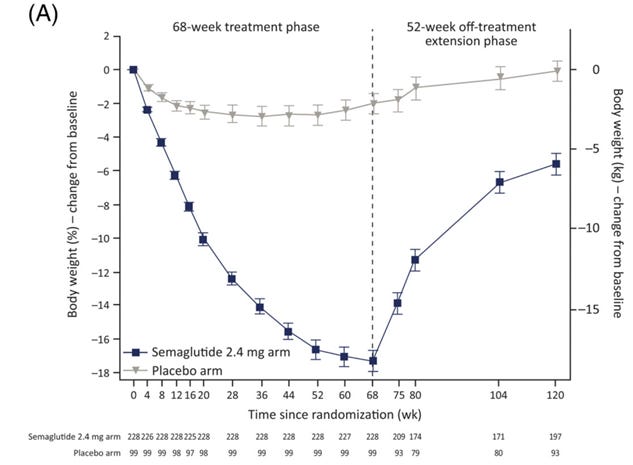
In terms of anecdotes: Cremieux reports that he lost weight on semaglutide, and when he stopped, he didn’t regain his hunger, and actually wants to gain weight. Scott Alexander said like a year ago that when he stopped taking tirz, his appetite came back (saw him a few months ago and he looks relatively thin, so gj).
Statistically, most people will regain weight after they stop taking GLPs, but it seems like there are a decent number of people (like me and Crem) where the effect of the drug on weight maintenance may be permanent.
VI.
I think most Americans have an eating disorder: 75% of Americans have BMIs over 25, ~2% develop anorexia at some point of their lives, and a decent proportion of Americans with normal BMIs are skinnyfats — not the pinnacle of healthy eating.
In terms of health, there are diminishing returns to reducing BMI below 26 for most people. Some people, like myself, are in weird positions where their optimal BMI is somewhere between 19-22 because they are 26 year olds with knee pain. Those are the exceptions.
The negative effects of being underweight on health are massively overstated and statistically confounded: disease makes people thinner and kills people, but being thin itself isn’t a massive factor in death, as long as you stay above 17 BMI or so.
In terms of aesthetics, the consensus seems to be that the most attractive female BMI is between 17-20; for men, the optimal body fat % is between 10-15%. About 4% of women actually fall in that BMI range, and a similarly low fraction of men have a body fat % that low:

The vast majority of Americans would aesthetically improve by using GLP drugs; even the people who are really lean would still find it easier to lose and maintain weight.
I’ve seen people complain about the cultural effects of the drug, that it encourages shallowness or certain beauty standards. Personally, I like being hot, and I like looking at hot people. I don’t think about it too much, and I wish other people were more like me.
The catch is that few of those people will actually end up using them. It’s superficially easy to order peptides on the internet, buy the necessary materials, and start injecting them into yourself. Not something most normal people are willing to do.
The case for GLP drugs being OTC seems pretty clean to me. It is possible to OD on them — just like people can overdose on caffeine or benadryl. They have side effects and can be dangerous… like every single drug that does something to the body. The benefits, on the other hand, are undeniable: easy weight loss as cheap as $10 a month.
III.
While I was on retatrutide, I got seriously into weightlifting. I’ve gotten really strong. In percentile terms, I’m stronger than the average guy now4, even though I am at the 7th percentile of weight for American men and my frame (besides shoulders5) is the size of the average women’s. I’ve gotten shredded, but I have yet to ascend to the status of jacked.
The idea GLP drugs make you weaker is true, in the sense that they cause people to eat in a calorie deficit, which causes them to lose lean mass, which, well, makes you weaker. But if you ignore that, I actually think the drugs make you stronger: GLP/GIPs eliminate fat deposits in your muscles and increase your insulin sensitivity which, theoretically, should make them stronger per unit of weight.
III.
Before GLPs hit the market, I had been following the obesity debate for some time. People have many explanations as to why it’s so difficult to lose weight and stay that way.
There’s the epigenetic theory, which is that being overweight rewrites genetic expression of fat tissue, even after the fat has been lost. This would explain, for example, why 80% of weight that is lost is regained after 5 years.
Another is that evolutionarily, we’ve been selected to prevent hunger more than overeating, so our bodies systemically make us feel more hungry than we need. People who feel too much hunger can lose weight through pain tolerance, but find it difficult to maintain that level of deliberate effort for years.
Trying to find the one theory that explains obesity is like trying to find a universal theory to explain hair loss or childlessness. We can, however, find a theory as to why obesity is high or rising in every country.
My theory is the problem is processed food. Specifically:
Processing that improves the taste and palatability of food.
Cooking.
Low fiber and protein content.
Softness
+ some people naturally have different appetites due to physiological differences in digestion and brain function. The heritability of BMI is 50-70%, though I don’t think that weight or even physiological set points are heritable the way people think they are, like the way intelligence or facial structure is genetic.
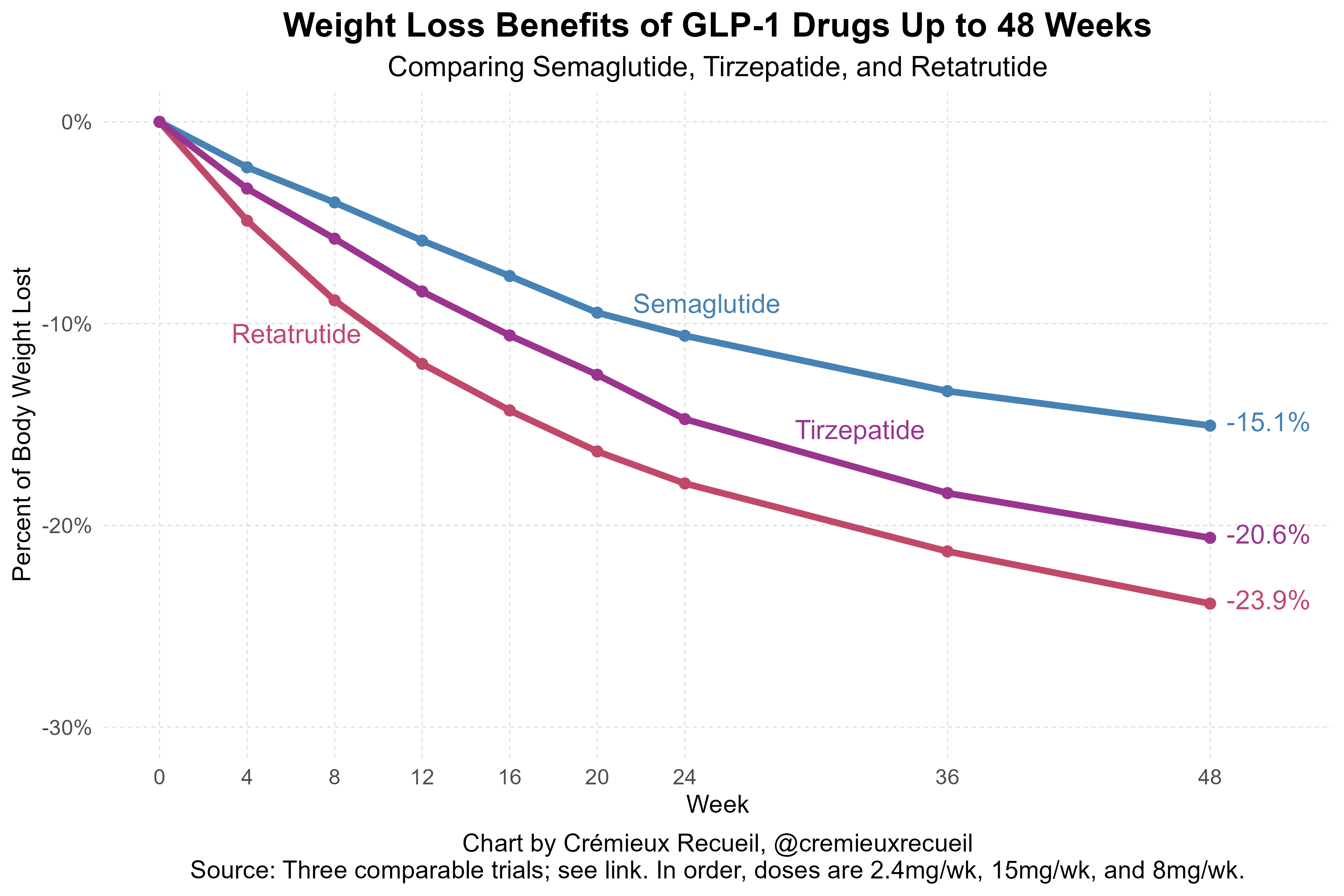
The evidence? The evidence doesn’t matter. ‘Just take GLPs’ is the new strategy for managing weight, at least for the large majority of people who respond to the drugs.
Let’s say we pull out the truth machine, and it can give us a final answer to why everybody is getting so fat. Regardless of what its output is: seed oils, sugar, microplastics, or an evolutionary mismatch + genetics — the answer is the same. Injecting yourself with Chinese peptides.
VII.
I have no issue with people who dislike GLPs due to concerns about safety or uncertainty, which are understandable. They are new, powerful drugs. People dooming about the observed side effects are simply uninformed, which isn’t much of an indictment either. Life is full of fallibilism. For all I know, I could be wrong too. Discussing the side effects of any drug is boring to me, because there is a very simple solution to them: just stop taking them.
I would be disappointed if it turned out to be true that these drugs suppress compulsive behaviour across the board. Some of history’s greatest geniuses were not calculating, cautious people. They were people who did what they did out of compulsion. Nietzsche and Kafka were like this. The difference between compulsion and motivation does not exist, compulsion is what we call motivation we dislike.
“Don’t take drugs because you might miss out on becoming a world class philosopher” — not exactly the best argument. What I am pointing at more generally is that impulsive behavour is often counterproductive, but that the same machinery that produces those impulses also is what makes us tick and enjoy life. GLPs help a lot with regulating appetite, but they also come at a cost in terms of physiology and hedonics.
I suspect many critics of these drugs dislike them because of moral and social anxieties they cannot or do not want to articulate. People feel like taking them is cheating, that their existence removes a criteria by which they could judge and filter people.
Taking GLPs is only cheating if the game you are playing is ‘sink as much displeasure into losing weight as possible’. Are glasses and washing machines cheating too?
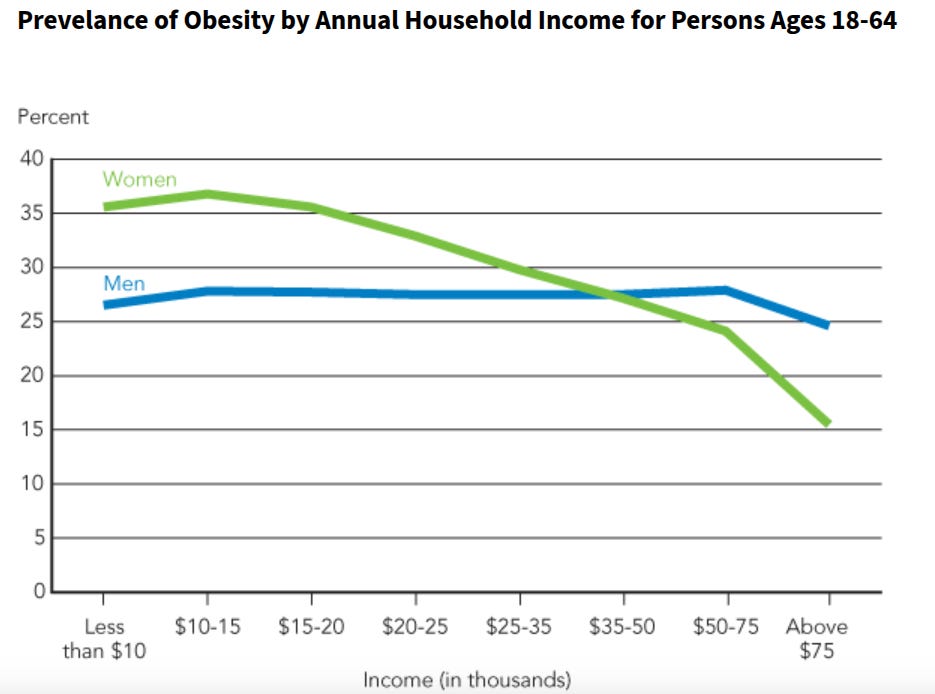
And it’s not like there aren’t millions of ways character can be read other than weight; are we really so stupid that we need people to be fat to discriminate? It’s not like it was ever good as a signal of anything — it hardly correlates with intelligence or social class; barely with personality, believe it or not. The signal in the noise is a little stronger in women, but muted:
Not a fan of the term “zero sum mindset”, but it applies to many critics of GLP drugs.
Conclusion
I took GLPs and I turned into a shredded balenciaga model. I felt nauseous, even when I took low doses, and my affect changed substantially when I took just 3mg. I didn’t even enjoy taking them. Was it worth it? Absolutely, probably the best purchase I have ever made. I really do care that much about looking good, and managing appetite and pain in the pre-GLP era really was that bad.
Sourcing
The cheapest place to buy GLP drugs is peptaura, which connects Western buyers to Chinese suppliers, cutting the costs of them by an order of magnitude. Their current prices:
Retatrutide: as low as $0.54/mg — $4-20 per month.
Tirzepatide: as low as $0.33/mg — $4-20 per month.
Semaglutide: as low as $0.48/mg — $0.5-13 per month
I would recommend taking tirz; it’s highly effective and easier on the heart than reta.
BAC water can be ordered on peptaura; everything else — alcohol wipes, reconstitution syringes, peptide case, and insulin syringes — can be bought on amazon.
I’ve also from kimerachems, nuscience, and nextgen with no issues.
Personal update
My sleeping condition6 has gotten worse. Modafinil isn’t strong enough to work anymore, and it made me nauseous when I exercised. So I switched back to amph, unfortunately psychs can’t prescribe me normal adderall7 until I get a sleep study done, and who knows when that will be. Just taking 20-40mg per day orally. Not something I want to do permanently, but it’s working well for now — I can stay awake for 16 hours again.
Still unemployed. I still have 2-3 months before my dad gets tired of me and ships me back to the tax haven8, so we are fine for now. I’ve been laserfocused on a specific thing which has consumed 8-14 hours of attention per day.
We are the same height, so he intuitively knows that, even though 70kg is on paper not overweight, that it’s not exactly a great weight on paper.
Technically, I didn’t even become overweight, but my legs were still not able to walk regular distances without some discomfort or pain. I went to the manifest conference this year, and even though I only walked 10-15k steps a day for 4 days, and that damaged my knees/ankles so much that I couldn’t walk without limping for 3 weeks.
Details:
Trizepatide and semaglutide are well-tolerated, ignoring the gastointestinal side effects. Retatrutide in particular is different, because it is also a glucagon agonist.
In retatrutide’s trials, these are the side effects that were reported more often in the treatment group than the placebos:
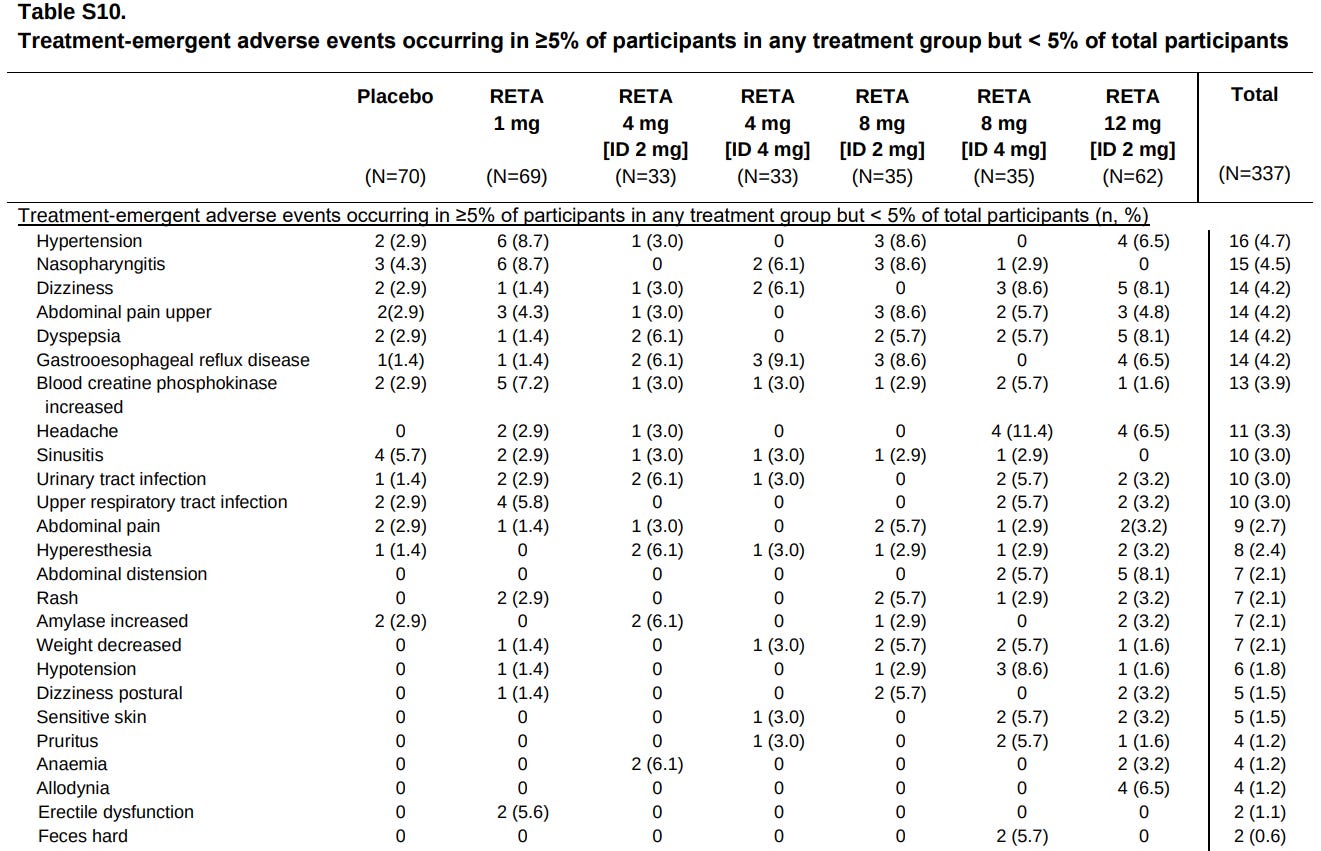
A lot of these seem either benign (feces hard, headache), statistically dubious (erectile dysfunction), or downstream of the gastrointestinal effects (abdominal pain, gastro reflux) — which can be ameliorated by starting with low doses.
One trend I see is that people on retatrutide seem to report more psychosomatic sensations and pain — particularly allodynia, pruritus, and sensitive skin. I think it’s possible this is caused by people not psychologically adjusting to their lighter and smaller bodies, but I wouldn’t count on it.
Another is more colds and respiratory infections. If you are predisposed to these, you might want to watch out for that; personally, I rarely get sick.
Interestingly, more people in the retatruitide groups report both hypotension and hypertension. People might respond to the drug in different ways.
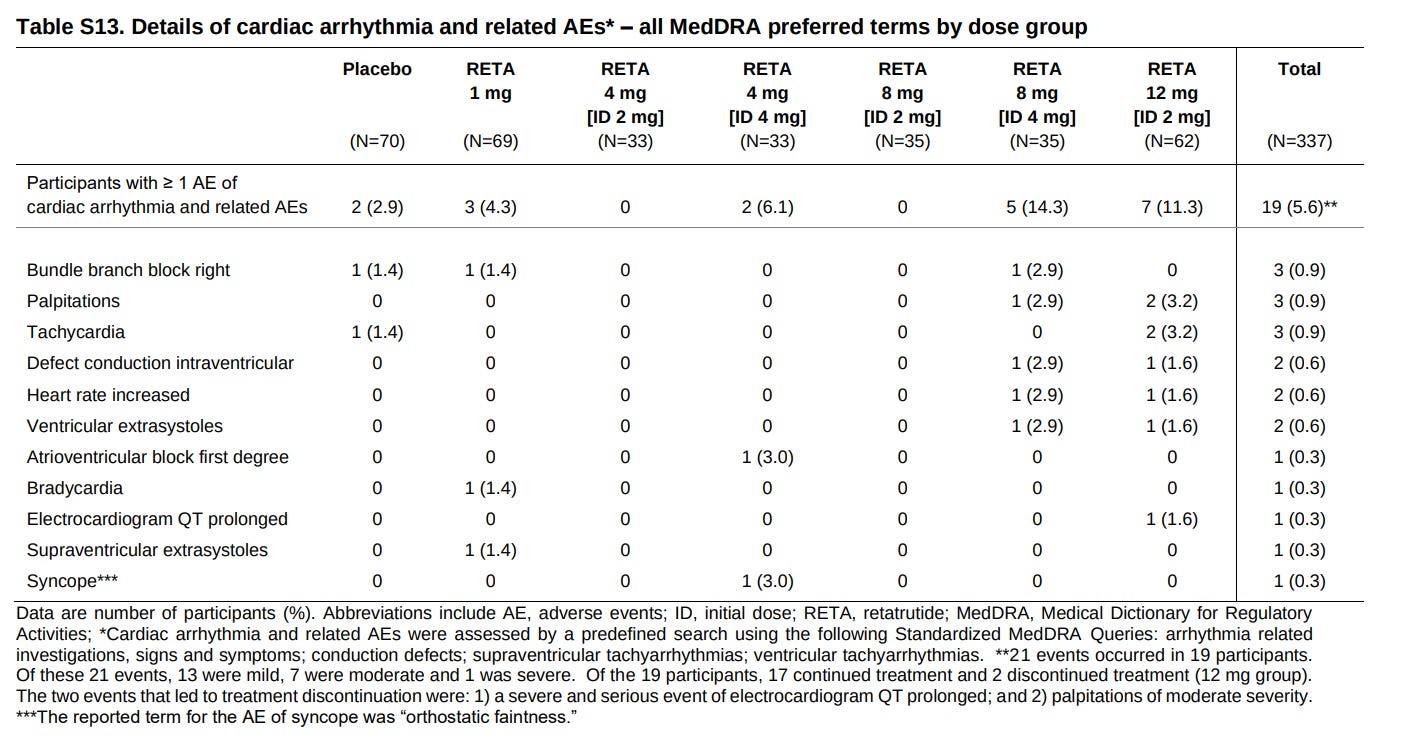
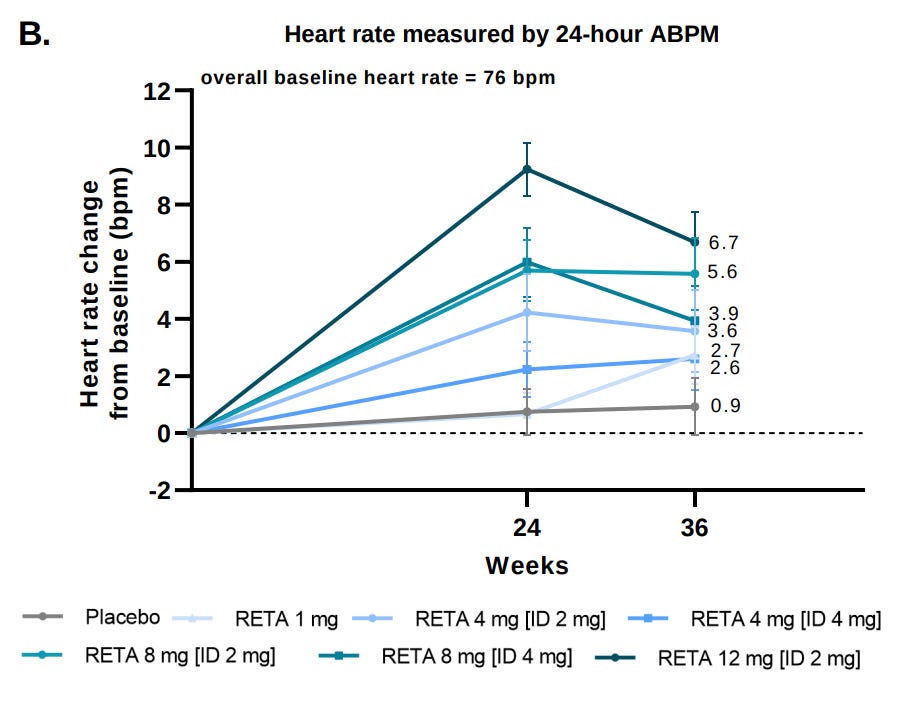
Of note were reports of cardiac arrythmia in people who took high doses of retatrutide:
Some other side effects of retatrutide worth reporting:
Lower blood pressure
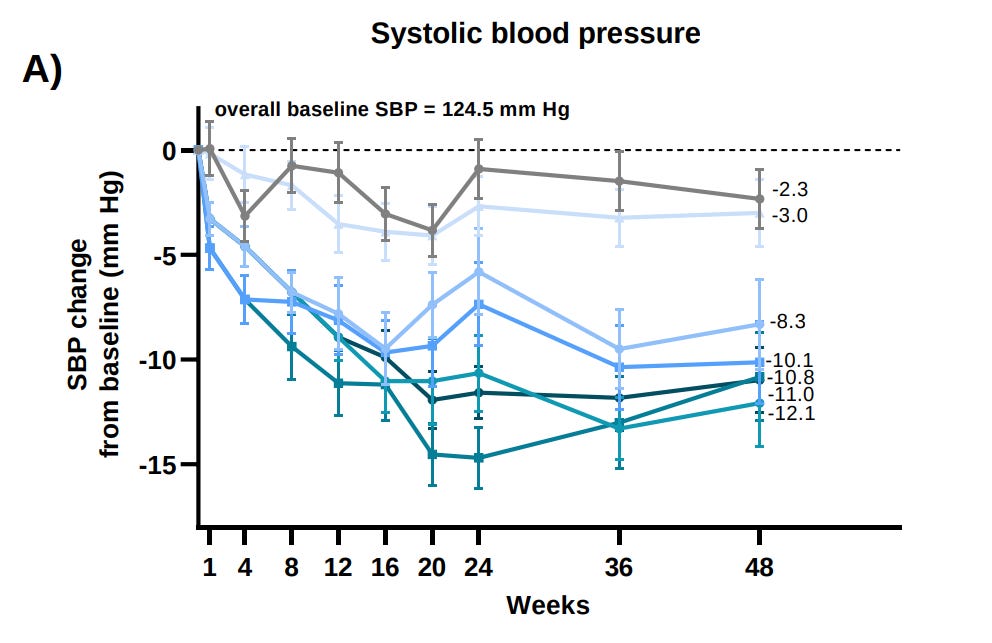
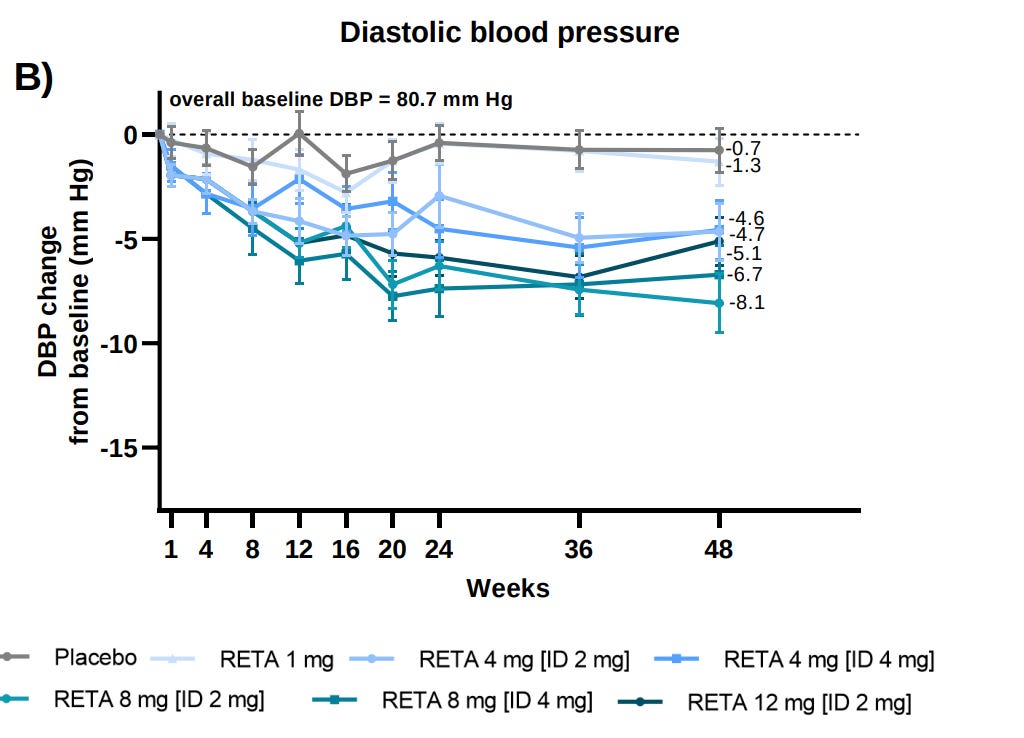
More favourable lipid profiles; barring a temporary drop in HDL cholesterol.
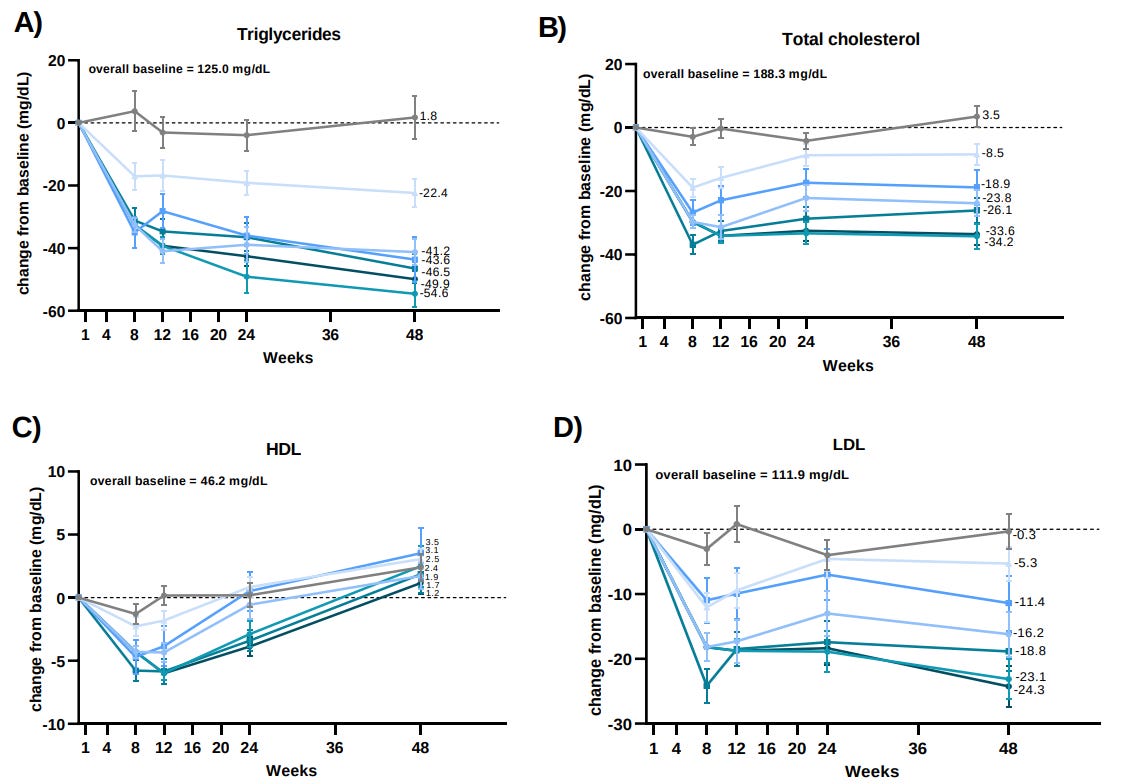
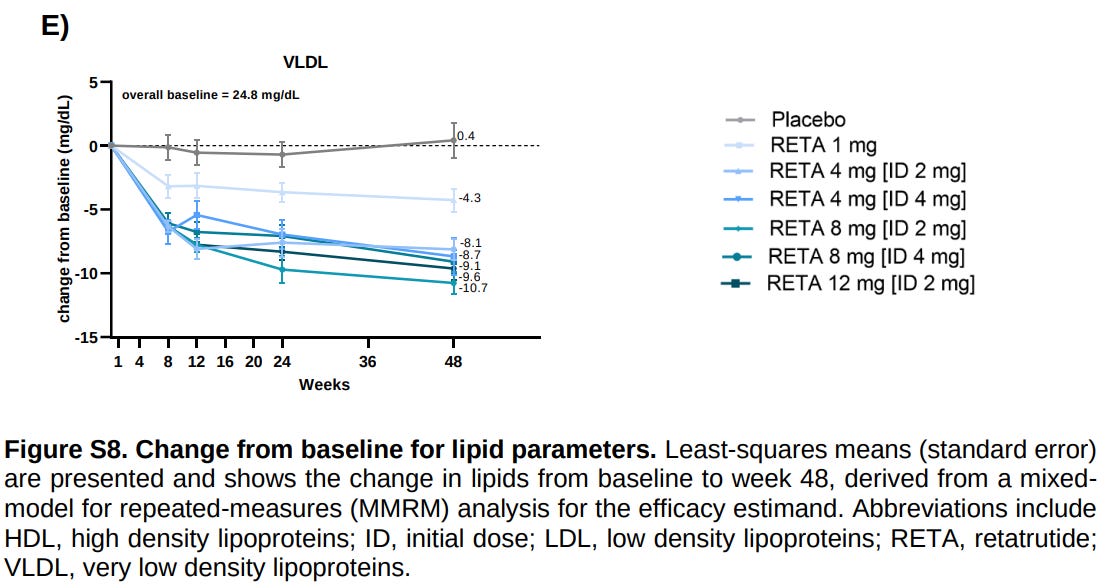
Higher heart rate
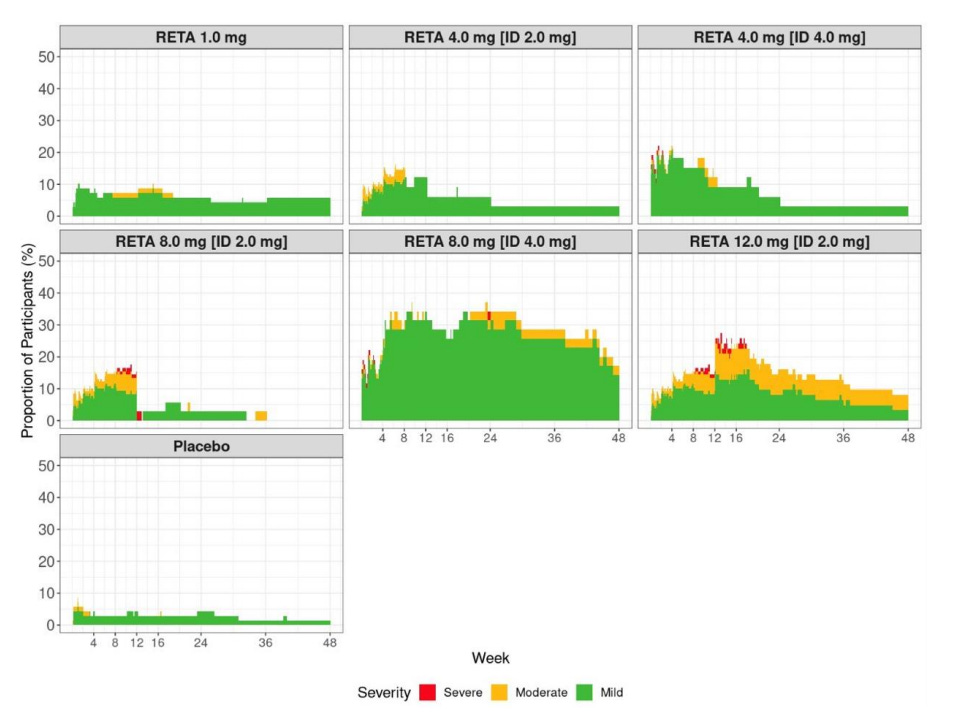
The nausea side effect can easily be dealt with by starting with a very small dose and then gradually increasing it. Even high doses of GLPs can be taken without the undesirable nausea this way:
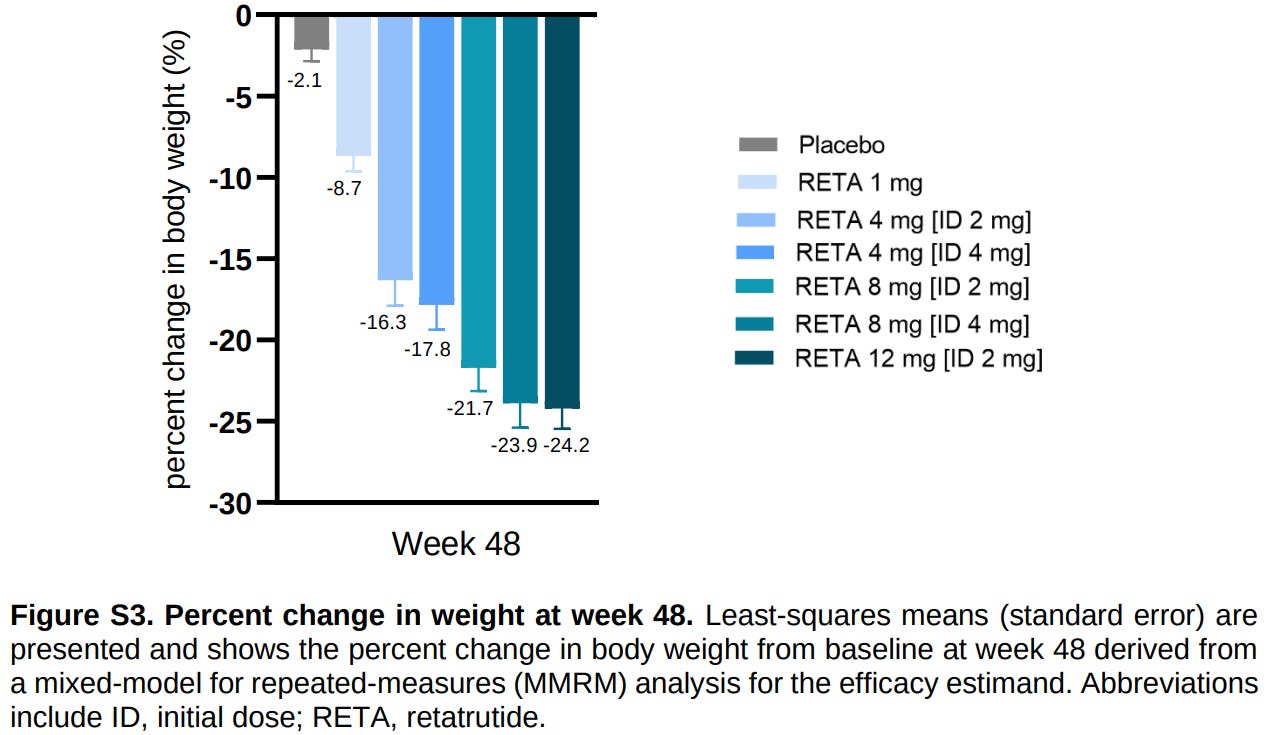
Starting with a lower dose hardly shifts the amount of weight lost:
My personal advice is to scale the dose depending on how nauseous you feel. Start with 1mg. If you feel too nauseous, take half the dose the next week; if you feel a little nauseous, stay on the same dose; and if you feel no nausea, double the dosage. I’d recommend against taking more than 8mg of retatrutide, personally, as it can have bad cardiac effects.
Stats:
1RM dumbell: 50lb
1RM tricep cable curl: like 130lb
1RM bench (cable): like 200-240lb
max clap pushups: ~45
max knuckle clap pushups: ~25
max pullups: ~20
Broad shoulders run in my mom’s family. Little sister is 5’1’’ and has man-sized shoulders.
Probably narcolepsy; could also be a chiari malformation, sleep apnea, or brain cancer. Narcolepsy/brain cancer are both very rare, but they are a better fit for the symptoms; chari/sleep apnea is more common but less of a fit.
Adderall is 75/25 dex/levo, while amphetamine sulfate (what I take) is 50/50. Normally people like dex more because it has less of a peripheral effect on the nervous system, but it works well for me, since my BP is low and take relatively low doses (relative to the junkies and addicts).
Oh no, my tax-dodging dad is going to force me to move back to a tropical island where I sleep in my own little home for free and I get to play with my cute little siblings. Seriously though, I don’t really want to go. Love my family, but islands are a lonely place, and I think I’m a little too old to be financially dependent…
>Still unemployed. I still have 2-3 months before my dad gets tired of me and ships me back to the tax haven
Same situation here, but my dad already got tired.
My personal observation is that reta tolerance seems to scale with weight. I could barely tolerate half the lowest therapeutic dose whereas others are on 10mg/week.
One interesting thing is that muscles have GIP receptors suggesting reta may protect against catabolism. And for oneself it has a dramatic lowering effect on lipids, resting glucose, and liver enzymes.
It gives a certain upregulation of sympathetic tone that I have found quite helpful, by comparison sema gave me cold extremities.