

TL;DR: the dark triad is a life history strategy that maximises for short-term gains in social settings, expressing itself through three personality traits: narcissism, machiavellianism, and psychopathy.
The dark triad is a set of three personality traits — machiavellianism, narcississm, and psychopathy — that are related to “dark” behaviour. I define these as:
Narcissism: intentionally distorting your image to the world while filtering social feedback and judgements through the distorted image.
Machiavellianism: deliberate, counterintuitive, and exploitative behaviour that seeks to extract value from others.
Psychopathy: emotional disconnect (not necessarily detachment) from surrounding individuals and insensitvity to punishment.
Statistically, it seems to show decent validity and reliability1. All of the traits correlate with each other and load on a general “dark factor”. It’s similar to low valence in the big five, but encompasses a distinct cluster of traits — low valence is closer to misaligned + incompetent while dark triad is more related to misalignment.
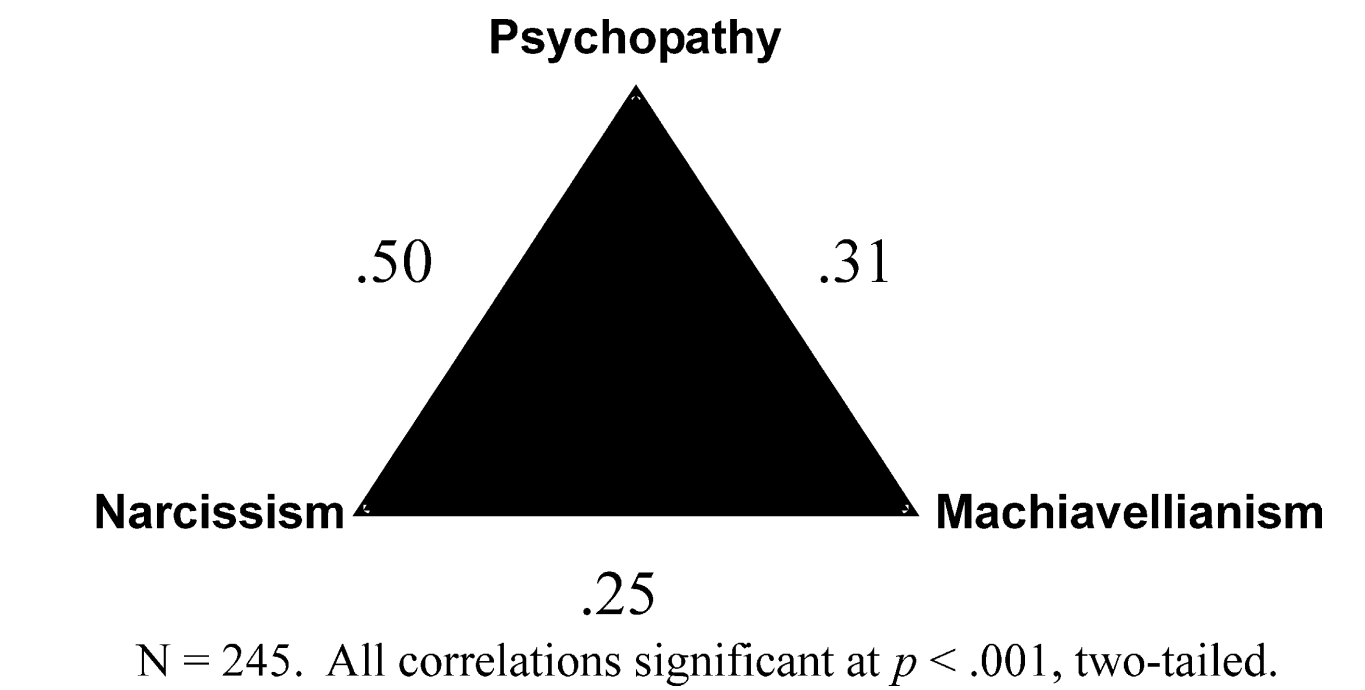
You’d think that a test which is considered by most to be a measure of whether you are a bad person isn’t reliable, because the bad people will not admit to being bad people. I actually think the opposite is truer, that surveys on taboo behaviour encourage people who engage in them to admit to them because it lets them release the internal pressure that accumulates from putting on a mask.
That aside, I do have some big criticisms of this personality model. The first is the tests. They often ask people questions that are either too generic to mean anything or don’t really relate to exploitative behaviour. For example, “it is not wise to tell your secrets” is a question that doesn’t really mean anything — it doesn’t specify what secrets and to who.
I think that the dark triad suffers from underconceptualisation. The recurring pattern in all three of these traits is a fast life history strategy where you optimise for short term outcomes and gains over longer term horizons. The strategy doesn’t need to conscious, or evil for that matter, it’s just the universe expressing itself in different ways. Since everybody dies, some people have shorter horizons than others, but nobody has a permanent horizon.
Shorter term horizons relate to narcissism because the short run encourages engaging in performative2 behaviour where the actor pretends to be more aligned and skilled than they really are. If they are engaging in a fast life history strategy, then what matters to you is the performative image, not your true self3, so your judgements and social feedback are filtered through that mechanism.
Often, narcissism is losely defined as being grandiose, unempathetic, overly vulnerable, exploitative, or self-centered. All of these things correlate with narcissism, but they don’t capture the underlying mechanism.
The relationship between machiavellianism and short-term orientation is pretty clear. When people like other people, they naturally engage in prosocial and long-term oriented behaviour. When I call my mother and tell her I love her, I am not “manipulating her into liking me”, I am just doing whatever feels natural. People who are looking for short-term gain strategies, on the other hand, have to do things that are less obvious or genuine in order to succeed.
I think that affective psychopathy relates to life history because emotionally attaching yourself to people you are going to cheat soon doesn’t really make sense, and punishment insensitivity relates to life history because a high dark triad person will need to do things that are punished by society if they want to be successful.
I don’t think it’s appropriate to conceptualise of dark triad as a psychopathology, but a strategy that works or doesn’t work depending on other character traits and circumstances. Ironic, given tht the word psychopathology derives from psychopathy itself. I assume there are high dark triad people who dislike the way they are, and want to change; my advice would just be to try playing longer games with better people.
Frequently discussed online is the question of whether all humans are selfish. I will first say that I don’t think the selfish-human theory is falsifiable, as altruistic behaviour can always be reinterpreted to be selfish through the lens of evolutionary biology or status economics. I do, however, think that the debate is useless, as people who see themselves as altruistic will not accept that humans are selfish; people who see themselves as selfish will always be skeptical of altruists.
In my opinion, the distinction between selfish and selfless behaviour doesn’t really make sense. If somebody goes to a cat and feeds it, you could argue that their behaviour is selfish because what made them feed the cat and enjoy doing it was neurotransmitter X; others could argue its selfless because the action distributes value from the human to the cat.
From a psychological perspective, everybody is selfish because all value and meaning is local; from an energetic one, people can choose to act in a way that redistributes value from themselves to their surroundings. What is more interesting, in my opinion, is whether people do selfless things because of evolutionary incentives or their own will. The answer is the will — just because organisms are selected for reproduction4, does not mean that the end goal of their actions is to reproduce. To think otherwise is to sneak teleology into science.
Like in the case of the MBTI, I find most criticisms of the theory boring and tedious. Some people point out that the theory originates from evolutionary biology at the species level, which is true, but not particularly interesting. Others argue that it is unfalsifiable, and it kind of is, but unfalsifiable theories aren’t necessarily wrong.
Further reading:
Review of Evolutionary Psychopathology by Scott Alexander

This word is beginning to mean nothing, but its use is fine here.
Another word that doesn’t mean anything.
diffusion.
I always wonder about cases where one is high and the other two are low. The one time I did this I wound up with very low narcissism and psychopathy and high machiavellianism--I'm harmless, but *very* suspicious and cynical.
Enjoyable read