

Status economics is analysing human behaviour through social incentives.
If people respond to price signals, then they respond to social signals too: approval, embarrassment, exclusion, and disapproval. Game theory then organises how people act when they are uncertain, being watched, and watching others.
A good example of its application: Werner on The Origins of Wokeness. Previous theorists argued that it originated from philosophy, the long march through the institutions, or WEIRD morality. Werner, on the other hand, argues that increased diversity in American elite spaces resulted in larger returns to signalling woke beliefs — which indicate that somebody is more able to cooperate with different types of people.
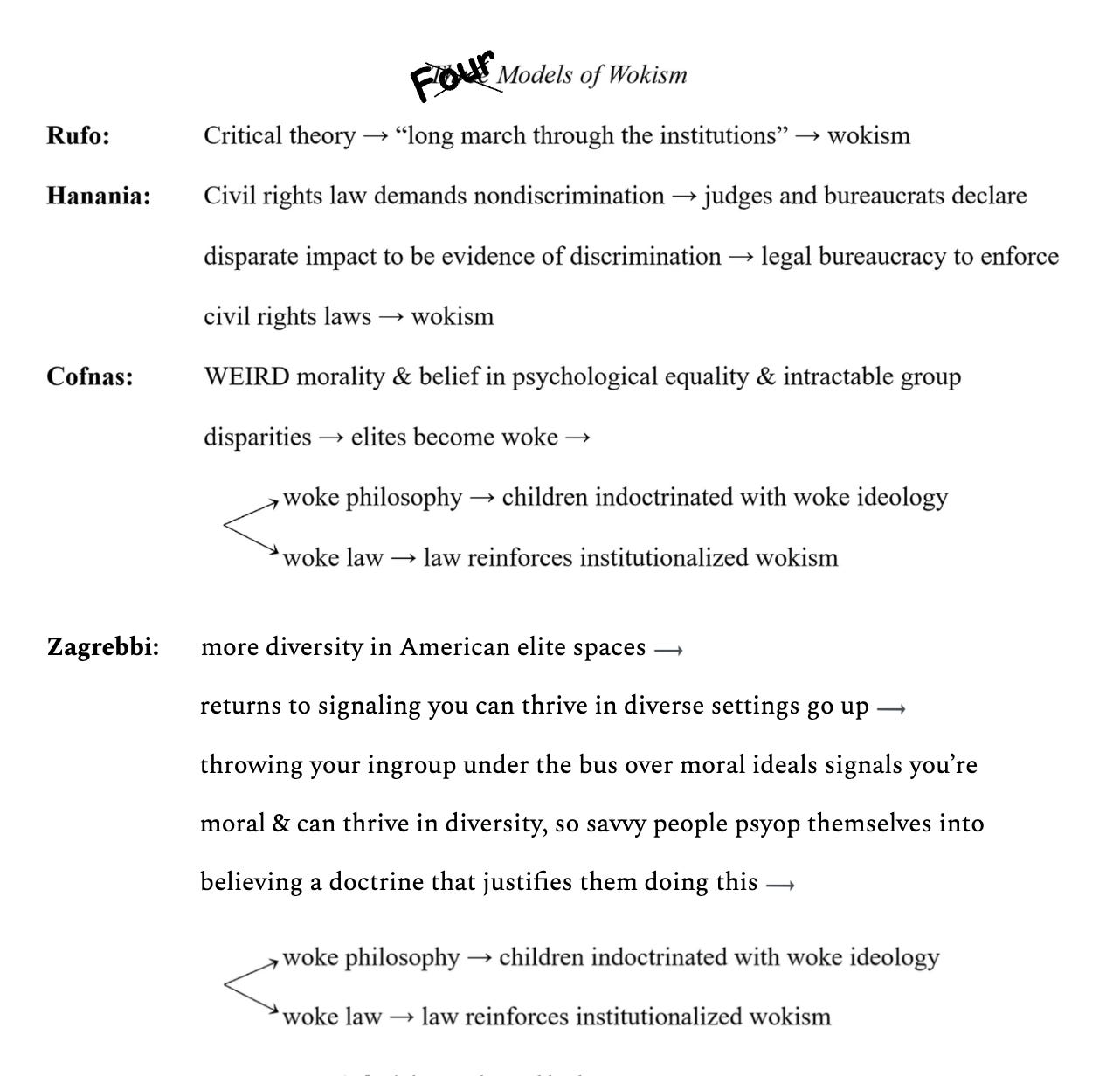
In this case, I deem its use appropriate. The status economics theory explains why woke beliefs are typically uncorrelated/positively correlated with intelligence, why wokeness escalates (race → sex → sexuality → gender), historical timing, and relative absence in East Asia.
Status economics takes behaviour that was previously considered irrational, moral, or unexplainable and attempts to explain it through a different lens. Low quality luxury goods? Status. Medical tomfoolery? Status. Art? Status. Altruism? Status. Education? Status. Politics? Status. People not consciously thinking about status when they engage in these activities? Self-deception.
It’s hard not to emphasise self-deception as foundational. When people are consciously living life, they rarely think about wanting to dominate others. Sometimes even when they are pressured. For status economics to be plausible, we must have a theory as to why people’s stated motivations do not map to their drives and actions.
I don’t think it originated1 from one person, group, or ideology. In terms of communities, status economics is currently popular in economics, tech twitter, the rationalist community, and the online right.
The appeal of status economics is evident. A lot of times, it just works. It discourages the convoluted psychiatric stories and common sense. It explains the unexplainable.
Where does it err?
Status Economics degenerating into metaphysics
Platonism for the elites is an insult.
In the myth of Plato’s cave, we have men casting shadows on the wall with clay figures — what they perceive with their raw senses. People can choose to leave the cave and find themselves in the rest of the world — the world of Platonic forms, ideas.
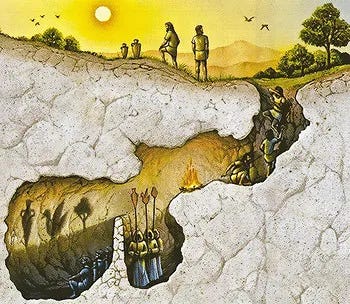
The application is clear. In status economics, morality and irrationality are shadow explanations for human behaviour; status is the true substrate behind everything. The appeal of Gnosticism — Marxism, Christianity, The Red Pill — is intuitive. The masses are a bunch of cattle and your third eye sees the truth behind everything. It makes you feel better than other people.
To divide the world into a “true” and an “apparent” world, whether after the manner of Christianity or of Kant (after all a Christian in disguise), is only a sign of decadence,—a symptom of degenerating life. The fact that the artist esteems the appearance of a thing higher than reality, is no objection to this statement. For “appearance” signifies once more reality here, but in a selected, strengthened and corrected form. The tragic artist is no pessimist,—he says Yea to everything questionable and terrible, he is Dionysian2.
The idea of a true and apparent world — in other words, the world has layers — is true on a figurative level. There are lenses, frames by which sequences of events can be radically reinterpreted. The issue lies in reificiation — thinking that the layers are not mere appearances as well.
The core tenets of the school — that pretending not to care about status is itself a status play, and that self-deception is psychologically real — makes the theory unfalsifiable. If people are overtly competing over status, that proves our theory. If people are not overtly competing over status, that proves our theory — they are just self-deceived.
It is falsifiable at the group level — see social signalling vs human capital models of education — but unfalsifiable at the individual level. The theory can explain what attracts people to education in general, but can’t explain the motivations of particular people.
Unfalsifiable theories are not necessarily wrong. They are dangerous. If you take them too seriously, it is impossible to test them. “All true beliefs are falsifiable” is not even a falsifiable statement3.
Another note on ‘not caring about status’ — I don’t take this literally. Figuratively, what is meant is that this person is playing with their cards face up. What they appear to be is what they are, uninterested in playing elaborate games, comfortable to carry themselves through their own values.
Take Frank Herbert promoting Dune as an example. Is he making a play for status? Definitionally, yes — he is vying for attention and desirability. But there is something reductive about claiming that selling Dune is about status — it’s like saying he’s doing it to enable capitalism, promote satanism, or feel good. It’s an empty explanation.
Motive vs method
This is where we get to separating motives, mediums, and products; status economics often confuses these things. Dune was probably written tons of reasons — boredom, money, fame, self-expression, mastery, and connecting to people. Writing and publishing a novel involves dealing with a social world with its own signals and incentives; if people like it, then the author is rewarded with attention/money/etc.
Presumably, if somebody is willing to put in the effort to publish and sell a novel, they have financial or social motives; likely both. That’s not a bad thing, but that doesn’t necessarily mean that was the only reason for having bothered to write one in the first place. It also doesn’t mean that they were just chasing “status” in the broader sense — they might enjoy attention, but not prestige; desirability, but not credibility.
What I am getting at is essentially this question: do we want power for its own sake, or is power the way humans accomplish goals?
The question is definitionally absurd; if we take cause and effect for granted, evertything is power. The distinction still functions in a utilitarian way. Are social resources valuable for their own sake, or are they only useful instrumentally?
When a business attempts a viral marketing strategy, they are essentially pursuing a type of status — attention. But are they pursuing status for its own sake? Perhaps, to an extent, but surely money is also a motive. But then you could ask why they want money…
What even is status?
Another massive issue; status is not one thing. I define ‘status’ as power through perception, what power people have as a function of other people’s beliefs.
I consider status to come in nine different forms:
Prestige: who is considered admirable?
Legitimacy: who reigns supreme?
Credibility: who is considered believable?
Immunity: who is allowed to get away with violating rules?
Leverage: who can impose costs and benefits?
Attention/clout: who commands attention — cognitive fixation?
Fame: who is remembered?
Desirability: who is wanted?
Access: who is allowed opportunities and resources?
Multidimensionality can be pedantic, but this frame solves a lot of the weird questions; for example, are young people low or high status? The answer: young people are more desirable, rule-immune, and are given more opportunities; but they have less leverage, credibility, and legitimacy. This also works for other debates about whether men vs women have more power. Often groups differ in which social currencies they possess.
Unfortunately, this does not go without saying: what is “high status” is individually dependent. People pay attention to, appreciate, and approve different things. These individual-level tendencies can result in aggregate effects at the group level, but many times, it’s not necessary to get most people’s approval/attention to get what you want. Only about 0.25% of the global population has bought Dune, the best selling scifi novel of all time4.
The opacity of human motivation
Is “status” a good explanation for human behaviour?
My vote is no. I think it’s a good explanation for macro-level weirdness: luxury goods, religion, altruism, ideology, and even some medical practices. Otherwise, I think it’s at best an arbitrary explanation and at worst a terrible one.
An explanation is not just a model. It’s a theory for why something is occurring and not something else. The apple fell because of the Earth’s gravitational pull, not because I sneezed before I saw it.
So, why do I like playing competitive video games? I will admit — winning feels good; losing feels bad. But why am I playing competitive video games… and not something else? Why am I not rapping, playing sports, or tasting wine? Why do I keep my childhood belongings? This is where status loses: it can explain why people play games, but it cannot explain why people pick them. The idea that art is about status is grotesque; it is to say that sex is about burning calories.
If something explains everything, then it explains nothing.
Regarding introspection: it’s easy to see emotions, thoughts, and perceptions. The mind is not flat, but it can only see the output of its depths, not the depths themselves. The machinery that creates thoughts/emotions cannot be accessed by the conscience and must be inferred; inference is unreliable. In a weird way, all desires are definitionally unconscious. This is why, I think, self-deception works. It’s not trickery if everything is hidden.
We often do not want things because of what they are, we want them because of what they represent5. Allow me to explain: we have base needs such as thirst, hunger, tiredness, sexual appetite, and bodily integrity. People then make demands of others to satisfy those needs: flirt, buy food, and request quiet. Our linguistic and cognitive maps of the world enable us to satisfy these base drives — we fear men with guns because they threaten our bodily integrity; we like sushi because it will satisfy our hunger. Sometimes we want to want things.
At times, these cognitive maps and demands of the world falter. and we want things that things that do not satisfy our bodily drives as much as we think they do, or at all. This is where unwholesome desire, taṇhā, comes from. The Buddhists were right to reject it.
When people seem to do and want irrational things that are connected to social mechanisms — farm attention from Neo-Nazis on twitter, buy luxury goods, or participate in religion — the easy explanation is just status. Sometimes that is the answer. Other times, the motivation is to satisfy desires that have stayed unsatisfied, and our unreliable linguistic maps have determined those are the answer.
Taking the psychoanalysis further, a lot of status economists are fans of Girardian desire, the idea that a lot of human motivation is mimetic. I’ve never read Girard, but I’ve seen some of that in myself; we were all teenagers once. The idea is cool, but bad as an explanation for human behaviour — what made something popular in the first place, is the more interesting question. It’s definitely overextended, for example, to explain what body types people find attractive.
There are other times where the answers are not that deep. Why do people like playing Skyrim? Lacanian desire? Mimesis? Need for community and affiliation with successful products? Maybe it’s just… fun.
Status Economics — current status?
Status economics is useful. It breaks us from the trance of gnostic explanations of behaviour, exposes that all social relationships are transactional under pressure… until it degenerates into its own gnosticism.
The school explains human behaviour well at the macro level, inconsistently at the micro level (this is true for economics in general). Humans have layered motivations and respond to some social incentives, not others. At the aggregate level, social incentives will reliably shift behaviour. “Status” is also a compresion word, which makes it useful in language but tenuous as a concept.
There’s also another question. If I dislike status economics as it is currently applied, what theory of human behaviour should replace it?
I am fine with nothing.
This will probably be the last article I write on the social status question. I’ve already written on the issue far too frequently, though I posted about it again since my opinions changed (of course!).
The geneology: Evolutionary theory was the first start, when people started to doubt religious and moral narratives of human behaviour. Nietzsche pushed that too and popularised the psychology of self-deception. Then, we get to the postmodernists, who double down on Nietzsche’s skepticism of metanarratives and note that power and knowledge are hard to separate. Then, we get an internet resurgence with the rationalist community, the GMU school of economics, and twitter.
See Twilight of the Idols
What if there was a true belief that was unfalsifiable? If I reject anything that isn’t falsifiable, then I will never be able to bring myself to believe it.
Dune was released in the 60s, so the death-adjusted percentage is probably closer to 0.2%.
The Lacanian Theory of Desire.