

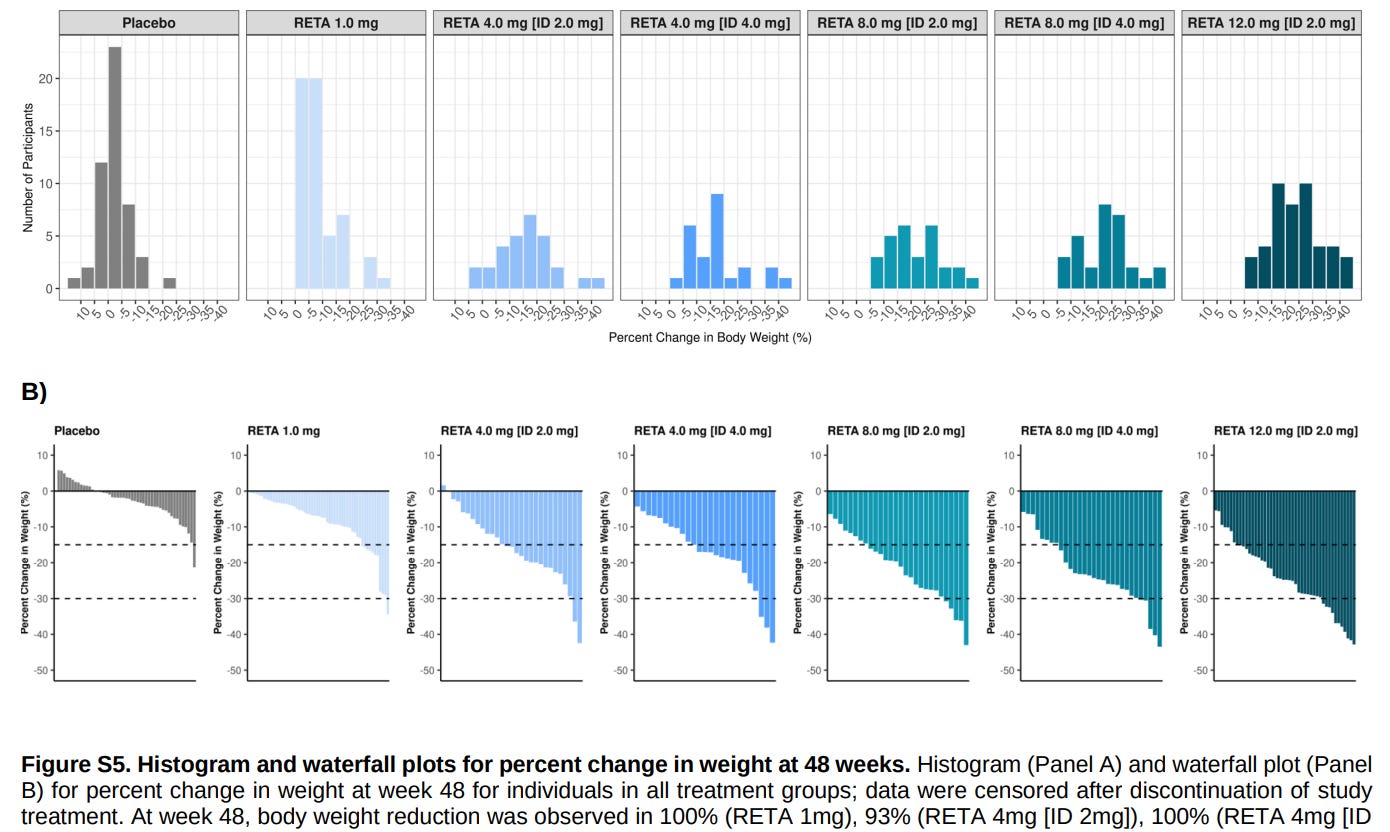
Fictional stories have a tendency to flatten how people use drugs, when the reality is that there are massive individual differences in how people respond to them. For example, some people hardly lose any weight, even when they are put on megadoses of 8-12mg of reta:
Likewise, there are also large differences in how capably people can act when under the influence of drugs, or when they are withdrawing from them. As a kid, I would have found it hard to believe that Stephen King wrote several of his novels while he had a severe alcohol and cocaine addiction; as an adult, I totally do.
So when an alcoholic says that they can drive better than the average person on 8 drinks, they might not even be wrong. It’s easy to brush this off as making excuses or special snowflake logic, but the fact of the matter is that everybody really is special in their own way.
But that’s a “bad story”, because people aren’t aware of how well they can tolerate drugs; kind of like how self-reports of attractiveness and intelligence are weakly correlated with the real measures. All of the people who think they can function on drugs and resist addictions take them; some of them do, and the rest become, well, junkies. So anti-drug messaging often devolves into universalist negative messages, even when they aren’t accurate.
Fiction has a tendency to moralise: to want to send a message. As such, the depiction of drug use is often selective: it depicts addicts who destroy their lives or die from overdoses, or it shows people living it up and having fun, managing to live normal and functioning lives regardless. It also has a tendency to underreport the mundane stories: accidentally buying counterfeit drugs, underdosing, or somebody getting lazy and not taking drugs after their plug pulls a no-show.
As such, it’s actually pretty difficult to depict how drug use works in fiction accurately: if 10% of opioid users are addicts, 10% just use them for fun, 50% try them and quit, and maybe 30% use them for medical purposes — a story could accurately detail what life is like for a person in each of these categories, while still failing to tell the full story.
Stories of people on drugs often underreport how often people try to mitigate side effects by changing doses or switching drugs. Maybe somebody notices that they are getting a little too happy on oxycodone, and they ask their doctor to switch them to buprenorphine, an opioid with a lower liability to addiction. They do it… and it works.
But that’s another bad story, because the message is suddenly that buprenorphine was a better treatment than oxycodone for this specific patient. Stories about specifics are hard to market.
II.
Another thing. Drugs also have this nasty habit of working. I mean, that is kind of what they do by definition: “A drug is any chemical substance other than a nutrient or an essential dietary ingredient, which, when administered to a living organism, produces a biological effect”.
When I started having trouble staying awake and focused in college, I looked at different explanations and solutions: not sleeping like a degenerate, quitting caffeine, and different supplements/lifestyle choices. None of them worked. Then I tried drugs, and suddenly I could stay awake for 16 hours a day.
II.
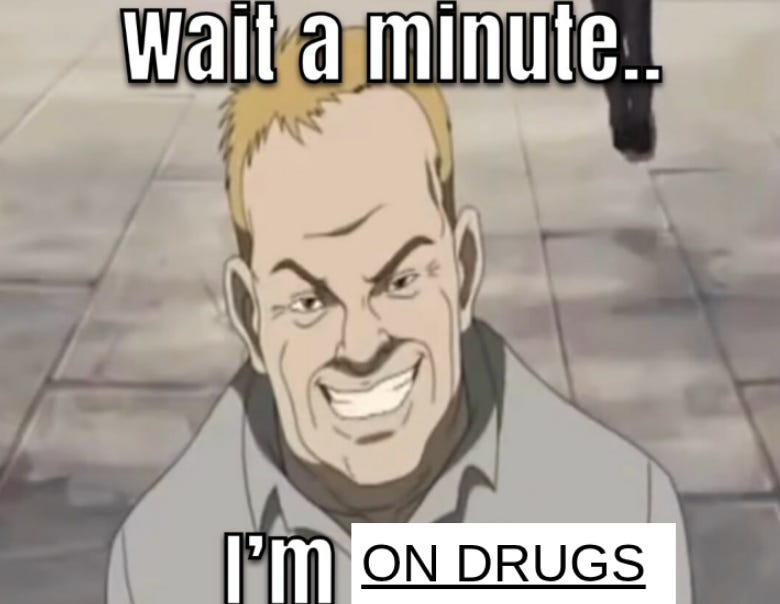
Story time. One time, I took 300mg of modafinil out of curiosity, and ended up getting extremely over-stimulated. A friend of mine was going through some rough stuff, and for some reason, I started to get really suspicious of him, and started accusing him of lying. He kept frame and sent me proof he wasn’t. I then did a double-take, and started to feel really embarrassed. Then I remembered.
I apologised mid-conversation and we went on with our lives.
I suspect that the ability to function interpersonally and productively on drugs is a function of being aware of A. how you feel in the moment, B. what dose/drug you are taking, and C. what main/side effects that drug has. At the time, I don’t think that I knew how large the effects of modafinil on personality were, and how they scale with dose.
Strangely enough, I think that maintaining function on drugs requires a certain level of self-denial. Let’s say I take adderall and go on a walk. I cross by somebody and our shoulders brush. And then I get an urge to punch them in the face. The rational thing to do is to think: “you are not tolerating the adderall well and that is not a good idea”. But will you? Some people will. Some people will not.
IV.
The Wolf of Wall Street is an interesting film. It was accused of glamorising drug use; the writers and some of the actors denied that, but I think it did something different. It portrayed drug use fairly realistically. I guess, it isn’t realistic for cocaine to immediately stimulate people, but that’s mostly just plot physics.
The movie is basically about a group of some capable but degenerate financebrtos who do drugs while they work and party. They also do illegal stuff to make money. And they manage to succeed anyway. Despite using drugs? Because of the drugs? My vote is that the drug use is incidental, that they probably would have done equally well without being degenerates.
The same goes for the illegal activity — it was probably helpful at first, but then they had moments where they could have stopped and gotten away with it, and retired with a decent amount of money. And they kept doing it, and they went to jail.
But that’s not really the relevant question here. The film portrays both the benefits and costs of using drugs: cocaine makes them feel great, quaaludes make them high, and they also make them do crazy and humiliating things. In terms of causality, the story itself doesn’t seem to be leaning one way or the other.
But the master variable here is the choice. These characters are smart people. They are not even addicts. They are choosing the drugs and crime lifestyle because, frankly, that is the way they wanted to live life. They are the masters of their own fate.
V.
Stories about drug addiction are boring. Girlfriend is being annoying? NEED DRUGS. Need to get to work? WHERE’S MY FIX. Bored? CALL THE PLUG. The addiction totalises everything they do in life. I guess it is a story that should be told and read a few times, but it gets old. Fast.
Drug abusers, on the other hand, are interesting. The drugs do affect what they do, but because they aren’t always on/withdrawing, they have a life and personality independent of them. What they are doing is a function of their own choice and ignorance.
I somewhat agree. I've been in a few pretty dark places because of being under the influence of drugs, and one thing that I think always helped was starting to repeat the mantra in my internal monologue: "my thoughts are not me."
And really, this is just the drug, and I can regain control, at least on that level. The other side effects are a different matter, but for example, after a case of serotonin syndrome, I didn't spiral into thinking about how depressed I was, because I knew why I felt that way. It will pass, I just need to hold frame.
But yeah, all of this is just the symptomatic layer.
Cocaine, for example, doesn't really have a high like when MDMA kicks in, at least that's been my experience. It's more indirect. I just notice that, yeah... we're doing pretty fucking great right now. I can imagine there are situations where you use that to keep your personality together, but I've never been rich enough for that, nor did I really see the point.
Still, there are people who actually do it, and I've met people who will literally do coke at work when they need to keep going. I find that a little pathetic.