

I have no intention of specifying who exactly the bad critics are; posting the list be unnecessary and accusatory. What I intend to do is to explain why they falter.
First of all
There are some genuine faults in Nietzsche’s philosophy.
It is opaque and difficult to understand. Nietzsche did write like this on purpose, he was a critic of systematic thought, but it makes for a rough reading experience. Experienced readers will still find most of what he writes unintelligible; he writes in a figurative, older prose that modern readers are not used to. The subject matter is also highly complex.
Beyond that, I don’t think he highlighted his philosophy of identity enough, which is central to a lot of his other ideas. A lot of the confusions about “creating your own values” go away when you realise that Nietzsche didn’t believe in a fundamental, unchanging self; he viewed it as an artefact of cognition and language.
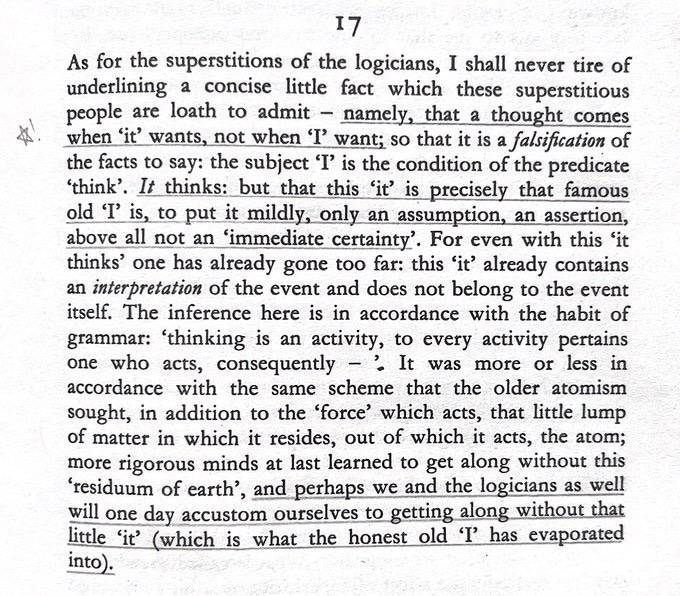
“You” don’t create your values, you do. Nobody just “decides” to be a Communist because of how large their elbows are; they do it because the philosophy aligns with the body1 — personality, cognition, and physique.
His fixation on Christianity is... regrettable. He was right to ignore logical/historical arguments regarding the truth of the religion and attack it on other grounds, but the amount of effort he spent on the issue far surpassed how relevant it was. The Antichrist in particular is a boring book.
His critics
The biggest knocks against Nietzsche: autistic obsession with Christianity and bad communicator. Both are forgivable — either due to the circumstances of his birth, untimely death, or consequences of his personal style.
Otherwise, the critics are flat. They can all be cleanly boxed into three groups:
The metanarrativist: Nietzsche’s philosophy undermines their metanarrative (Christianity, Judeochristian morality, Marxism, Nationalism…), so they do not like him. The most boring and predictable critics.
The contextualist: people who dislike Nietzsche’s philosophy because of his followers or Nietzsche himself.
The bull: somebody who made an honest attempt to read Nietzsche’s philosophy, and either didn’t understand it because they took it literally, or are unintelligent.
Often, the metanarrativists try to justify their criticisms of Nietzsche by addressing him, his following, or his philosophy. Because they have ulterior aims, said criticisms end up being either boring or sloppy.
None of Nietzsche’s critics are worth reading for their own sake2. They are engaged in a tug-of-war with a ghost; They hate him for what he threatens, not who he is.
Onto the specific criticisms:
Nietzsche was a nihilist
Nietzsche was a scholar of nihilism, which he rightly understood as the defining aspect of modernity. In popular discourse, there are two caricatures of Nietzsche: one of them was that he was a teenage nihilist3 who thought people should do whatever they feel like; the other is that he saw nihilism as a plague and sought to cure it.
The funny thing is that, when you read Nietzsche, it’s not even clear which caricature is the real face. Part of this is because he discusses nihilism the most in the Will to Power4, a book published of posthumous notes. Predictably, it’s an awfully written slog, with some gold in the garbage.
Nietzsche uses the word nihilism loosely — a historical force, a psychological state, and a philosophical concept. If we look at his published notes, he does not define it as a loss of meaning or values, but as the devaluation of the highest values: justice, morality, logic, and rationality.
2 (Spring-Fall 1887)’
What does nihilism mean? That the highest values devaluate themselves. The aim is lacking; “why?” finds no answer.
The catch: defining it as a philosophical concept also opens it up to other definitons. The latent influence of the philosophical state of the world is ‘nihilism as a historical force; its influence on the human brain is ‘nihilism as a psychological state’. As such, I think Nietzsche’s liberal use of the term is justified, but I can’t help but feel like the term ‘nihilism’ does not mean anything anymore.
The Will to Power analyses nihilism descriptively. I believe Nietzsche’s dichotomy between active and passive nihilism was an attempt to cross between the descriptive to prescriptive. Essentially, active nihilism is what happens when somebody grows so strong that their older, higher values no longer fit with them. Passive nihilism is what happens when you are weak, can’t believe in your own values, and give in to comfort.
Nihilism. It is ambiguous:
A. Nihilism as a sign of increased power of the spirit: as active nihilism.
B. Nihilism as decline and recession of the power of the spirit: as passive nihilism.
23 {Spring-Fall 1887)
Nihilism as a normal condition.
It can be a sign of strength: the spirit may have grown so strong that previous goals (“convictions,” articles of faith) have “ become incommensurate (for a faith generally expresses the constraint of conditions of existence, submission to the authority of circumstances under which one flourishes, grows, gains power). Or a sign of the lack of strength to posit for oneself, productively, a goal, a why, a faith. It reaches its maximum of relative strength as a violent force of destruction—as active nihilism.
Its opposite: the weary nihilism that no longer attacks; its most famous form, Buddhism5; a passive nihilism, a sign of weakness. The strength of the spirit may be worn out, exhausted, so that previous goals and values have become incommensurate and no longer are believed; so that the synthesis of values and goals (on which every strong culture rests) dissolves and the individual values war against each other: disintegration— and whatever refreshes, heals, calms, numbs emerges into the foreground in various disguises, religious or moral, or political, or aesthetic, etc
My personal reading is that neither caricature — the teenage narcissist nihlist and nihilism disrespecter — are the real faces. Nietzsche saw nihilism as a state to be confronted, not something to embrace or fight. Moreover, if you read the Will to Power, it seems he admitted to being a nihilist in the past:
25 (Spring-Fall 1887)
On the genesis of the nihilist.--It is only late that one musters the courage for what one really knows.’. That I have hitherto been a thorough-going nihilist, I have admitted to myself only recently: the energy and radicalism with which I advanced as a nihilist deceived me about this basic fact. When one moves toward a goal it seems impossible that “goal-lessness as such” is the principle of our faith.
Nietzsche the person
I haven’t dived deeply into his biography. He had a neurological disorder, likely CADASIL, which gave him frequent headaches, bouts of fatigue, and worsening vision. He became incontinent in 1889. This limited his movement for some periods of time; in others he would go hike dozens of kilometers a day in spite of his illness.
Cognitively, obviously brilliant. In school, he got above average, but not excellent marks. By the time he was a young adult, he was an excellent philologist and was appointed as professor at the age of 24 at the University of Basel without a doctorate. In his lucidity, I’d guess he had an IQ of 130-160.
His mental state, before his insanity, is up for debate. It’s clear that his health problems and personal relationships caused a lot of strain on him. However, if you read his philosophy, he’s clearly not an unhappy or deranged person. He believed that a person’s philosophy was downstream of their body, affirming life and joy. His tone in writing is typically either critical, elated, or plain — not one of somebody miserable.
Physically, he was tall for his time (173cm6) and decent looking7.
Socially, he was considered polite, graceful, but a little awkward. It’s likely he died a virgin, and several women rejected his proposals for marriage. His personal relationships, like with the Wagners, or with his family members, were rather tumultuous. Sometimes due to his own behaviour.
There are lots of myths about Nietzsche: breaking down and hugging a horse, meeting the king of Brazil, catching syphilis in a brothel, his philosophy drove him mad, and of having no friends. Even the story of Lou Salome rejecting Nietzsche’s proposal for marriage is in question, though I think it is likely that happened.
An acceptable life, all things considered.
Which is why, when people attack Nietzsche, they either resort to false accusations or try to argue that his life was not in line with his personal philosophy. That he promoted strength, but was a weak man. An incel who supported eugenics. Generally an uninteresting avenue of debate, especially when one considers that Nietzsche himself would have supported reading his philosophy as an autobiography.
His followers
Many philosophers have been remembered and discussed. Few have active followings.
Nietzsche’s is massive: forums, youtube, social media, the public, and academia. On every side of the political isle, be they Marxists, Rationalists, Fascists, or Liberals.
It’s easy to say that the philosopher and his followers are different, but in practical social life, people often encounter the philosopher through their followers. Philosophy is can be an affiliative activity.
I personally find this criticism boring, I will concede that it is not a bad reason to avoid him. I suspect part of the reason why I have haven’t read French and analytic philosophers is their fans — pretentious and conceited in the case of the French; sterile in the case of the analytics.
Moreover:
He doesn’t advocate for anything
This is… mostly true. A feature, not a bug. Questions over answers.
Nietzsche is fundamentally a negative philosopher. He is trying to break things: egalitarian morality, weakness, Christianity, other philosophers, and metanarratives. He showed us what nihilism was, and told us to look at it. His positive vision is individualistic, that people need to create their own values and paths in life.
This also segues into the earlier point. Many try to twist Nietzsche’s philosophy to accommodate their own ends; Nietzsche never told people to become warlords, lazy Europeans, Marxists, or high school jocks. It’s forgivable to ignore him based on his followers, but ultimately unsound.
Also, a comment on this from polytropos (the anime/history/philosophy guy):
38
It is imperative to always be on guard against dogma, against theoretical frameworks, against anything that promises an easily achieved intellectual rest. Many weak intellects have fallen under the spell of thinkers like Spengler and Evola, who promise simple and schematic answers to the exceptionally difficult problems of history and mythology, owing to this temptation. Nietzsche took the greatest pains in his late period to avoid encouraging dogmatic thinking in his readers. It is not without reason that the doctrine of eternal return, the core of his thought, is presented only twice in his published works. Nietzsche is the prophet of our age, he was the first to recognize and describe nihilism, he furthermore did so with genius, and for that reason he is the greatest educator we have. But I would advise caution in approaching Thus Spoke Zarathustra and his unpublished notes. An unbelievable amount of garbage has already been written about these works, the time is not yet right for them to be understood in their full significance. Heidegger, although his lectures on these works and Nietzsche are far and away better than any other commentary, did Nietzsche a great disservice in approaching his thought from a principally metaphysical standpoint.
Nietzsche was a Fascist
Regarding his political beliefs, I suspect that the polemic against him — that he was a sexist, eugenicist, and racist elitist — is more true than is commonly believed. If you take what he says literally, that is what you have to conclude. I have to say, that even if that were all true, I would not care. The idea that he was a leftist is even more indefensible; he only selectively criticised the right — Christians, nationalists, traditionalists, and anti-semites — the factions he did not like.
He worships power
If that was true, he would worship the crowd, the most powerful thing in the universe.
Regarding the Will to Power, it’s one of Nietzsche’s more undeveloped ideas. It’s also not what people imagine it to be — Nietzsche conceived of the will to power as a latent metaphysical force behind life. It was an idea formed in response to the Darwinists and Schopenhauer (will to live vs will to power), who thought that the purpose of life was longevity/reproduction. Nietzsche thought that was a teleology; the fact that organisms that reproduce tend to remain in the ecology does not imply that reproduction is the “goal” of life. Modern evolutionary scientists will clarify this issue of teleology in words, but often they buy back into the Darwinian frame anyway.
He encourages evil/cruelty/meanness
Not really. He himself was a polite person.
I suppose that, if somebody thought that they felt elated when they were being cruel, that he wouldn’t object to it on moral grounds.
Enabling, maybe. Encouraging, no.
Nietzsche isn’t cool
Rarely an explicit argument, but definitely there. “Teenage edgelord”, “all vibes”, “gateway drug”, “a stage to go beyond”, “old news”, “undergrad”, “nazi”, etc.
Also false. Nietzsche had the most aura of any philosopher ever.
The moustache. The mythology. The style. All real.
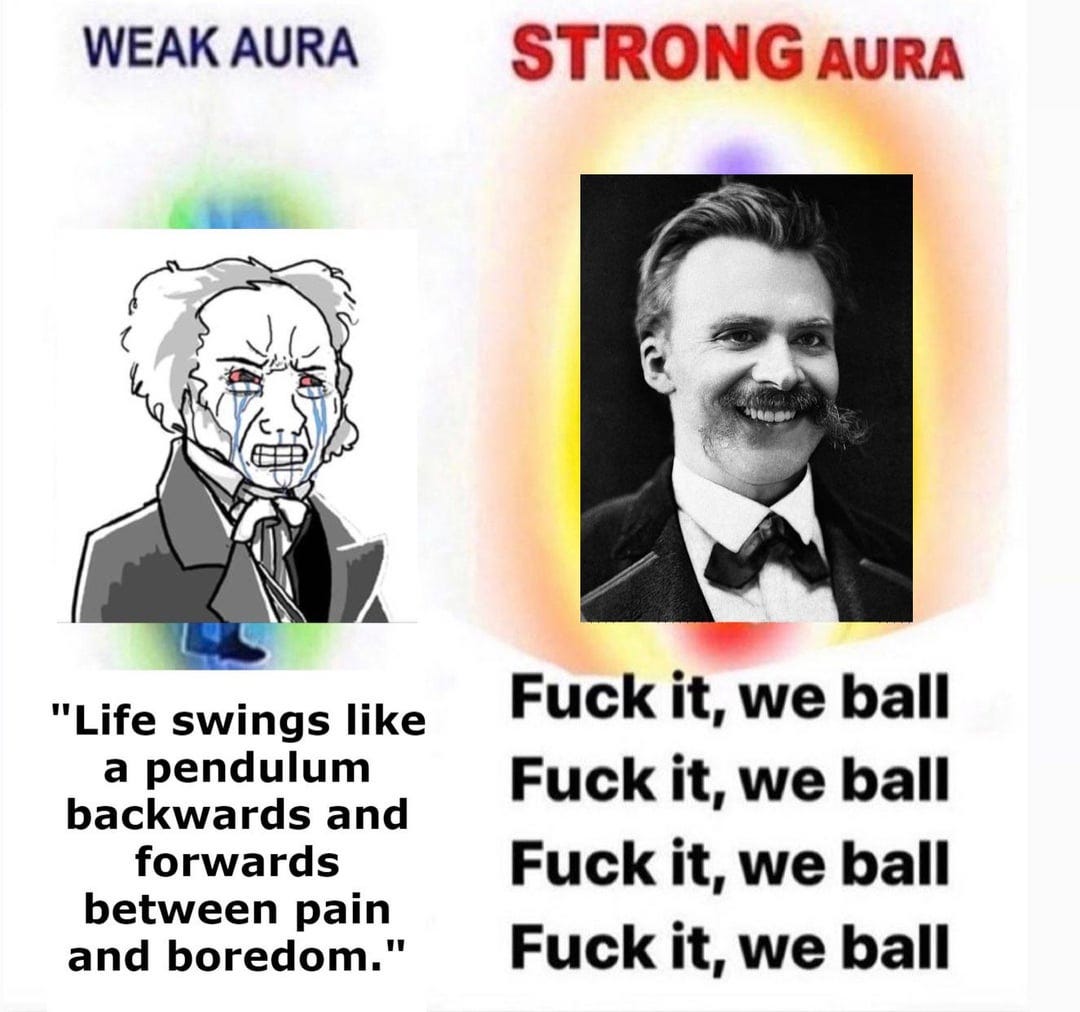
In fact, he has so much aura that all of his terminology — overman, resentiment, God is dead, slave morality, will to power — is all memes now. People are always ready to suss out who the “real Nietzscheans” are and who is just pretending or grifting. Nobody would bother doing that, or bother pretending to be Nietzschean if he was just a loser.
Nietzsche has already been socially metabolised
Often not made as a real, descriptive claim, but worth refuting in its own right.
To some extent, Nietzsche’s ideas have already been absorbed. The ‘God is dead’, last man, focus on nihilism, and psychology of resentment are all common online.
That said, it’s hard to look at a world so moralistic, resentful, religious, dogmatic, focused on “identity”, and say — “hey guys, Nietzsche has already been dissected, nothing to see here”. Only the most digestible and prescient aspects of his philosophy have been eaten; everything else remains ripe.
Nietzsche’s philosophy is unsystematic, but it’s not random. A lot of his lesser known concepts — amor fati, eternal recurrence, identity, determinism — do relate to his broader ideas. The popular Nietzsche is a gun with no target. Even people pliable to Nietzsche believe in a half baked version of what he wrote about.
His denial of absolute truth is self-refuting
In a way, yes. Radical skepticism swallows itself.
Nietzsche’s denial of objective knowledge looks performative and stupid if you believe in objective knowledge; obvious if you do not. Both of these perspectives of Nietzsche’s perspectivism are wrong.
Perspectivism is very hard to sell. Making logical arguments for it looks silly, and just asserting it is empty. Nietzsche tried to make the case for it — by exposing the logical absurdity of a privileged perspective, noting the limitation of language, doubting whether to doubt everything, and questioning whether truth can exist for truth’s sake —and I think he did it well. If anything, he didn’t go far enough. Many “perspectivists” do not take their perspectivism seriously.
There’s also the misunderstanding that, because Nietzsche was a perspectivist (he was), that he thought all perspectives were equally valid. He didn’t think there was something cosmic that elevated some perspectives over others, he thought they differentiated themselves through other means: whether they denied or affirmed life, for example.
If you believe in “regular philosophy” — stable identity, logic, moral realism, causality, free will — then what Nietzsche speaks of sounds bizarre. People with those views often cannot imagine what it feels like to hold those views, so they dismiss them.
Genealogy of morality = genetic fallacy?
The idea behind this argument is that Nietzsche traces the development of slave morality to historical and psychological conditions that occurred in the Ancient Jewish population, that developed into Christianity. He then criticises said morality based on how it emerged. On a logical level, this is to some extent true, but Nietzsche’s historical work on morality is still interesting in and of itself.
Genealogy is far from Nietzsche’s only objection to traditional morality. He thinks that pity multiplies suffering unnecessarily, that free will doesn’t actually exist, and that people want to believe in it because it pokes holes in the idea of moral responsibility.
The Eternal Recurrence
Critics of Nietzsche’s object level philosophy do not understand this because they take it literally. Nietzsche formulated the eternal recurrence — the idea of living infinite identical lives — as a thought experiment. He thought that if you embraced the idea of living infinite identical lives, you affirmed life.
Further reading
The man himself. I recommend Beyond Good and Evil, the Genealogy of Morality, Twilight of the Idols, and his Wikipedia page — it’s decent. The Will to Power was good but poorly written and extremely uneven. The Antichrist was just boring.
Nietzsche is often criticised for saying that, if all philosophy is downstream of the body, then people would have to conclude the same of him. Presumably, he would agree. He doesn’t believe in a “view from nowhere”.
I’ve heard Heidegger’s writings on Nietzsche are good, but can’t vouch for them myself. He’s not a critic of Nietzsche as much as he is an interpreter of him.
When someone says ‘nothing matters’ because everything is relative, they’re secretly assuming that only universal, absolute values can matter. That’s an absolutist mindset, not a relativist one.
The Will to Power is Nietzsche’s writing. People massively overrate how much Elizabeth edited and arranged his notes, to ward off the claims that he enabled Nazism or Fascism.
Nietzsche’s understanding of Buddhism was limited and filtered through Schopenhauer and other European scholars. I think some of his criticisms are appropriate — that Buddhism optimises for clarity over greatness; others are incomplete.
Average male height in Germany at this time was about 165cm. Nietzsche’s height would put him one standard deviation above the mean, around the 84th percentile.
Not only were people shorter in the past, they were less attractive. By our standards, Nietzsche was mid, but in his time he was probably above average.
Nietzsche's unique style is commendable, but I think he's only the most high-aura philosopher due to recency bias. In Ancient Greece Pythagoras had so much aura that he was basically turned into a demigod... Today, though, this deification has obscured our view of the true Pythagoras, so we only really remember him as "the triangle guy"
One of the issues with Nietzsche is that American academics purposely distorted his philosophy in the post-WW2.