

Hoe math (HM) has promoted what he calls “levels theory” which theorizes that humans reach and access levels of metacognitive development at different rates.
The theory is explained in this chart and video:
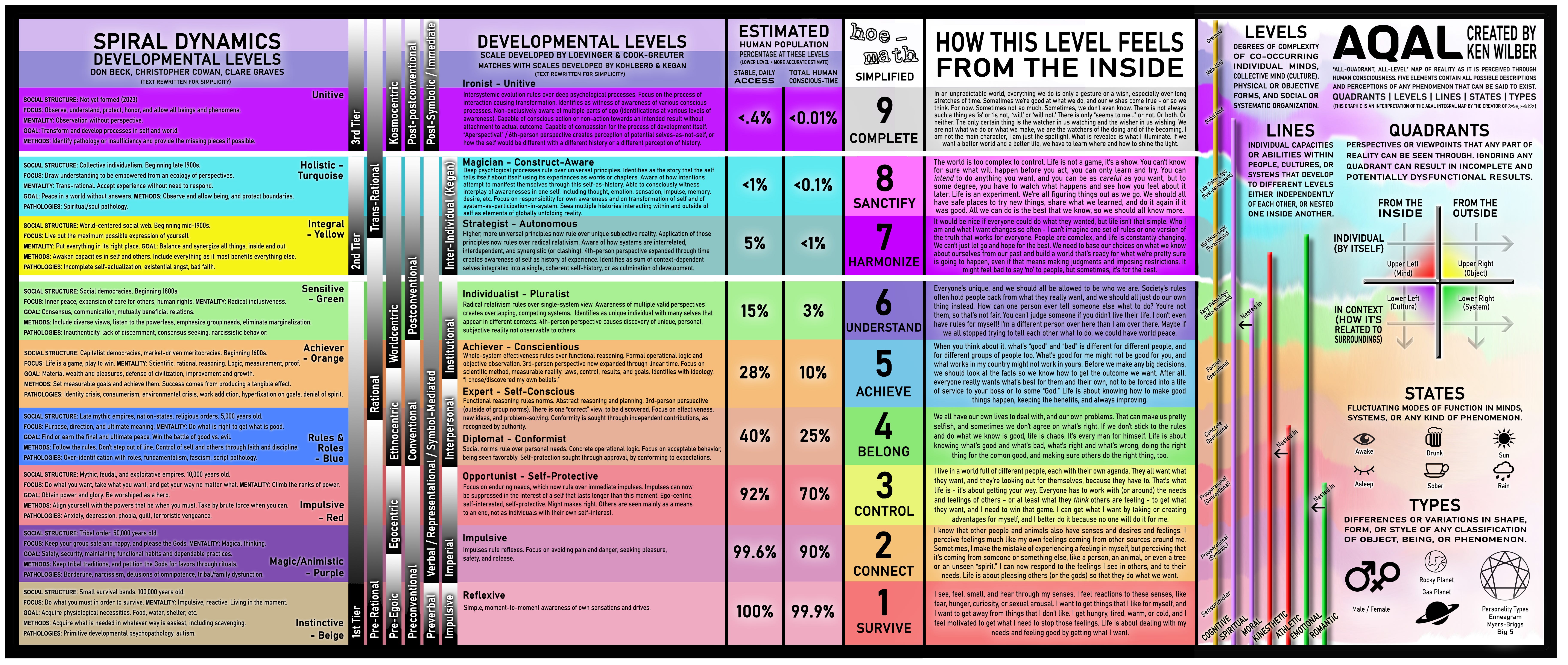
This was originally inspired by two theories: spiral dynamics and integral theory; the former was accused of being a cult and the latter was accused of being pseudoscientific1. All of this stuff is very long and inaccessible, so I will summarize the levels shortly. All of them have a number (e.g. 3), colour (e.g. yellow), and description (e.g. control).
Reflexive layer: recognition of base drives like appetite, arousal and sensations. Reached by almost all humans with ease. Vibe: sleep, eat, repeat.
Connective layer: recognition that other individuals have the same drives that you do, and act to satisfy them. Vibe: empathy, spirituality.
Control layer: realising that situations can be manipulated so that your gains are met and their gains are lost. Enduring needs can be prioritized over temporary ones. Vibe: machiavellianism.
Rule layer: recognizing that a society where everybody explicitly and unashamedly maximizes for their individual gain can’t work. Rules + morality are invented. Vibe: choose the right, be included.
Achievement layer: recognising that what is considered good and bad varies by time/place; what is considered true and false is as well. Pivot towards using reason to understand the world using a consistent set of principles and methods to uncover what is true and false. Vibe: the enlightenment, science, democracy.
Pluralist layer: recognition that people’s conclusions about morality and the universe vary from person to person, even when using reason. Skepticism of science, absolute truth, and morality. Identifies as multiple selves that emerge depending on the context. Vibe: hippies, postmodernists.
(Note: levels 7 to 9 are iffy) Harmonization layer: recognising that relativism does not lead to radical inclusionism and that different individuals and groups have different values that are not compatible with each other. Accepts that the map is not the territory and that there is no privileged observer.
Sanctification layer: the individual identifies as a non-dual experience, that is to say, they shed the belief in the ego and observer altogether and perceive their conscious activity as being various interconnected parts rather than a whole. “The map is not the territory” becomes just another model.
Unitive layer: results in intersystemic growth overriding psychological processes, and people now identify with what is monitoring their conscious activity. Ability to act towards a goal without being attached to the outcome.
People access different levels at different times, but people have a maximum level which they cannot think past until they are able to elevate their perspective. Development in different areas (e.g. athletics, morality, self-perception) can happen independently, so somebody who has an advanced understanding of morality might be poor at empathising.
HM tried to roughly estimate the percentage of people who have stable access to each level. He estimated that roughly 5% of people have access to level 7 — even if you restrict that to American adults, I think that is way too high and I doubt it would be even above 1%. If you exclude people who are not into either philosophy or psychology, I doubt that they would independently be able to develop past level 5, even if they were smart and functional. Even most philosophers seem to struggle to go beyond level 6.
An increase in metacognitive level corresponds to an increase in perspective. HM illustrates this with an example of a woman (at level 1) who is angry at a man because she saw something on the internet. The man (level 2) understands that she mad and is depressed by it. A different set of eyes (level 3) looks at what is happening, and wonders how they can exploit the interaction for their own gain, while another set of eyes (level 4) beyond that thinks of what rules could be made to deal with with the situation, and so on.

There are other similar metacognitive theories, such as Kegan stages:
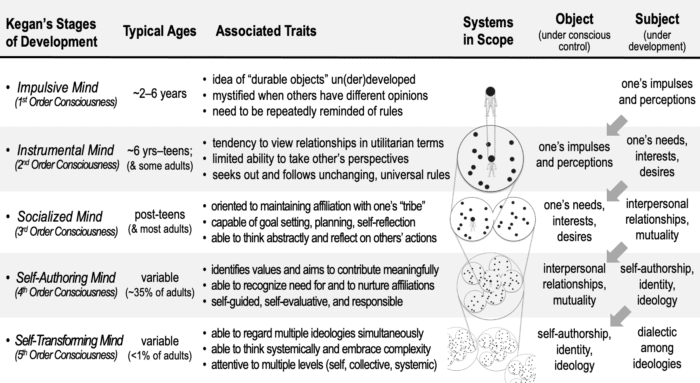
Kegan 1 translates to HM 1, Kegan 2 translates to HM 3, Kegan 3 translates to HM 4, Kegan 4 translates to HM 5, and Kegan 5 translates to HM 6+. Both of them are based on a similar underlying idea, that each advancement corresponds to an increase in perspective, though they are rendered in different manners.
In my opinion, HM’s levels 1-6 are legit and sound. Many of them have been named with other words: 5 is the enlightenment mindset and 6 is the postmodernist mindset. All of the levels above 7 are harder to describe because they are much les
In HM’s theory, development past level 6 has less to do with people’s relationship to society and more with the relationship they have with themselves. This is where the disagreements start: I don’t think that the style of self-perception corresponds that well to level development. “Style” in this case being the manner people relate to themselves, not the sophistication with which they do. Identifying with your beliefs, for example, is a style of level development that is common in people at level 5, but some people surely could be rationally convinced they are not what they think2, without having to ascend to level 6 (postmodernism).
I’m not really sure of how the levels should be organized after level 7, which just seems like a more deep understanding of postmodernism.
On a related note, I don’t like how the original Spiral Dynamics theory presents the upper levels. They seem carefully crafted to exploit people’s insecurity about their cognitive development. These are the descriptions of the higher levels in SD theory:
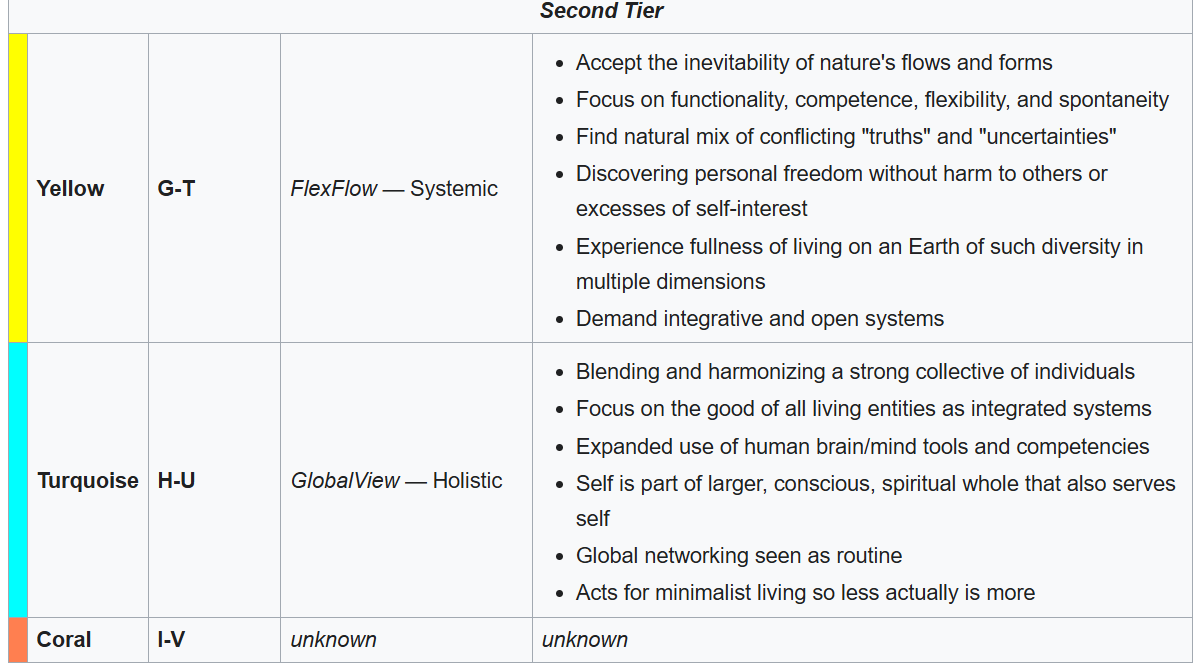
If one ranks a bunch of things from top to bottom on a list, people will naturally want to be at the top of it, especially if understanding the list itself is a function of being at a higher level. The descriptions of the upper levels are vague and generic, allowing people to easily identify with them. For example “find a natural mix of conflicting truths and uncertainties” is easy to identify with. “Focusing on functionality, competence, flexibility, and spontaneity” is a personality type, not an enhanced level of cognitive perspective.
Metacognition is not “scientific” theory by any means, but the idea itself is sensible, organisms need to be aware of their own goals before they are aware that other organisms have them; people need to understand how rationality works to understand why it doesn’t always work.
I would expect the correlation between g and level access to be about .5, with the strongest influences being age, informational environment, peers, and a tendency to introspect. Humans are mimetic creatures, and they will naturally adopt the highest level they see in their surroundings if they are ready for it. I don’t think level access would correlate that highly with success in life, which is determined more by action than reflection.
I don’t care about these accusations, though the existence of them is informative and context-appropriate.
This brings me back to a hazy memory of the Mormon church, which discourages being negatively judgemental. I remember a woman who was frustrated with herself because she kept having intrusive negative judgements about others appear that she had to rationalize away. She asked another woman whether “she” was the judgemental thoughts or the raitonalizations, and the other woman replied that the rationalizations were her, and the judgemental thoughts were something else (maybe the devil?). That one question haunted me for some time, as I had the same internal experience — only for Jordan Peterson to drag me out of Plato’s cave.
intersystemic growth overriding psychological processes, and people now identify with what is monitoring their conscious activity. Ability to act towards a goal without being attached to the outcome.
Im not even sure what this is supposed to mean. Just a form of mindfulness, identifying thoughts as they appear
“Not because it is the most advanced for of it, but because it is the final one”
Typo i think, for—>form