

Woodley and Kanazawa wrote a paper which found that children conceived by older parents were less attractive:
The effect of paternal age on offspring attractiveness has recently been investigated. Negative effects are predicted as paternal age is a strong proxy for the numbers of common de novo mutations found in the genomes of offspring. As an indicator of underlying genetic quality or fitness, offspring attractiveness should decrease as paternal age increases, evidencing the fitness-reducing effects of these mutations. Thus far results are mixed, with one study finding the predicted effect, and a second smaller study finding the opposite. Here the effect is investigated using two large and representative datasets (Add Health and NCDS), both of which contain data on physical attractiveness and paternal age. The effect is present in both datasets, even after controlling for maternal age at subject’s birth, age of offspring, sex, race, parental and offspring (in the case of Add Health) socio-economic characteristics, parental age at first marriage (in the case of Add Health) and birth order. The apparent robustness of the effect to different operationalizations of attractiveness suggests high generalizability, however the results must be interpreted with caution, as controls for parental levels of attractiveness were indirect only in the present study.
The p-values check out:
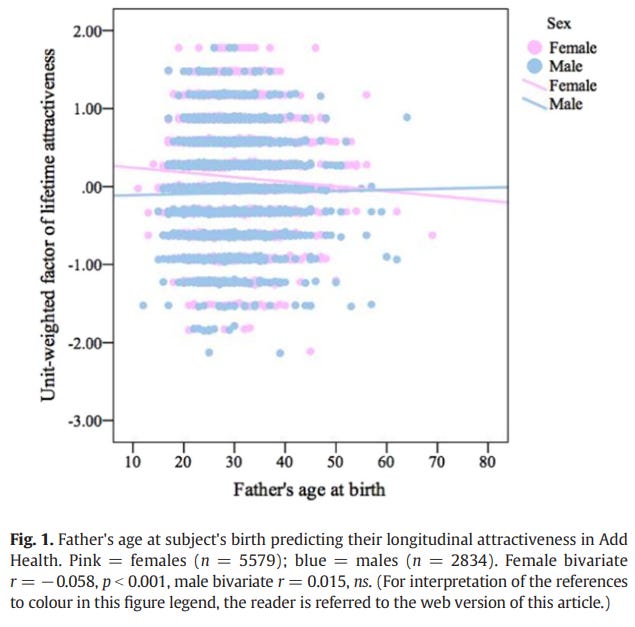
Intuitively, the idea makes sense: older parents will have more genetic mutations, which will cause them to be less attractive to their peers.
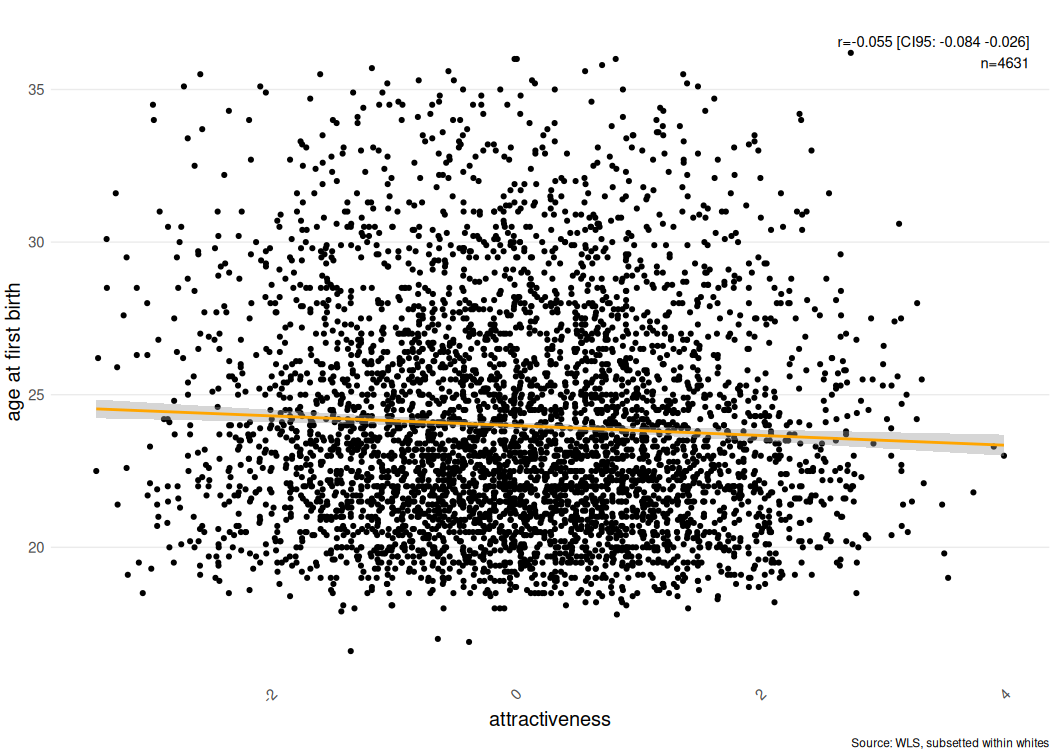
The problem is that this could be confounding: that attractive parents have children at earlier ages. It’s an issue the authors were aware of, and tried to control for indirectly.
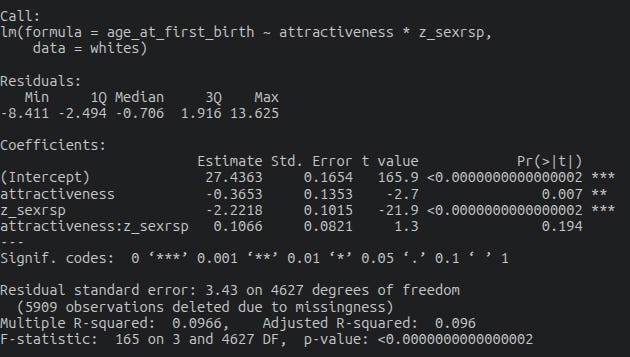
To test the extent to which confounding played a role, I checked the raw data of the Wisconsin Longitudinal Study, which had the yearbook photos of the participants rated by 12 different researchers on the basis of their physical attractiveness. It turns out that attractive people have kids at an earlier age. The magnitude of the correlation matches the one between parental age and child attractiveness, just in the opposite direction. And it’s not like the original correlation was strong to begin with.
It holds for both men and women:
The idea that older parents have more mutations, and that those genetic alterations have negative effects on the appearance of their children is not unreasonable. What is disputed is the extent to which that correlation is causally mediated.
There are many other ways you could have worded this title
this is exactly why I'm never having kids