

Mechanistically, the story seems pretty clear. Cerebral creatine deficiency is a documented cause of intellectual disability. Supplementing creatine increases the concentration of creatine in the brain (#1, #2). Some people, even without a monogenic disorder, may be deficient in creatine for physiological or dietary reasons.
Ignoring these people’s unique circumstances would be a little mean, wouldn’t it?
From our premises, we can conclude that supplementing creatine almost certainly improves cognitive performance at the population level.
The better question is in who, and by what magnitude.
The skepticism toward creatine supplementation is warranted — the studies on it are often of low quality, we don’t know what the dose-response effect of brain creatine is on IQ, and we don’t know which people would improve by supplementing it, but it’s gone a little out of hand. Not knowing isn’t the same as knowing a not.
As far as I can tell, creatine is innocent until proven guilty. Even if I knew it didn’t improve IQ, I would still take it because of its effect on athletic performance. So, personally, I’m not interested in tearing the literature apart or running my own studies on it; though I would encourage other people to do the dirty work.
III.
There might be publication bias in the literature too, according to a correspondence between gwern and a scientific researcher:
The common publication bias checks like the funnel plot are useless with 3 studies. As it happens, there is no need to do any hypothesis-testing here: Ling (personal communication 2013) mentions that 2 student theses were done involving creatine supplementation & cognition with apparently uninteresting results, but did not have any copies and the university library had not retained any; this is prima facie publication bias. Hence, we know that the meta-analytic results are biased upwards by publication bias.
The base case in meta-analyses seems to be that the observed effect is about a third of the size when it is replicated in a follow-up study. Even meta-analytic correction methods overestimate the effect.
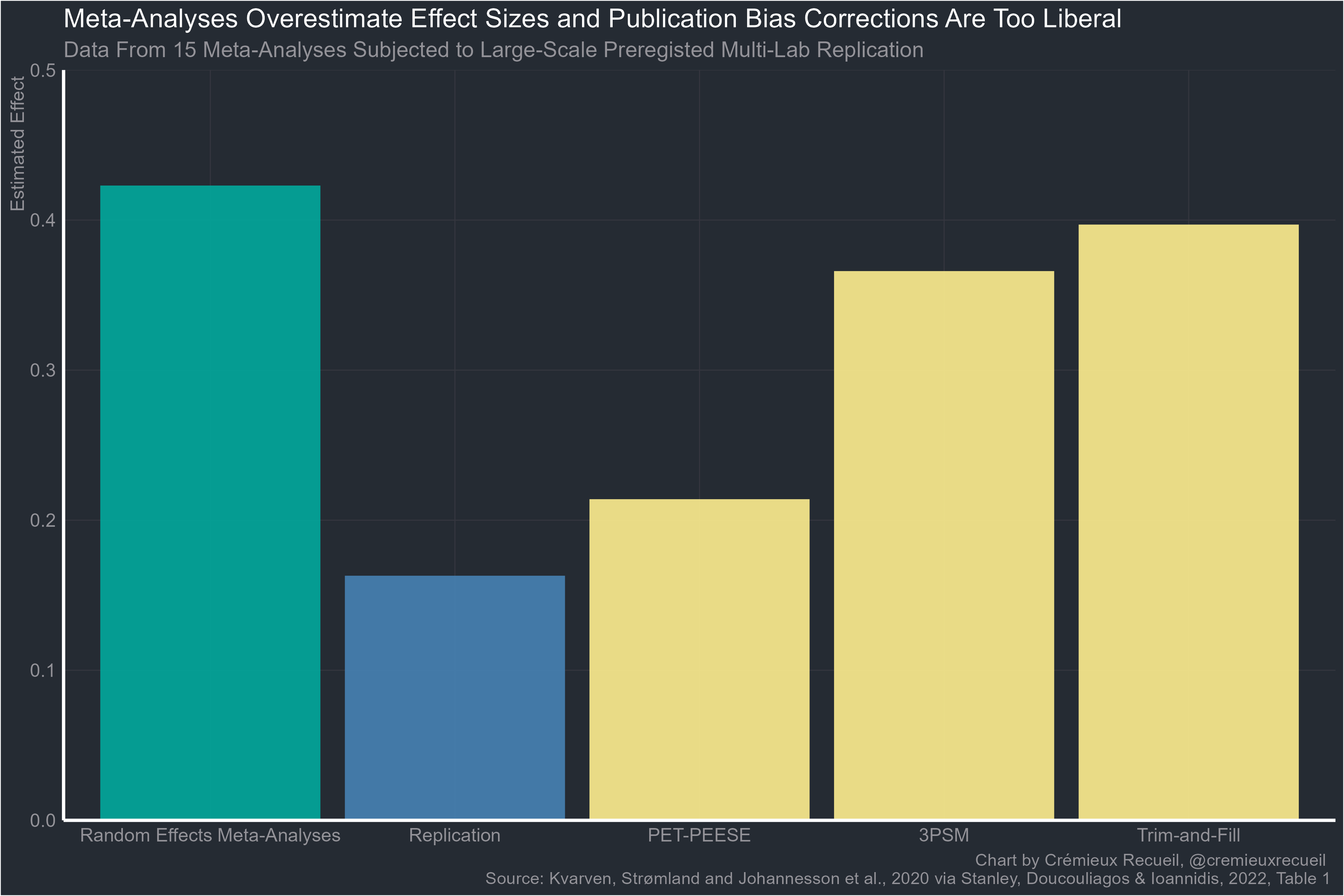
I think it’s fair to give creatine the same treatment. This is the latest meta-analysis:
Sixteen RCTs involving 492 participants aged 20.8–76.4 years, including healthy individuals and patients with specific diseases, were selected. Creatine monohydrate was the form used in all included studies. Creatine supplementation showed significant positive effects on memory (SMD = 0.31, 95% CI: 0.18–0.44, Hedges’s g = 0.3003, 95% CI: 0.1778–0.4228) and attention time (SMD = −0.31, 95% CI: −0.58 to −0.03, Hedges’s g = −0.3004, 95% CI: −0.5719 to −0.0289), as well as significantly improving processing speed time (SMD = −0.51, 95% CI: −1.01 to −0.01, Hedges’s g = −0.4916, 95% CI: −0.7852 to −0.1980). However, no significant improvements were found on overall cognitive function or executive function. Subgroup analyses revealed that creatine supplementation was more beneficial in individuals with diseases, those aged 18–60 years, and females. No significant differences were found between short- (<4 weeks) and long-term (≥4 weeks) interventions for improving cognitive function. Low-to-moderate risk of bias was found, and no significant publication bias was detected. The GRADE assessment indicates that the certainty of evidence for memory function is moderate, suggesting a reasonable level of confidence in the positive effects of creatine on memory. However, the evidence for processing speed, overall cognitive function, executive function, and attention is of low certainty, indicating that further research is needed to confirm these potential benefits.
They found no effect on overall cognitive performance… which could easily be a power failure. Just look at that confidence interval:

They didn’t find any publication bias using the egger’s test; again, based on the gwern correspondence, it sounds like it definitely exist. They just couldn’t prove it.
If we average out the effects on their outcome variables: general ability, executive function, trail making test, attention, stroop test, memory, processing speed, and reaction time (meaningfully different from processing speed) — we get (0.51+0.01+0.31+0.31+0.21+0.03+0.32+0.34)/8 = 0.26. Divided by 3, we get 0.086. That sounds fair to me.
V.
Oh: that big “more is better for creatine” study? Written by the guy serving on the scientific advisory board for AlzChem, which manufactures creatine. I generally find arguments based on social/fincancial ties tedious, but I find this specific case a little suspicious.