

In social games, people must agree to make choices under uncertainty.
In constraint games, what constitutes a good or bad choice is determined by the world — physics, the market, a compiler, or a scoreboard.
In coordination games, what constitutes a good or bad choice is determined by people themselves — peer review, courts, editors, managers, and voters.
Here is a map1 of which games are which:
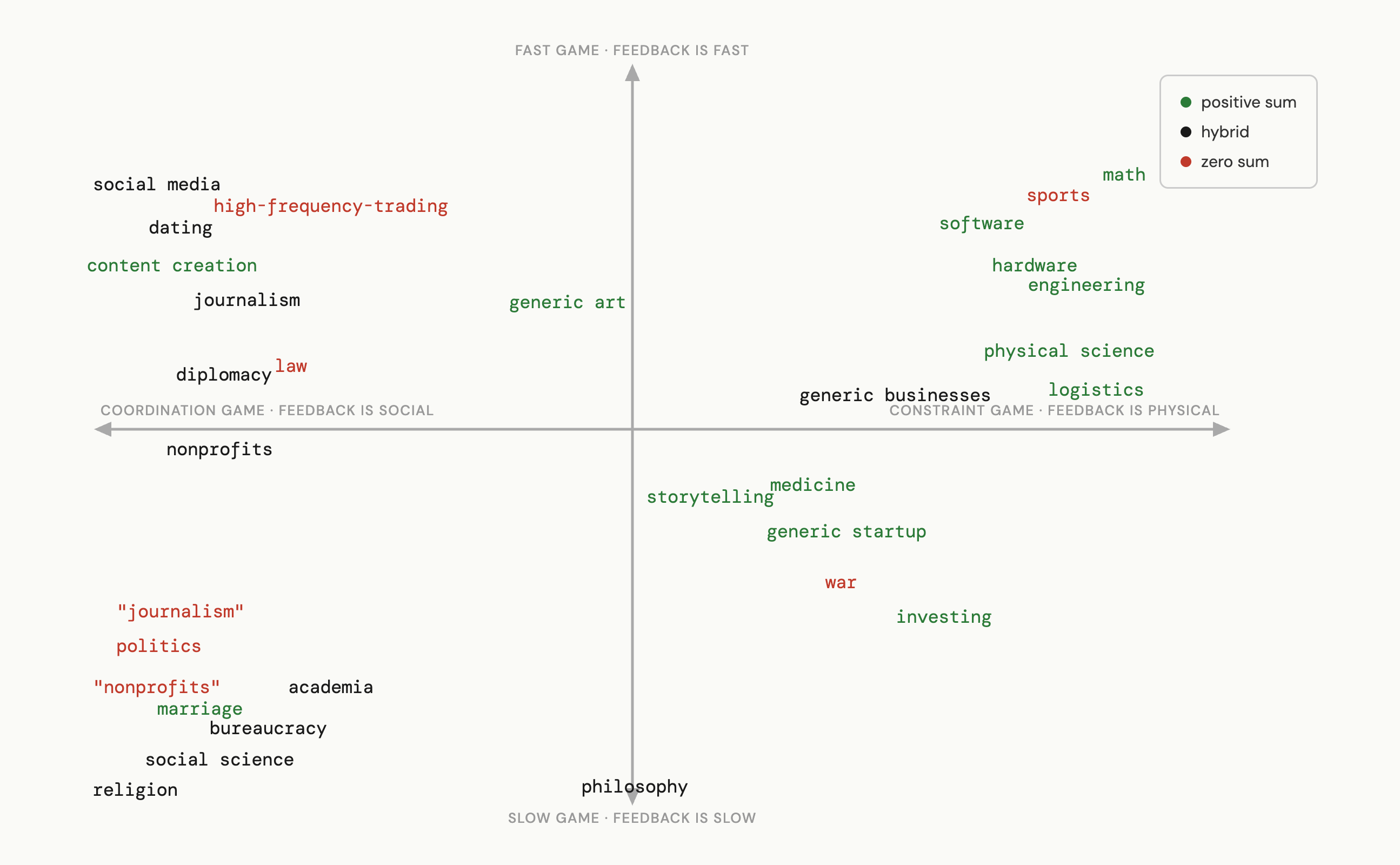
The further up and right you get, the more reliable experts in the game are; the further down and left, the less reliable. People in top-right games are paid for being right, and punished for being wrong. People in other quadrants are either inconsistently paid, or other people pay.
The most universal law of human cognition is that people can believe anything — if they are socially incentivised to, and don’t have any skin in the game. This is true in religion, ethics, ideology, and conspiracy theories. Intelligence and maturity are nonfactors, especially if people are examined across time and space. Because of that, coordination games often run off the rails because there is no reliable corrective mechanism that can nudge people towards truer beliefs.
Constraint games run on power — not the ugly kind, but what people normally call leverage: the ability to create things like computers, toilet paper, or concrete. Coordination games run on social status — also not the ugly kind, but what people believe to be aligned, reliable, and powerful. Coordination games, because they do not have corrective mechanisms, are more likely to degenerate into covert rank-jockeying and cargo cults.
So, let me get the elephant in the room out of the way. Constraint games are better.
Why play coordination games, then? Mostly because we have to, and because they feel more natural to us — they involve love, belonging, intensity, rank and status sensitivity, shame, and identity. It’s a lot more common for people to go into STEM because they think that it’s pragmatic, but lack innate and persistent passion.
No game is purely a function of coordination or constraint. Coordination games also have scoreboards — they just work too slowly or unreliably, so people cannot default to them to make decisions. The effect of a party endorsing a policy might not be seen until the next election, and even then, the results of the election could be skewed by individual leaders or the state of the economy.
More notes on these games:
Markets makes feedback more physical and speeds it up. This is why storytelling and generic art are shifted rightward.
Goodharting in physical and fast-feedback domains gets punished quickly.
Engineers pretend to be cool. Priests pretend to have usable dashboards.
If there is no scoreboard, status is the scoreboard.
Intelligence is more rewarded in constraint domains; personality traits and tolerance of ambiguity are more rewarded in coordination domains.
I’d guess that extraverts, feelers, and perceivers (in MBTI terminology) are likely to select into coordination games than constraint games.
The underlying incentives of a game and the kind of people who select into it might be totally different.
Medicine is less STEMy than people think it is. There’s a coordination layer to the game where the doctors act as something close to priests who reassure people that they are being taken care of. The standard surgery + antibiotics + drugs stuff works, but overall the field is quite social and delayed in terms of feedback. See the Elephant in the Brain for further information.
Philosophy is weird. There’s no scoreboard, but it’s not consensus-driven either.
Zoomers are sorting out of coordination game majors (e.g. humanities, politics, and religion) and into constraint game majors (e.g. STEM, finance). They do play coordination games, but they almost exclusively play them online with little expectation of value.

Thank you to Substack Enjoyer for making it
Thanks for the three-dimensional chart of professions, businesses and other pursuits such as philosophy and religion.
I work in electronics and C++ computer programming.
With rare exception hardware engineering is very good, because it is impossible to fake success. The extraordinary utility, complexity and sophistication of the entire electronics industry is breathtaking. Likewise the robustness, performance and safety of the commercial airline industry. Commercial airliners are designed and manufactured to cope with extreme stresses and some degree of subsystem failure, when properly guided by pilots selected according to skills, rather than DEI tick-boxes. See this crosswind landing by an Airbus A380, the largest aircraft ever produced except for the single Ukrainian Antonov 255: https://x.com/planesanity/status/1982582751149875331. Also this Boeing 777 with its brakes glowing orange hot after an engine failure prompted an aborted takeoff at ~330km/h: https://youtu.be/ZjDO_tv7SME?si=-AvyxAJeeZLqm5Ry&t=77.
The marketing of hardware can work on very different principles to the engineering of the device. So the creation of dense FLASH memory devices, with over 100 layers of transistor circuitry, belongs at the top right of the chart, with their long-term reliability probably well assured by theoretical projections and high-temperature testing. Most of the marketing is honest and positive-sum, but for years there has been a commercially successful, fraudulent and so destructive, sales strategy, including on eBay, who don't seem to care about it, of FLASH memory devices of a given capacity, such as 2 GB, being programmed to appear as if they had much higher capacity, and being sold for a fraction of the cost of a legitimate device with that higher capacity.
Medicine is not one thing. Some aspects of medicine rival the heights of commercial aircraft engineering in how difficult they are to achieve, and how beneficial they are. Yet whole swathes of medicine and related research are moribund due to corrupted, groupthunk ineptitude.
Groupthink resulting in wrong conclusions and harmful behavior is an instance of large number of people, including the majority of all members of a profession, worldwide, using their intelligence, judgement and influence over other people to ignore, or to passively remain ignorant of, information which would correct their mistaken thinking. A common form of this is that at in individual and profession-wide level it is more important, at least in the short term, to be seen to be right rather than to be right.
For instance, most doctors, immunologists, virologists, epidemiologists and public health officials still do not know that the immune system can only function properly with at least 50 ng/mL (125 nmol/L = 1 part in 20,000,000 by mass) circulating 25-hydroxyvitamin D. They think that 20 ng/mL is enough for full health, but that is only what the kidneys need to perform their part in the regulation of calcium-phosphate-bone metabolism: https://vitamindstopscovid.info/00-evi/.
Due to corrupt influence of drug and vaccine manufacturers, and their own direct interest in performing revenue-generating services, most doctors are much more interested in drug, surgical, monoclonal antibody, chemotherapy and vaccine interventions than reducing the risk of disease through proper vitamin D3 supplementation to attain at least 50 ng/mL circulating 25-hydroxyvitamin D all year round.
Hundreds of thousands of virologists, vaccinologists and dementia researchers are highly intelligent, well trained, well paid and socially lauded for their work, but they take no interest in vitamin D3 nutrition, when it is the single most important population-scale intervention which would diminish the impact of the illnesses society pays them to tackle, without the need for further research. (Neurodegeneration: https://vitamindstopscovid.info/00-evi/#3.3.)
Worse still, for fear of losing their high social status and public funding for all their work, the majority of virologists still deny that a handful of their American and Chinese colleagues deliberately created a virus for the (crazy) purpose of immunising wild bats, all over the world, with a spray-on live, transmissible, genetically engineered virus, against harbouring the evolution of coronaviruses which might infect humans (DEFUSE: https://jimhaslam.substack.com/) and that this gain-of-function research resulted the SARS-CoV-2 virus which caused the COVID-19 pandemic.
These activities of highly intelligent people, including in the disastrous vaccinocentric handling of the pandemic, killed tens of millions of people - and the full recognition of these failures is still being covered up by highly intelligent people in the mainstream media and government (with the important exception of United States Republican representatives and senators).
Although medicine and related research is dealing with more complex and messy things than the atmosphere, takeoffs and landings, and although some aspects of medicine are correctly based and beneficial to a near miraculous degree, the ignorance and corruption continues, year-after-year, harming and killing millions of people, because the participants, and many members of the public, are so fixated on their current, mistaken beliefs, and fail to enquire into the importance of nutrition or the real effectiveness and safety of vaccines and mRNA and adenovirus vector gene therapy injections which are falsely marketed as vaccines.
It would be difficult to to represent these divergences of hypothesis testing technique and the resulting deadly, instead of life-supporting, outcomes in the broad field of medicine in a diagram, but they are crucially important and point the way to improvements.
Every day I marvel at what humanity can achieve, such as this Intel CPU chip with 28 cores, which was designed ten years ago: https://www.flickr.com/photos/130561288@N04/50129523578/in/album-72157715091371561/ (now available on eBay for USD$600) and how many aspects of medicine, politics and cosmology are so corrupted or otherwise misdirected as to result in destructive or at least completely mistaken (Big Bang Theory) outcomes when they are supposed to result in truthful understanding and beneficial or at least enlightening outcomes.
A key distinction is the time delays inherent in the feedback cycles which guide the beliefs and work. With electronics, one can test the results within minutes or day, or a few months in the case of complex integrated circuits. Cosmology permits no experiments, so it is completely different from engineering or medicine. Thank again for the diagram. I don't recall any other analysis which highlights these feedback loop time delays.
Hi Sebastian, if you don’t mind my asking, what was your discipline of formal education?