

A brilliant and frustrating book.
Chater’s thesis is that the mind is flat — superficial, simple, and unpropositional.
We think we have unconscious beliefs, personality traits, or desires that inform our thoughts and actions. The author argues those things do not exist, and that our actions and thoughts are made up based on what we have experienced before. That we believe what we do because we chose to believe it at some point in the past.
In his own words:
We have all been victims of a hoax, perpetrated on us by our own brains. Our brains are spectacular engines of improvisation that can, in the moment, generate a colour, an object, a memory, a belief or a preference, spin a story, or reel off a justification. And it is such a compelling storyteller that we are fooled into thinking that it is not inventing our thoughts ‘in the moment’ at all, but fishing them from some deep inner sea of pre-formed colours, objects, memories, beliefs or preferences, of which our conscious thoughts are merely the shimmering surface. But our mental depths are a confabulation – a fiction created in the moment by our own brain. There are no pre-formed beliefs, desires, preferences, attitudes, even memories, hidden in the deep recesses of the mind; indeed, the mind has no deep recesses in which anything can hide. The mind is flat: the surface is all there is.
What he is really arguing in the book is something more complex: that the propositionality of the mind is specific to what is conscious. Everything else is a mish-mash of neural networks that do not adhere to strict logic, and change from moment to moment.
Specifically, propositional statements like “I hate my father” and “I am allergic to apples” may arise in the brain’s conscious experience, but not correspond to the brain’s structure. There is no set of neurons that encode axioms like “I hate my father”. What ultimately decides how you react to your father is dependent on the neurons and environment, not the conscious belief.
Beyond the rhetoric, Chater does make some genuine mistakes after he lays out his premises.
Chater believes all perception is inference. That is to say, perception constructs an interpretation of reality based on sensory inputs — it’s not the inputs themselves. He loves mental illusions, and likes using them to demonstrate this.
My favourite examples are impossible shapes: things which your mind can perceive, but are not logically possible according to the rules of this universe:
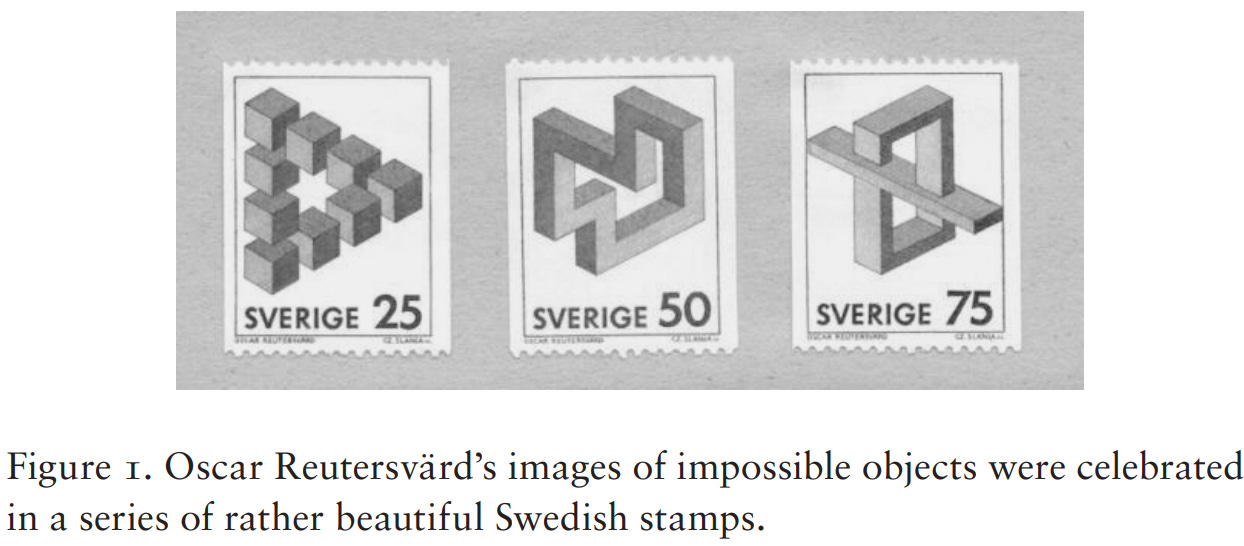
Here, we aren’t just seeing a bunch of black and white dots on a paper. It feels like we are actively constructing an interpretation of the image — a shape that feels coherent, even if it is not.
Another optical illusion that helps show perception is inference: the Bs are easier to see in the second image because the grey bars fill in the conceptual blank for us. Despite the fact the amount of optical information we receive is equivalent in both images.
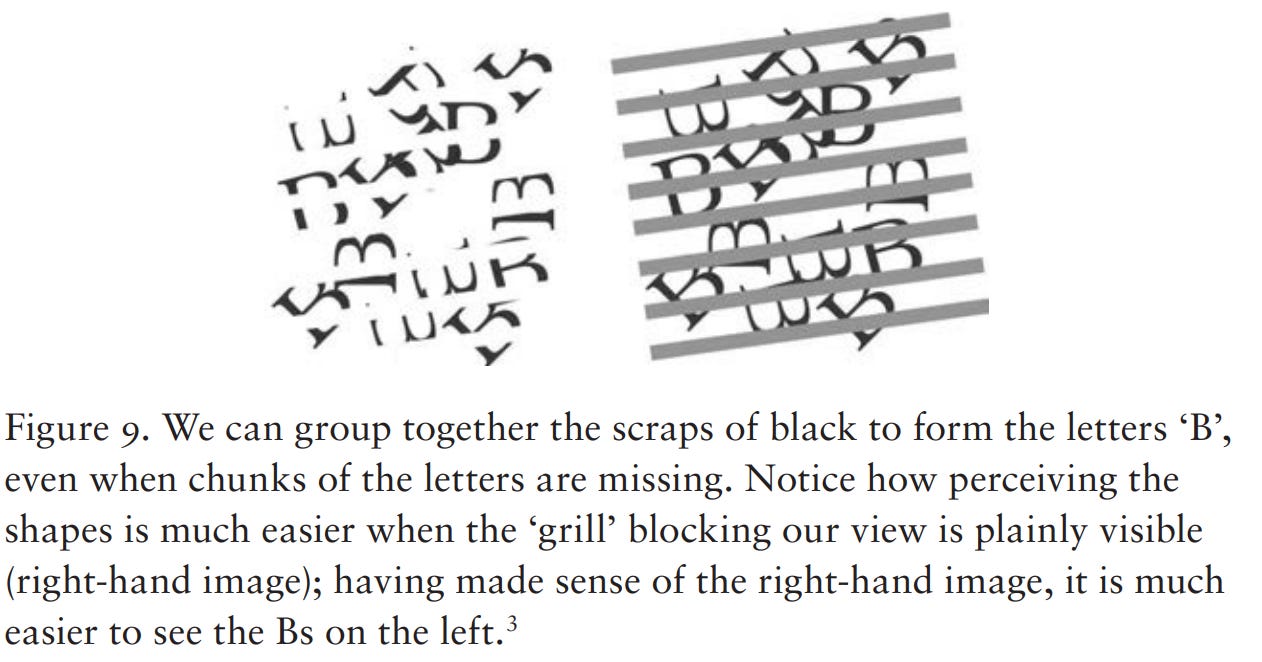
Where this relates to his thesis, is that what you experience is not raw data: but an interpreted and processed version of it. Conscious perception is the output of the mental process — not the inputs or the process itself.
Chater then leads these illusions to another point — that perception can only focus on one object at a time. We think that we can perceive a whole image at a time, but only a clear subsection of it is seen at a time:
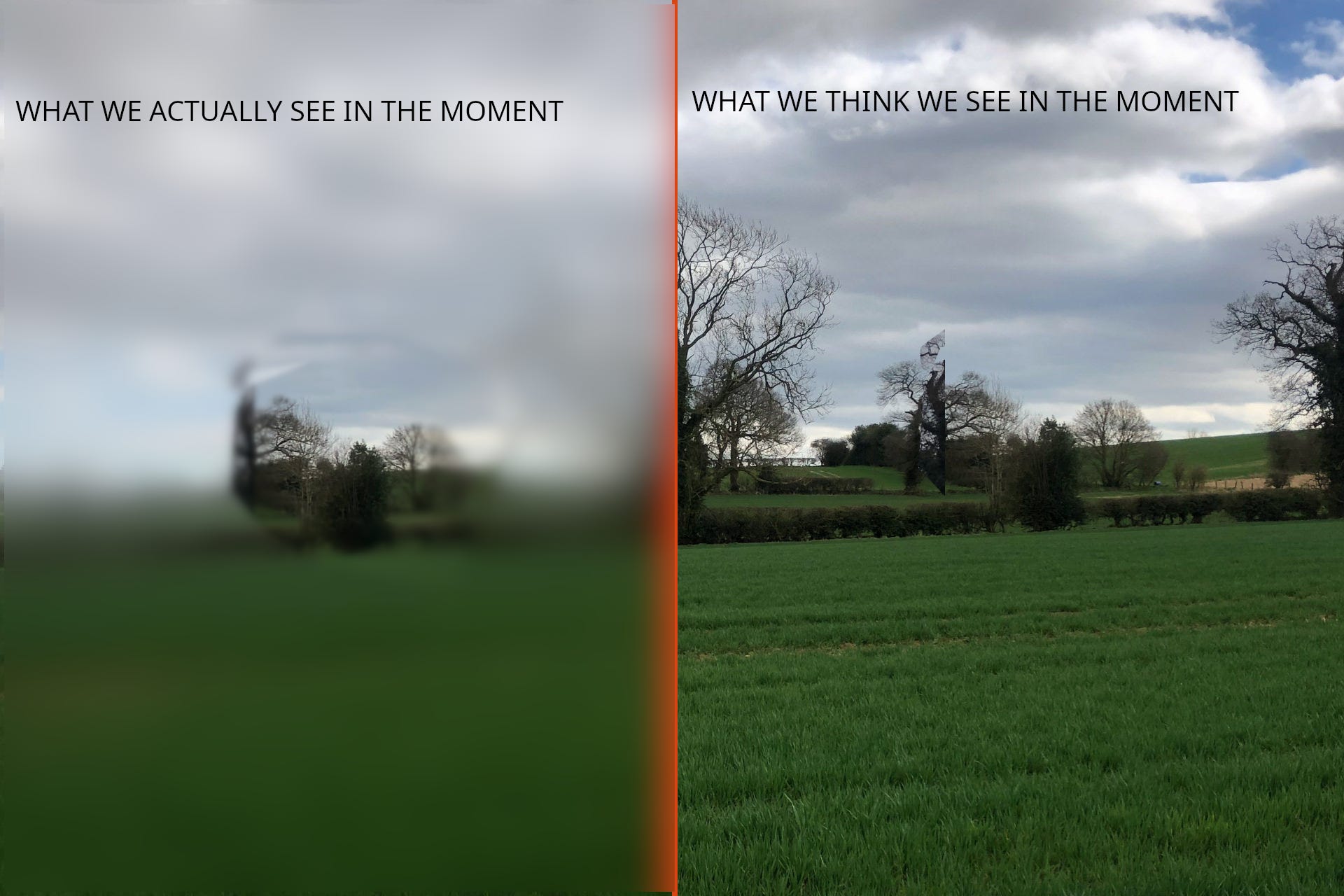
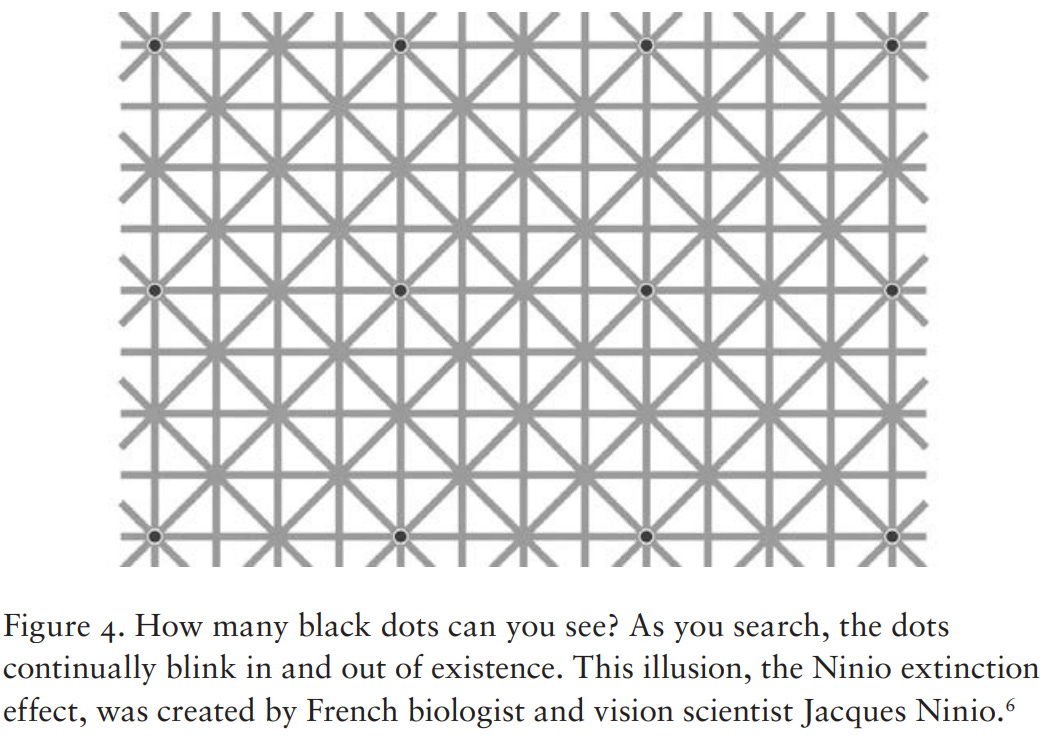
This can be experienced more directly in the following optical illusion. Darting one’s eyes throughout the grid causes the black dots to appear and disappear dpeending on where focus is placed:
This has been tested more rigorously with studies using computer vision. This involves a camera which tracks where people’s eyes are focusing at a given point. Some researchers then tried testing the limits of human vision by having a text that was written entirely in gibberish except for the fragment of the text the eyes were gazing at.
This is done by having the displayed text change depending on where the computer predicted the subject was looking — this is achievable with fast refresh rates and low latency. According to Chater, their study found that people don’t notice anything is amiss as long as the distance between the center of focus and the right side of the text window is 12-15 characters.
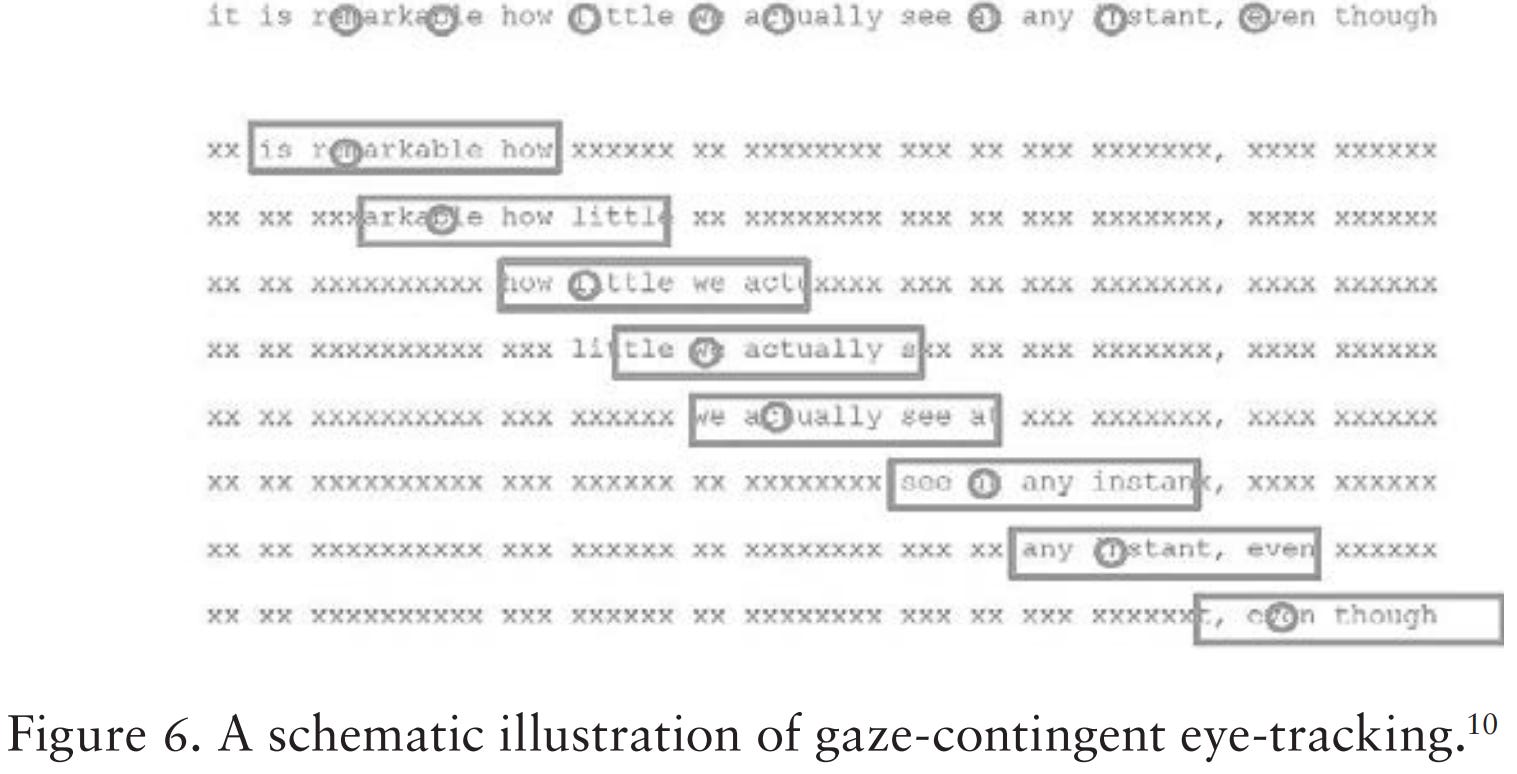
Big if true. I checked his source, and Chater is taking the study’s conclusions too far here. The authors were wrong too, to be fair. For reference, this is the abstract:
A computer-based eye-movement controlled display system was developed for the study of perceptual processes in reading. A study was conducted to identify the region from which skilled readers pick up various types of visual information during a fixation while reading. This study involved making display changes, based on eye position, in the text pattern as the subject was in the act of reading from it, and then examining the effects these changes produced on eye behavior. The results indicated that the subjects acquired word-length pattern information at least 12 to 15 character positions to the right of the fixation point. and that this information primarily influenced saccade lengths. Specific letter- and word-shape information were acquired no further than 10 character positions to the right of the fixation point.
Early psychologists noted that people could pick out words in their peripheral vision 2-3 lines above or below where they fixated their gaze. This study was trying to evaluate how wide vision was in an experimental environment where people are actively reading.
It did this by testing whether the participants — six high school boys — were really using their peripheral vision using computer vision. They used six different types of dummy text depending on their content and spacing, and also manipulated the window lengths from 13 to 100 characters.
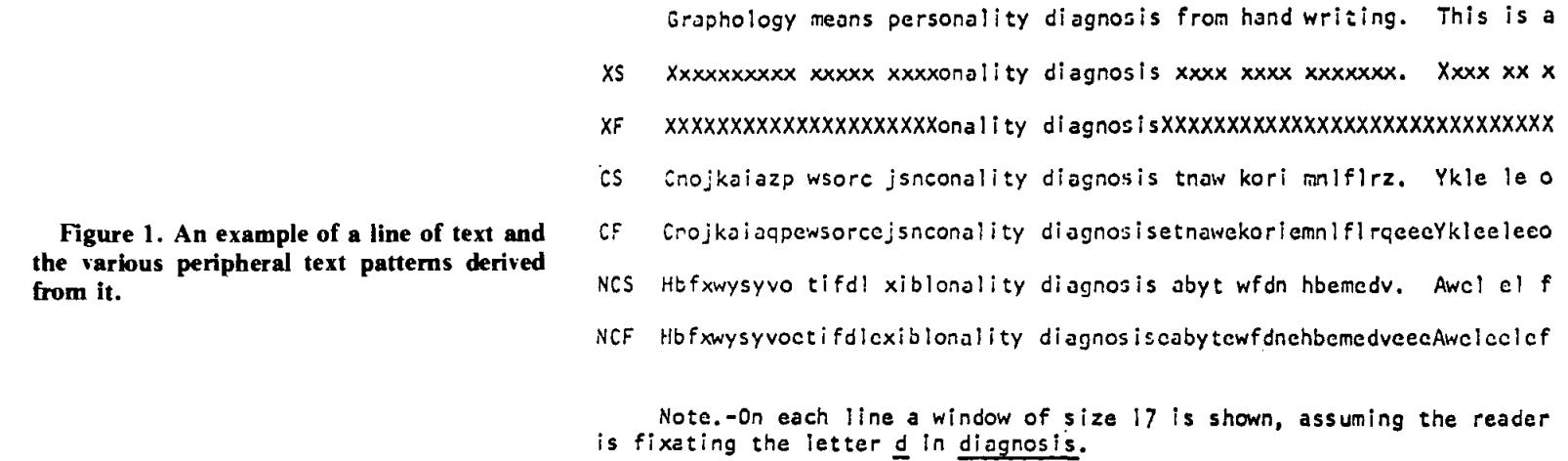
They then assessed how easily they read based on what the computers inferred from their vision: how long they looked at characters, and how far their eyes jumped from character to character to continue reading. Empirically, there was no statistically significant difference in objective reading skill past a window span of 25 — which is where Chater got the figure ‘12-15 characters’ (25/2 = 12.5 =~ 12-15).
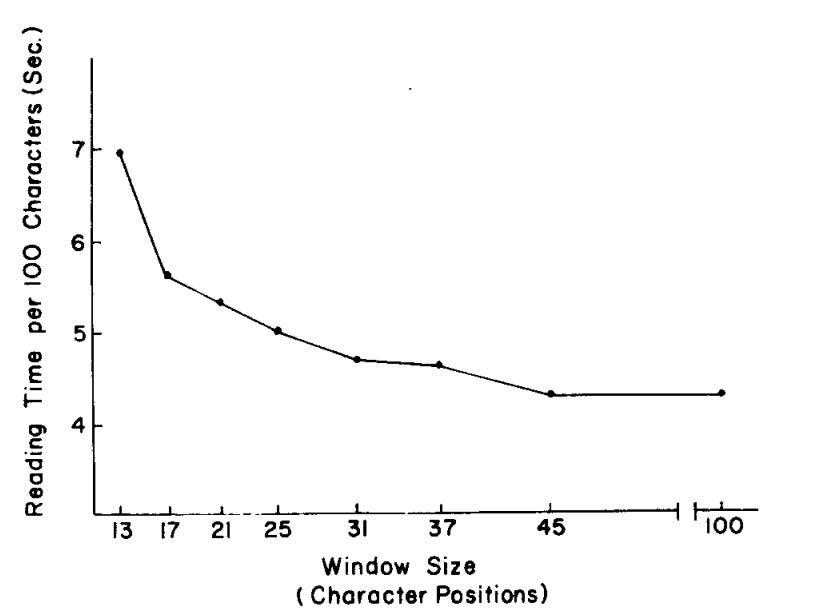
The obvious problem here is the lack of power: they had six participants. If one charts the relationship between window size and the length of people’s eye movements, one can infer at what point people stop using their peripheral vision to read. Visually, to me, it seems possible that there is a window size effect until 40 characters (remember to divide by 2).
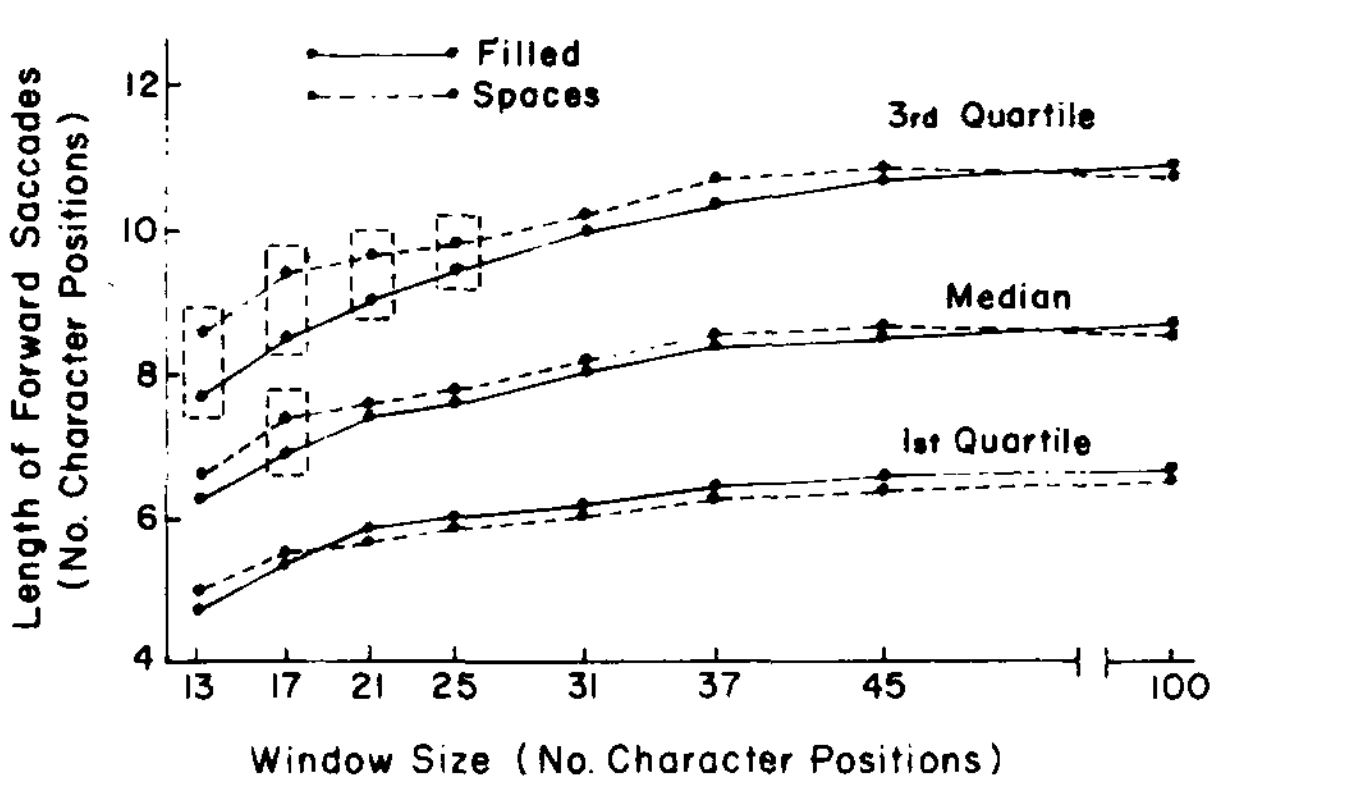
Given there is intraindividual variability in visual span, it’s likely the average is lower, but the maximum is higher.
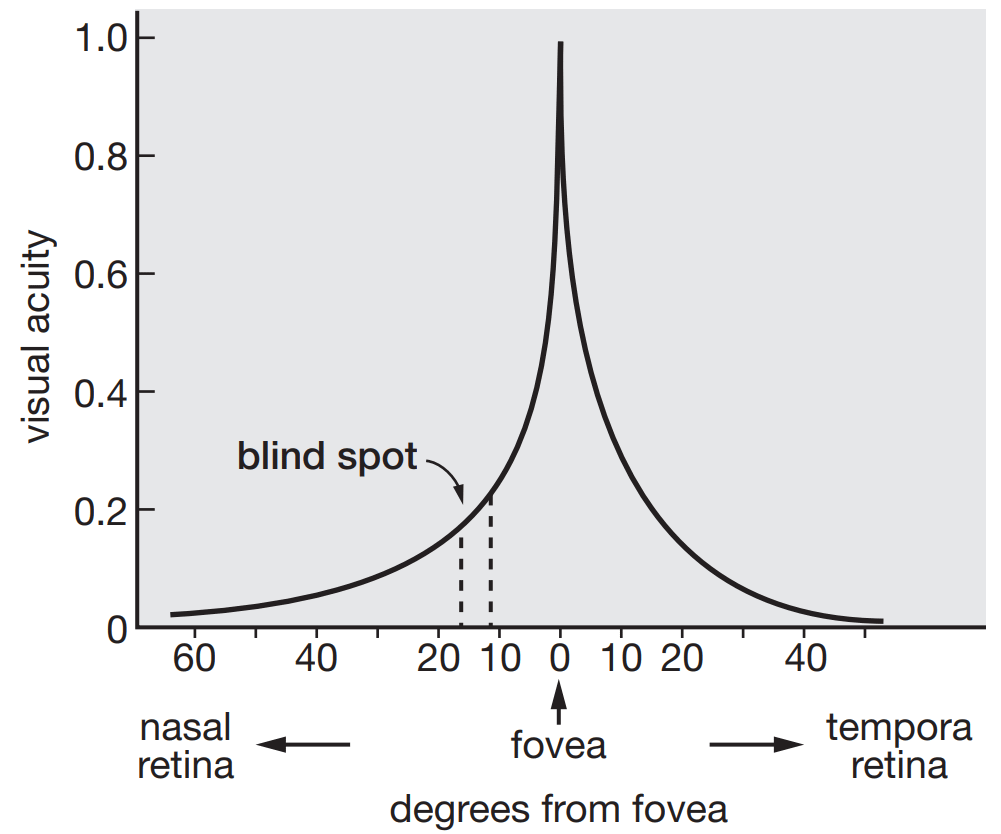
The same logic can be applied to how long it simply took them to read — we still get the same number: 40 characters. That correponds to 10 degrees of human vision on both sides, according to page 3 of the study. And that’s the amount of vision people use to read, not necessarily what people use to see. Though that does seem to be the case, coincidentally.
Looking back at the book, 10 degrees seems to be around where human vision starts turning into garbage; right before the pupil’s blind spot.
Chater then brings us to a different theory: the brain transforms inputs into outputs; we only see the outputs, not the inputs or the process involved. Our perception is not the raw data, but an interpolation and interpretation of it based on our cognition. Thoughts and physiological reactions can be observed, but what caused those things to occur cannot.
He makes some first-principles arguments for this being the case. If our brain is a network of billions of neurons, and we are only conscious of one thing at a time, then it must be unconscious of everything else. To him, what looks like multitasking — chewing gum and walking at the same time — is the brain carrying out automatic processes that do not require cognitive resources.
If we are conscious of one thing at a time, and the brain is a network of 100 billion neurons communicating by streams of electrochemical pulses, we must necessarily be unconscious of almost everything our brain does. This should not surprise us. As we have seen, we are only ever conscious of the results of our brain’s attempts to make sense of the world – or rather, to make sense of some small part of it. Yet these results arise from a hugely complex cooperative computation, the cycle of thought, involving a substantial fraction of those 100 billion neurons and drawing on vast amounts of information from our senses and our memories.
That does not mean the brain is oblivious to everything it is not attending to. Through peripheral vision, the brain can detect unexpected motion and pay attention to them when appropriate. Keeping these processes maintained does not require the brain’s global attention; it helps direct it.
He also notes that multitasking is impossible at the cellular level because neural transmissions would become jangled and confused:
“But it is hard to see how a vast population of interconnected neurons can coordinate on more than one thing at a time, without suffering terrible confusion and interference. Each time a neuron fires, it sends an electrical pulse to all the other neurons it is linked to (typically up to 1,000). This is a good mechanism for helping neurons cooperate, as long as they are all working on different aspects of the same problem (e.g. building up different parts of a possible meaningful organization of a face, word, pattern or object). Then, by linking together, cross-checking, correcting and validating different parts of an organization (the parts of a face, the letters making up a word), it is possible gradually to build up a unified whole. But if interconnected neurons are working on entirely different problems, then the signals they pass between them will be hopelessly at crosspurposes – and neither task will be completed successfully: each neuron has no idea which of the signals it receives are relevant to the problem it is working on, and which are just irrelevant junk. So we have a general principle. If the brain solves problems through the cooperation computation of vast networks of individually sluggish neurons, then any specific network of neurons can work on just one solution to one problem at a time.”
Personally, I buy it. I’ve played thousands of hours of League of Legends, and people definitely cannot look at two things at a time — they can’t look at both the minimap and the lane.
The theory is literally false, in the sense that the brain can engage in multiple processes at a time, figuratively true in the sense that one process must dominate at all times.
Some of Chater’s thoughts on emotions are interesting. He thinks that emotional states are something that are inferred based on context, not felt. For example, our interpretations of what a man feels depends on what we see in his surroundings:
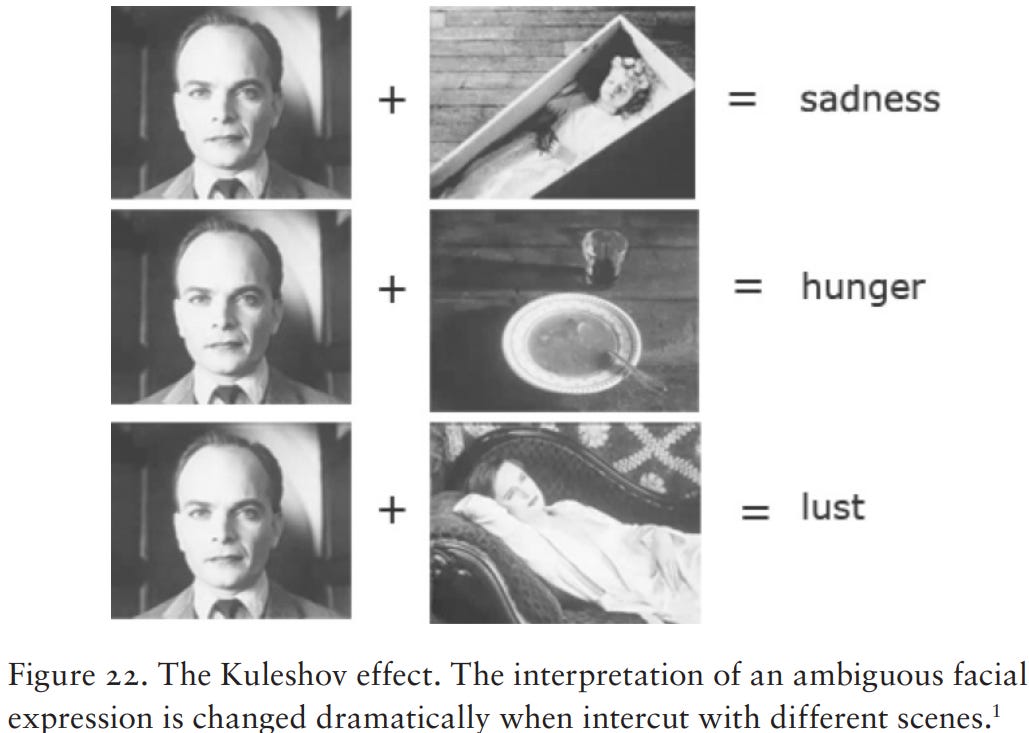
This politician looks angry alone, but elated with others:

The author1 extrapolates from there to argue that our own interpretations of our emotional states are confounded by the context. This is the most boring part of the book, so I’ll skip2 over it. In my opinion, emotions aren’t real in some strict sense, but that doesn’t have to do with the structure of the mind. The emotions are the map, physiology is the territory; the fact that emotions don’t exist is besides the point. They are descriptive labels.
Now we get to one of Chater’s biggest theories: the brain is always improvising.
My objection: if everything is improvising, then nothing is. Improvising, as a term, only makes sense when it can explain some human behaviour but not all of it.
Let’s say I want to kiss my older sister on the forehead. I drive over to her house and then do it. Chater will have you think that, because there isn’t a book in my brain commanding me to kiss her, that I improvised that action. That’s nonsensical. If she pulled a gun on me and told me to leave, I probably wouldn’t kiss her. Otherwise, it’s a pretty fixed event. Literally true, figuratively wrong.
Now, what if I just slid over to her house, had no pre-existing plan to kiss her on the forehead, and did it anyway. I’ll grant that is an improvisation, but when you strech the definition of that word to include literally everything you do, it loses its meaning. A theory of everything explains nothing. The word is used for rhetorical purposes in the book, to argue that humans are shallow.
If everything is improvising, then reading directly from a script must be too.
In a physical sense, it is impossible for the brain to be living anywhere but the moment. We only think it does not because we can remember the past, and weigh future outcomes as well as past experiences into our decisions.
The frame of improvising misleads us into thinking we are evanescent and can do anything, ignoring how much human phenotypes are stable and genetic: the 75% heritability of intelligence and personality traits, the consistency of our food preferences. Variety often hides consistency — one day I read the g-factor, then I read Metamorphosis, and then Fate/Stay Night. All different materials, but read.
Chater acknowledges the consistency of human behaviour, using the metaphor of water channels. Our thoughts are water, and they flow through the channels that already exist, and then the water flowing through the channels cuts through them:
Thoughts are like water droplets finding their way from high ground to the sea, following the channels in the landscape, whether gullies, streams or river valleys. And, in its passing, each droplet cut those channels just a little more deeply. The landscape, then, is partly a history of past water flow, as well as a guide for how water will flow in the future. In the same way, our mental life follows channels carved by our previous thoughts, and traces of our present thoughts and actions will shape how we think and act in the future.
Which is rather odd: this metaphor illustrates depth, not shallowness. It would be shallow if the landscape before the water arrived was flat, but it clearly is not. In this metaphor, it is genes that affect the distribution of the density of dirt across the mind’s landscape, the landscape’s shape, and the rate at which channels atrophy when no water runs through them.
Chater then builds on his theory that brains constantly improvise. More accurately, that humans are dispositional and cannot live anywhere but the present. But basically, he then concludes that explanations are unreliable, made up in the moment, and unreflective of mental depth.
I once read a philosopher argue that people had really shallow understandings of how the world around them worked. That they couldn’t even explain how a simple zipper did. Which is the most worthless thing I’ve seen written. You don’t need to know how zippers work, you just need to know that they close when you tug up, open when you tug down.
Chater appears to form part of this tradition.
“Whether explaining how a fridge works, how to steer a bicycle, or the origin of the tides, we have a feeling of understanding which seems wildly out of balance with the mangled and self-contradictory explanations we actually come up with.”
When we are asked for an explanation of something, the answer will necessarily be incomplete. If I am asked why I love my parents, I can say “many reasons” or “I don’t know”. These are true answers, but not meaningful ones. The inaccurate, abritrary nature of explanations is only a bug if you expect them to be something else.
The author cites Gazzaniga’s research3 to argue that human explanations are ad-hoc and nonsensical. This involved studying split-brain patients, who had the connections between their left and right brain severed as a treatment for epilepsy. This somehow didn’t have noticable effects on their cognition or lifestyle.
The left side of the brain controls and receives stimuli from the right side of the body, and vice versa. So my man Gazzaniga decided to see what happened when the left side of the brain was forced to explain the unexplainable: behaviour that originated from stimuli it received from the left side of the body — which is connected to the right side of the brain. It turns out that, when that happened, the split-brain participants would just make up the explanations for their unexplainable behaviour.
Consider a particularly striking study by one of the pioneers of split brain research, the psychologist and neuroscientist Michael Gazzaniga. He simultaneously showed a split-brain patient, P.S., different pictures on the left and right halves of the visual field.2 The left-hand picture was a snowy scene; the brain’s cross-over wiring pipes this information through to the visual cortex of the right hemisphere. The right-hand picture was a chicken’s foot, which is sent to the corresponding area in the left hemisphere. Like most of us, P.S.’s language-processing abilities are strongly concentrated in the left hemisphere; the right hemisphere, in isolation, has minimal linguistic abilities. P.S.’s left hemisphere was able to report what it could see – and fluently describe the chicken claw, but P.S. was unable to say anything about the snowy scene that the right hemisphere could see.
What this research is showing us is that the quality of our explanations deteriorates when we are forced to explain what we can’t. This doesn’t necessarily hold for anything besides that. My inuition is that the explanations we make for why we make large decisions influenced by multiple variables (e.g. relationship breakups, career changes) are incomplete. Otherwise, I think they can work. “Running an errand” is a good explanation for being in a car.
Chater builds from that faulty premise to argue that those arbitrary explanations we make up in the moment create our long-term preferences and behaviour. To make this claim, he cites what he calls “choice arbitrage studies”. These involve asking people to choose between two objects. Once they make their selection, they are intentionally presented with what they did not choose, and asked to explain why they chose it.
One example involves getting people to choose which woman they are more attracted to, and then are asked to explain why they prefer the other. In this experiment, many of the participants then began to explain why they made that choice, citing reasons like their hair colour, earrings, or face shape.
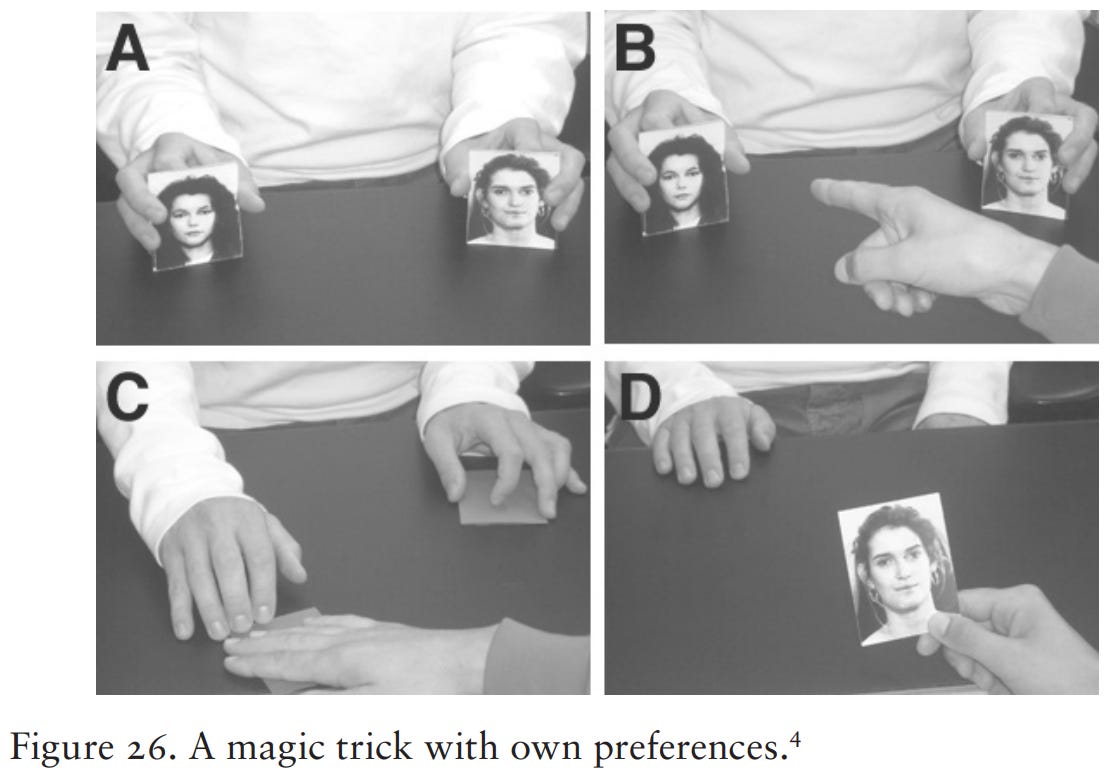
I have no reason to think the study did not happen as he describes it; where I differ is interpretation. In that image, the proctor is presenting two women who share a lot in common: race, hair colour, and apparent age. People would probably notice the trick if that was not the case, and they would be more likely to make a choice based on stronger preferences.
It also might be the case that the subject chose one at random, so they didn’t notice the trick. Or maybe they thought something was wrong when the proctor falsified their choice, but felt constrained by the structured environment, and had no incentive to introduce social friction by asking if the proctor was mistaken. Or maybe they felt something was wrong, but thought it was unlikely that the proctor would trick them or make a mistake.
Chater also presented a more interesting study to argue this was the case: they had Americans fill out a form about their political beliefs before the 2008 election. On half of the forms, there was an American flag in the corner. Those who had the flag on the form were more likely to agree with right wing political attitudes.
When they tracked the participants’ votes in the presidential election, they found that people who had the flag in the form were more likely to vote for the Republican party.
Chater then argues that is evidence of his hypothesis, that our in-the-moment choices are arbitrary and possible to manipulate. And that would be true… if that flag priming study actually replicated.
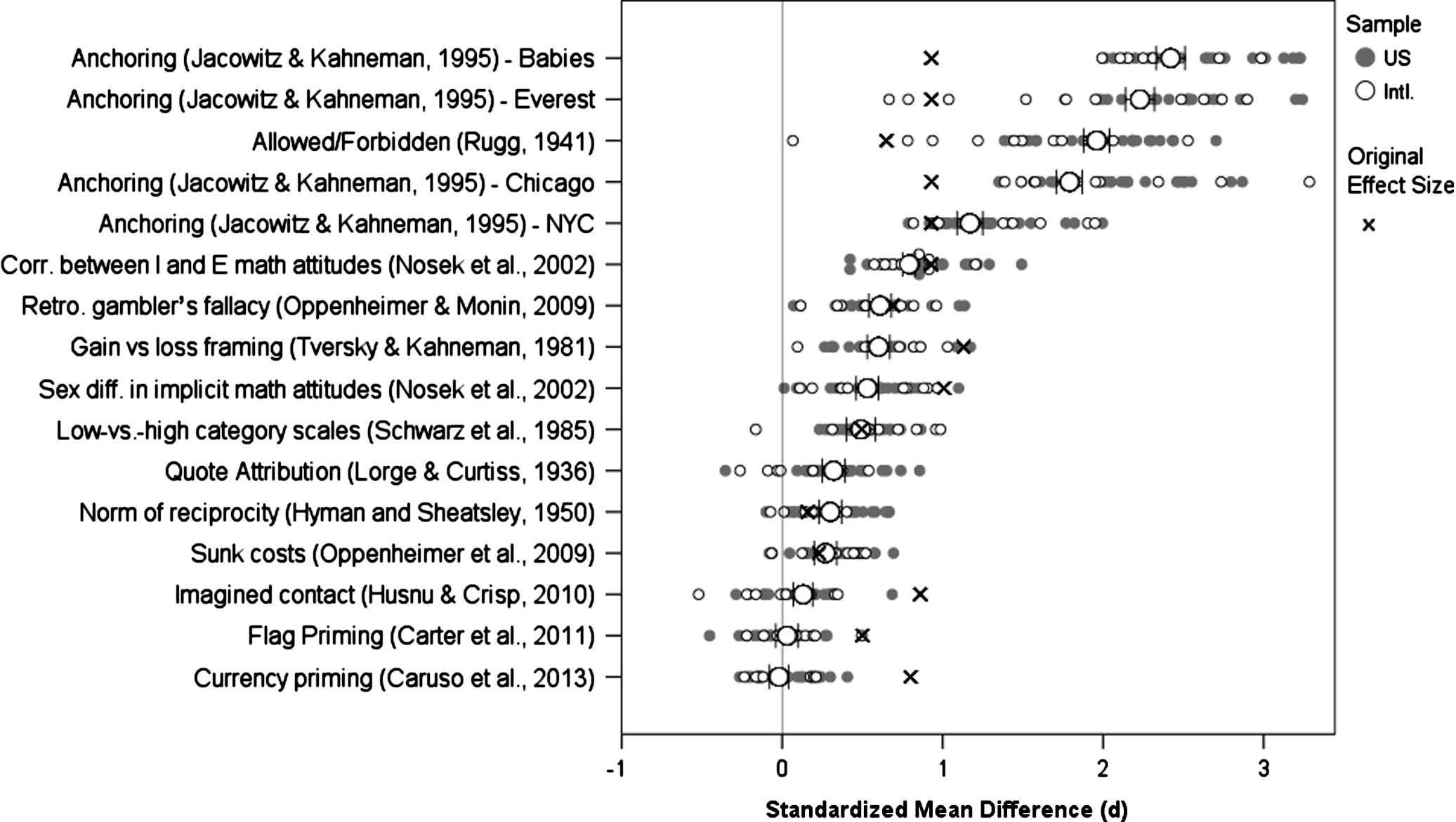
So maybe it is possible to trick subjects with these cute experiments, but the explanations those people made didn’t actually track to the creation of new preferences or identities. So much for Chater’s thesis, then — the mind is not flat.
That’s the end of the argument, logically.
Not the book, though. Chater then argues the unconscious exists the way psychoanalysts or common folk think it does. By unconscious, he means a part of the mind that has beliefs, desires, thoughts, and identities that is hidden from our conscious experience.
I think this is necessarily true if you conclude that the propositional character of our conscious experience does not apply to raw sensory data or our unseen cognitive processes. I don’t know if that’s Chater’s argument (I don’t understand it), but it’s fair if that is the case.
Concretely: we have a mental surface: thoughts, actions, sensory perceptions, and feelings which can be consciously observed. Then, we supposedly have some sort of unconscious mind underneath that surface: motives, thoughts, feelings, and identities that we do not know, but affect our consciousness.
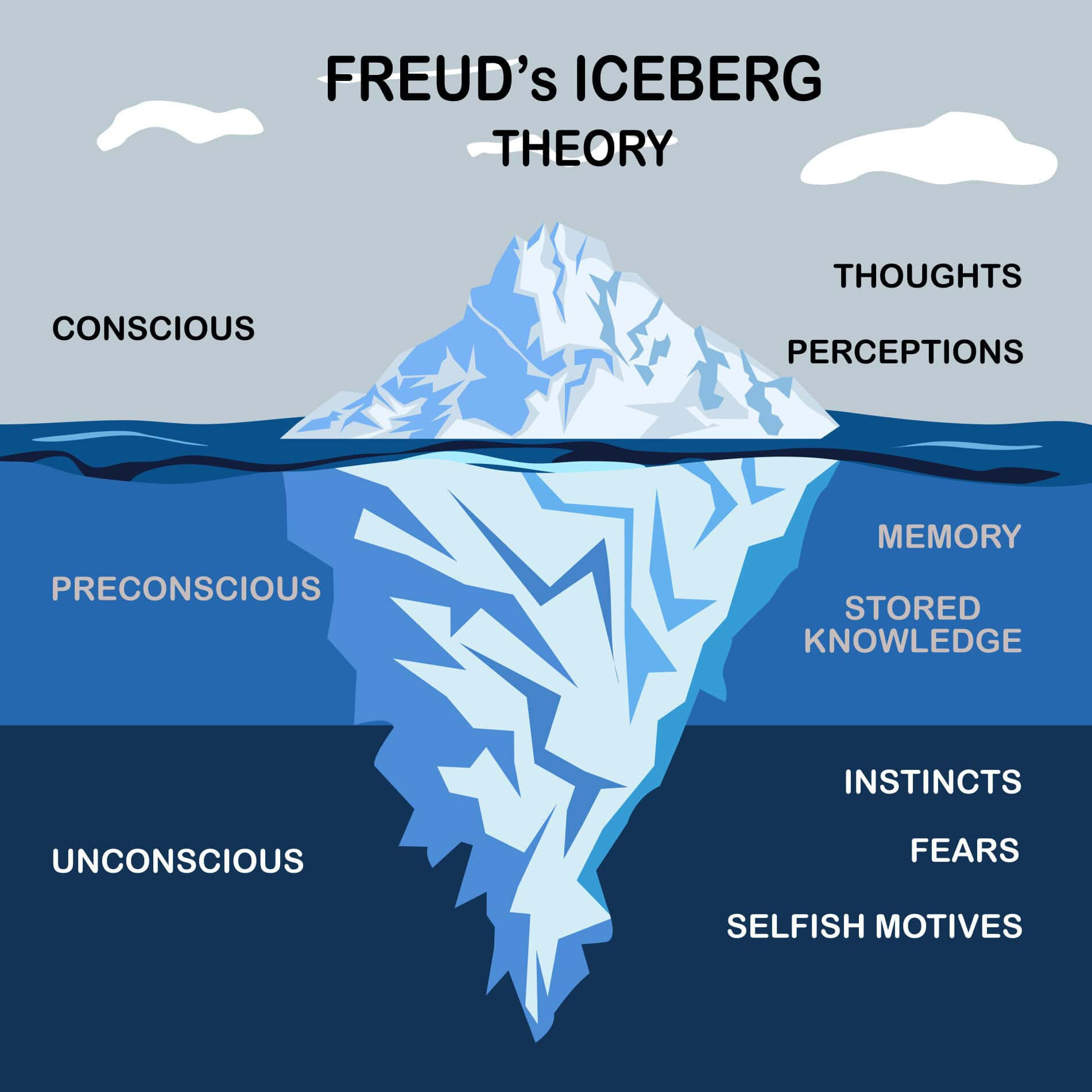
Chater astutely notices this analogy tricks us into thinking what is conscious is like what is not. That the ice above the water is the same as the ice beneath it. That the consistent and clean thoughts we see on the surface generalise to what is underneath.
But the vision of the iceberg, with its vast dark mass hidden below the water, hides an important but entirely flawed assumption. In an iceberg, the material that is above and below the waterline is precisely the same – ice is ice, whether deep beneath the waves or sparkling in the sunlight. And, for this reason, it seems only natural that what is hidden can be made visible and what is visible can be made hidden – it is still the same ice whether we lift it from the waters or plunge it into the depths. The metaphor suggests that the very same thought could be either conscious or unconscious – and could jump between the two states. Accordingly, a thought that was previously unconscious might be brought into the light of consciousness (whether through casual introspection, intense soul-searching or years of psychoanalysis).
In that regard, I don’t think Chater was radical enough. You might think you have a conscious drive to “satiate thirst”, but you have only inferred it based on patterns of behaviour and physiological signals. You can’t see a neuron or set of neurons in your brain that activate when you need water.
Every single drive, fear, and desire you have is unconscious. Nothing is being repressed, just ignored or unrecognised. The only way you can learn anything about yourself appears to be… introspection.
Chater does not like introspection as a word or concept. He never says this so nakedly, but its clear from his writing. A problem I see is that intropsection isn’t really one thing. One kind — noticing emotions — is plainly useful. Causal accounts of why these emotions occur: environmental factors or one’s personality — are useful for self-interpretation, but often wrong.
People are almost always unwilling to admit to being wrong, especially if it’s about something as personal as the self. People are often highly overconfident in their interpretations of themselves, and are unwilling to revise them.
Much error can come from taking your thoughts too seriously; even the eminent and talented philosopher Bertrand Russell did — he went on a bike ride and somehow realised that he no longer loved his wife Alys. What followed was an unhappy marriage that eventually broke apart.
The philosopher, logician and political activist Bertrand Russell writes memorably of a moment of apparent emotional insight in the autumn of 1901: ‘I went out bicycling one afternoon, and suddenly, as I was riding along a country road, I realized that I no longer loved Alys. I had had no idea until this moment that my love for her was even lessening. The problem presented by this discovery was very grave.’
For Russell, this thought was no mere creation of the moment (perhaps a product of a frustrating morning’s work, or the aftermath of argument); instead, he interpreted it as an indisputable revelation, breaking through from a hidden subterranean emotional world. This proved to be a disastrous interpretation, at least for their relationship, which foundered rapidly, though not leading to divorce until twenty years later. Of course, the marriage might have failed in any case, but once Russell had received, as he saw it, a damning and final verdict from the ‘inner oracle’, he became utterly convinced that the relationship was dead. And with that belief firmly established in his mind, there was probably little hope.
Russell, here, is assuming the mind works in syllogisms: I either love or don’t love my wife. It doesn’t. You have a dispositional attitude towards your wife, and could feel anything towards her in the moment. During that bike ride, he might just be in a bad mood, and a thought just sprung into his head. It didn’t need to be taken seriously.
Chater’s ultimate argument is that a unified, stable self does not exist. That feels like the biggest clam he makes in the book, the most derivative of his premises, but it’s also the most reasonable conclusion to make. Great philosophers like Hume, Nietzsche, or Buddha noticed the same thing. In a way, Chater is still right — the mind has no propositional and unchangeable depth.
Where I would push back is that this model of the human brain, in a weird way, opens itself to more depth that the alternatives. The incoherence and evanescence of mental depths is not evidence of its absence, or of it not being worth wondering about. People do have genetically-determined personality traits which will reliably affect how they act and feel. They have beliefs… held loosely or in contradiction with others.
So
The mind is a woman and she has B-cups.
I read the entire book, some sections of it twice. If you can get me to do that, you are entitled to at least a 6/10. I give the book a 9, and it's earned a place on my sidebar. The book is great at taking bad ideas and tearing them down — Freudian nonsense, identitarian self-modelling, multitasking, and whatnot. The model he replaces it with is good, but incomplete and sometimes plainly wrong.
The most useful information in the book:
Perception is inference.
The mind can only focus on one thing at a time.
Only the outputs of the brain can be observed.
Self-explanations are necessary, but shouldn’t be taken too seriously.
Minds are dispositional, not propositional.
There is no stable, coherent self.
The unconscious has no desires, beliefs, or deep hidden self.
Chater unredpilled me on self-deception. People don't need to trick themselves because there is nothing to trick. The paradigm of self-deception assumes there is a way people can find the answers that explain their own behaviour — that must be overidden. It doesn't exist.
What happens is that, when people are asked about their behaviour in a socially sensitive context, they default to defensive and benign answers. The answers aren’t lies because they often do not know the answer, unless their behaviour was planned or highly deliberate. The anwers they provide aren’t necessarily wrong, they just happen to be what people are incentivised to share. The Elephant in the Brain is the fact we think we are righteous individuals in the first place.
Many other schools of philosophy do not survive the scrutiny of flatism. Psychoanalysis is the most obvious one. Rational econometric models of human behaviour fall out of favour, as brains are not propositional. Modern beliefs about a true self or even nonexistent one look flimsier.
The worst conclusion you could make based on this book is that, because you don’t have mental depth, that you can become anything. That if you keep working hard at math or being a good person, that you can become those things. That if you keep eating potatoes and convincing yourself you like them, you will. It’s the kind of logic your parents used to get you to participate in extracurriculars you didn’t care about.
Genes are real. Persistent environmental effects are real. Free will is fake. Case closed.
In second place would sit the idea that, because our explanations can be faulty and selective, that they must always be. Not exactly. Somebody asked to explain why they are in a bed at night could say they desire to sleep; it wouldn’t be wrong. The problem lies with wanting explanations to do things they cannot.
Fragment:
University of Minnesota provided some of the first direct evidence that this is right. Psychologists Stanley Schachter and Jerome Singer injected volunteer participants with either adrenaline or a placebo, and led them to a waiting area where they could sit for a while before the beginning of the experiment. They found that they had to share the waiting room with another participant who, so it seemed, was also waiting to be taken through to start the experimental session. But the waiting room was the experiment – and the other person wasn’t a fellow participant at all, but a ‘stooge’ of the experimenters. The stooge acted either slightly manically (making and flying paper aeroplanes) or angrily (outraged by a questionnaire they had to fill in while waiting). The artificially adrenalinized participants had stronger emotional reactions to both stooges than those who had just received a placebo. Crucially, and remarkably, their emotional reactions were stronger in opposite directions. Confronted with the ‘manic’ stooge, participants interpreted their raised heart-rate, shortness of breath and flushed face as indicating their own euphoria; but with the ‘angry’ stooge, those very same symptoms were interpreted as signalling their own irritation.
We have already described the heightened emotional reactions of the Uninformed participants in Schachter and Singer’s experiment. But what about the Informed participants? If adrenaline merely acts as an emotional intensifier, then it should operate in just the same way whether we have been told about the likely effects of the shot or not. But if, instead, we are attempting to interpret our emotional experiences, in the moment, in the light of our physiological state, then our knowledge of the likely effect of the adrenaline shot should matter a lot. The Informed participants will attribute their state of high arousal to the shot; and therefore they will be less inclined to use it as a clue to the strength of that emotional reaction to the stooge (though, almost certainly, they won’t be able to ignore it entirely). And, indeed, this is exactly what Schachter and Singer found.
To make his case, he cites a study of some researchers who pumped subjects full of adrenalin and had them wait in a room with a fellow participant… who was actually a proctor, a stooge. He was either flying paper airplanes or angrily filling out a questionnaire.
People who received the adrenalin felt stronger emotional reactions to the stooge’s behaviour than people who received the placebo — if the stooge was negative, the participants said they felt angry; if he was positive, the participants said they were elated. This changed if the participants were told that they had received adrenalin, so they assumed their heart rate and breathing were due to the medication, not the stooge’s behaviour.
This study proves that people can have incorrect causal explanations for why they feel emotions, but not that the interpretations themselves are wrong. The participant’s environment might influence how they interpret their emotions, but it could causally influence their physiological state. The participants could have found the paper airplanes endearing, and incorrectly assumed their physiological arousal was due to that.
This gets weirder when we realise that our causal interpretations influence our physiological state. Take, for example, a girl who wakes up groggily and hears her family talking in the kitchen. She assumes that they woke her up, and that caused her to become prematurely fatigued, and that angers her. But what if she woke up dazed because she ate too much before bed, and the noise had nothing to do with it? Presumably, that would not anger her.
This research was the basis if the final episode of House’s fifth season (which I recommend).
> Perception is inference.
> Only the outputs of the brain can be observed.
> Minds are dispositional, not propositional.
If you take these together, you realize that most of what cognition is, is a type of predictive processing that works to reify itself as a process: namely, the mind takes something to have already happened/existed, then attempts to enforce that outcome/perception even more through thought.
That is why almost all advanced meditation practices – from whichever tradition – end up pointing to the same conclusions one ought to arrive at experientially: to see the true nature of the mind as a positive reinforcement machine, and to understand oneself apart from that machinery alone.
That said, as you pointed out, not all habituation or positive reinforcement is created equal. Some of these loops are clearly more upstream than others, and uprooting them (or even noticing them) is difficult or impossible; not to mention likely not ideal.
The other thing to emphasize is that the 'brain' is only one aspect of the machinery of the mind. Loosely, the 'job' of the brain is to take the perceptions from all others aspects of mind – i.e., from different parts of the body, environment, etc. – and 'synthesize' them into a predictive inference as described above.
The unconscious is real