TL;DR:
“It just works”: tesamorelin
Efficacy, at a cost: MK-677
Efficacy, but of uncertain safety: CJC with DAC
Safe, possibly effective: ipamorelin, CJC with no DAC
Besides directly supplementing with growth hormone, drugs can also target ghrelin or GHRHR receptors to cause the body to naturally release growth hormone. Most of its effects are mediated through IGF, which causes bone growth, fat loss, muscle repair, connective tissue repair, and neurotrophy.
The GH itself also increases water retention, which can lead to increased blood pressure, joint pain, and muscle pain. It also increases insulin resistance.
Growth hormone has traditionally been used as a performance enhancing drug, but its rather overrated in that regard. It might not even make people stronger — it makes people lose fat and gain lean mass, but the gains in lean mass do not translate to improved strength.
The kind of people who would find GH or its alternatives valuable are people who want to recover more quickly or have low baseline levels of IGF.
How much is too much?
The evidence GH and IGF increase the risk for cancer and death is pretty solid.
Knocking out the genes that promote GH signalling is one of the most effective interventions for raising the lifespan of mice. People with acromegaly, which causes chronically elevated GH and IGF, typically live about 10 less years; GH deficiency does not appear to have a marked effect on lifespan. People with Laron syndrome, which causes insentivity to GH, have been observed to rarely have cancer.
In normal humans, IGF levels range from 150-400 ng/ml:
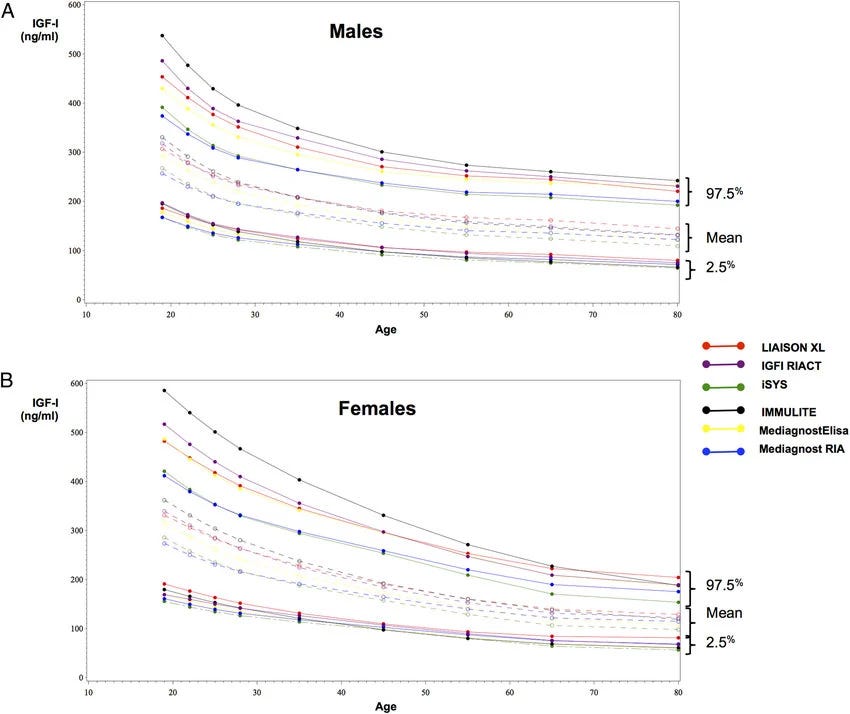
People with acromegaly typically have IGF levels in the 400-800 ng/ml range1, which eventually causes the development of several health problems, like sleep apnea or high blood pressure.
Normal people can have IGF levels in that range and remain asymptomatic, but that’s likely because their levels eventually regress to the mean. Even if normal humans can be found with naturally high IGF levels, that doesn’t necessarily mean those levels are safe.
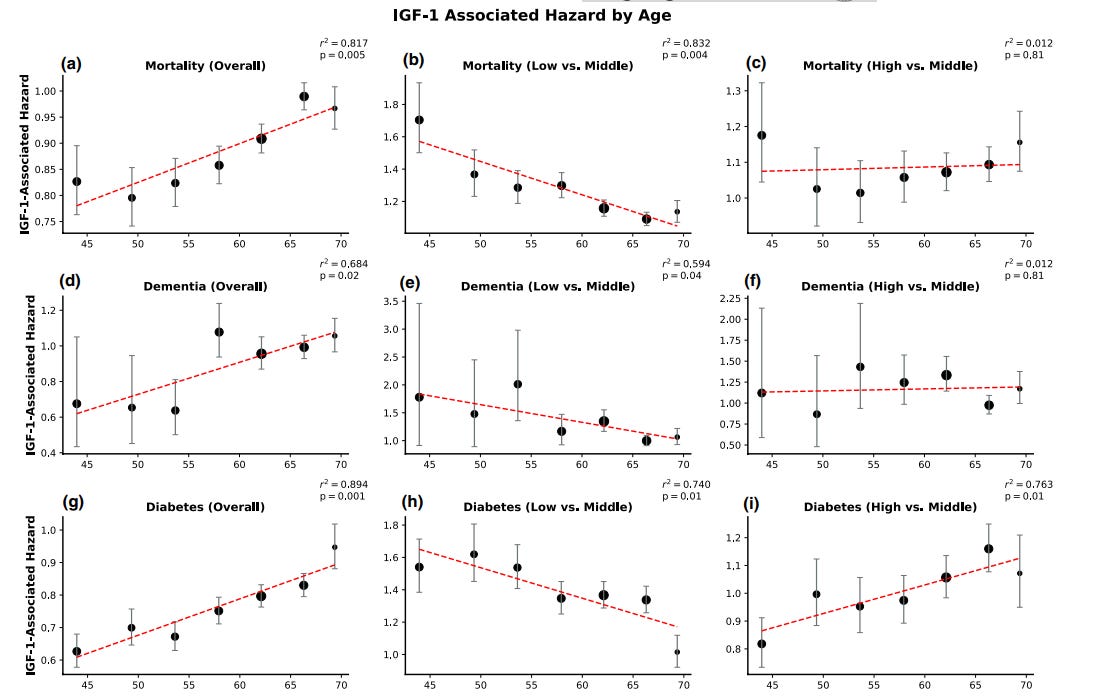
Empirically, IGF is a good candidate for a trait that shows antagonistic pleiotropy: it has positive effects in the youth, but more negative effects in the elderly:
The age x dose interaction suggests that low IGF-1 is bad regardless of age; something the anti-PED people will never tell you:
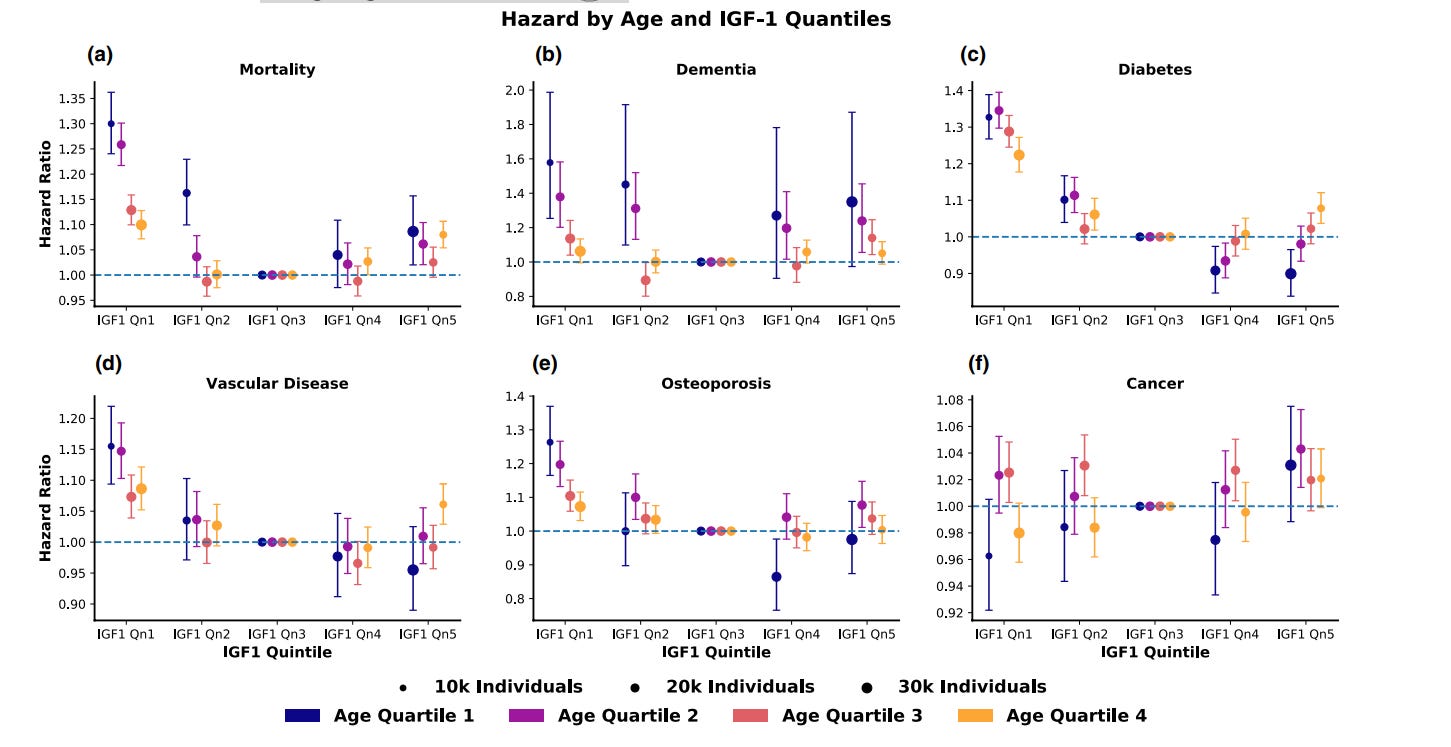
Genetically, high IGF levels are only robustly associated with colorectal cancer in the UK biobank and Japanese biobank. These correlations, including the genetic ones, are probably confounded by other factors that are hard to control for. That said, I still think it’s still pretty likely that chronically and unusually elevated IGF does drive cancer risk and mortality.
Summary:

Tesamorelin
Gold standard. It secretes GH through the GHRH receptor; half life of 30 minutes.
It’s been demonstrated to reduce visceral fat in FDA trials.
At doses of 2mg/day, it increased IGF levels by about 60-100%2 in this study:
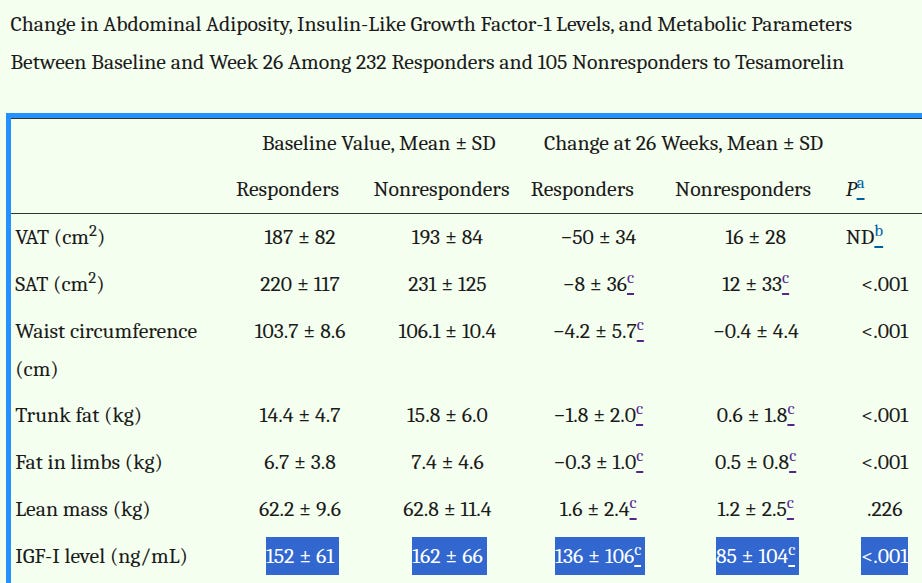
They didn’t specify how long after injecting this was; a different one finds a similar increase in IGF levels by 181 ± 22 (ng/mL) 20 hours after the same dose (2mg) of tesamorelin had been administered.
Tesamorelin is pretty well tolerated; side effects include joint pain, muscle pain, and injection site reactions. The joint and muscle pain probably come from retained water putting stress on the muscles and connective tissue. Presumably, if used for enough time and at high enough doses, it would also increase the risk of
People have taken 2mg/day of this drug for as long as 26 weeks, causing their IGF levels to increase by up to 100%, with none of these complaints. About 2.5% of young adults have IGF levels of 300-400, which is similar to what the average person would achieve from a 2mg dose of tesamorelin. The optimal dose is probably lower than that.
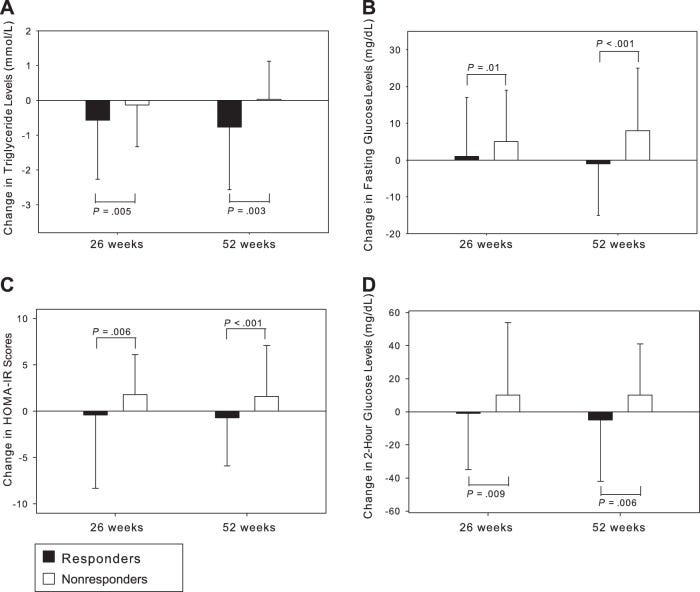
This drug doesn’t seem to affect insulin resistance much, not in the FDA trial3, or in a small sample of diabetics.
Interestingly, this absence of effect is due to its reduction in visceral fat, which improves insulin resistance. People who did not lose >8% of their visceral fat on the drug had higher resting glucose levels, while the responders didn’t change:
MK-677
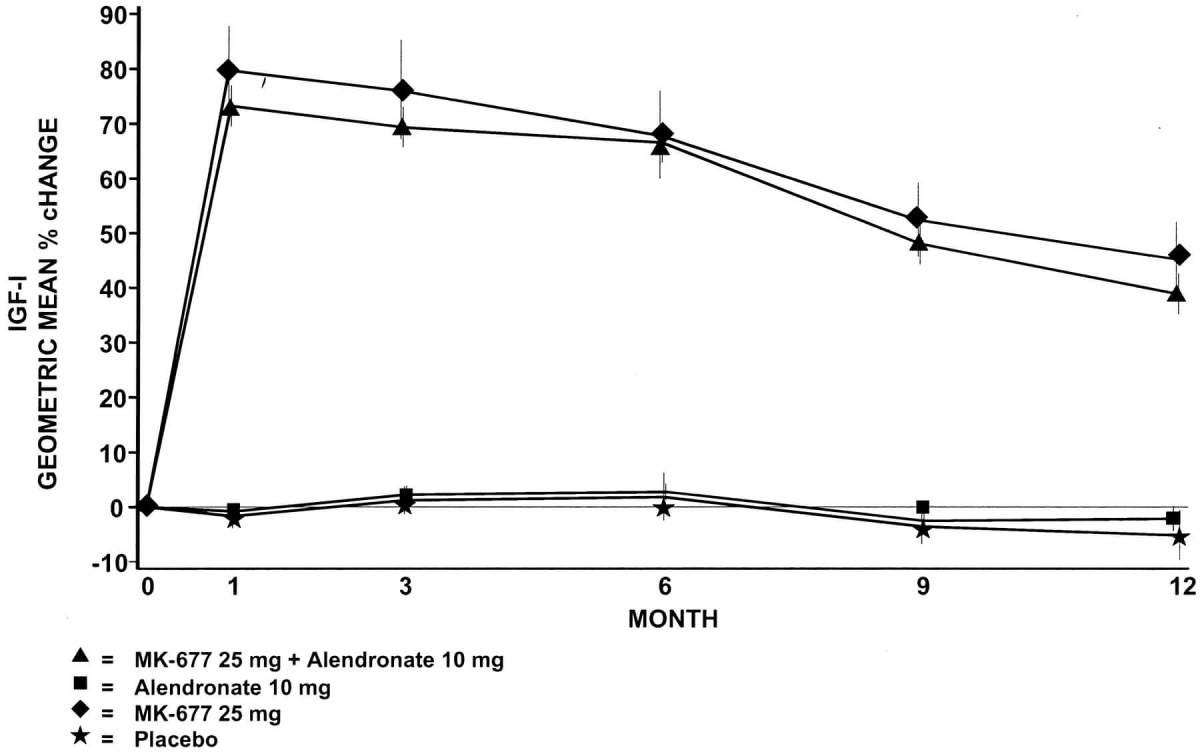
Another option is MK-677, a ghrelin analogue which can be taken orally. Its half-life has been cited to be 5 hours, and it elevates IGF for 24 hours, so it only needs to be dosed daily. The empirical evidence it works is fairly undeniable.
Despite being considered highly potent, it doesn’t even raise IGF as much as 2mg of tesamorelin does, and the effects of it taper off with time:
It also stimulates appetite, which many people find difficult to tolerate. It has few benefits over other options, besides the fact there is extensive empirical evidence that supports it, and the fact that it can be taken orally. It also increases growth hormone levels for longer than other secretogues, so more its negative side effects — water retention, joint/muscle pain, and tingling — should be expected.
CJC
CJC is a fragment of GHRH which stimulates the release of growth hormone. When the DAC component is added, its half-life is increased from 30 minutes to about 7 days. In this formation, it has been demonstrated to increase IGF levels for a week using only one dose:
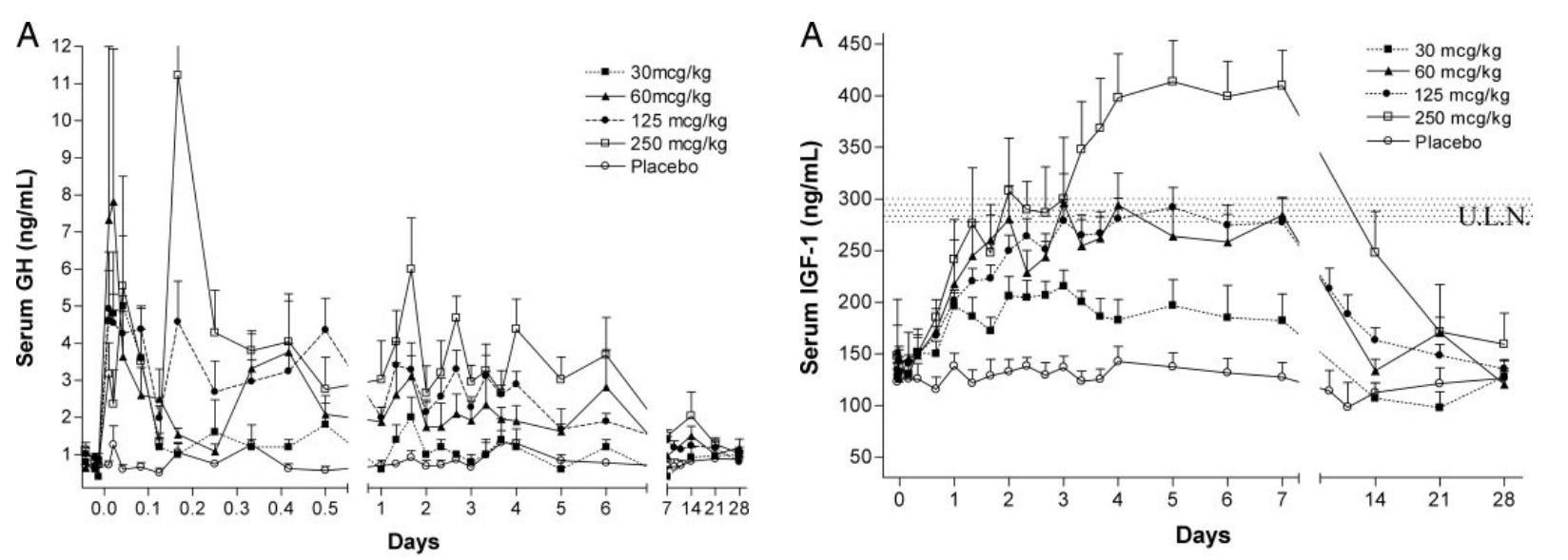
The GH increases that it causes are also more erratic, leading to higher pulsatile increases as well as higher chronic levels. The community seems to think this is better, as it leads to less receptor desensitisation and IGF-mediated downregulation.
They also ran a second study where they had some people take weekly doses, and found that low doses could deliver the same IGF increase as tesamorelin:
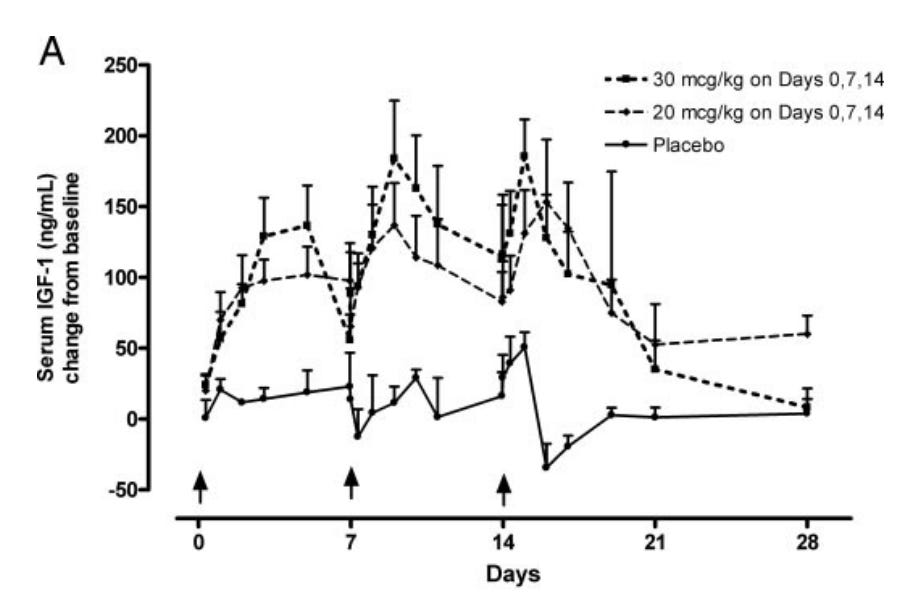
CJC with DAC was pretty well-tolerated at low doses, but 100% of the subjects who took the 125-250mcg/kg doses experienced diarrhea and flushing. No consistent changes in glucose or lipid levels were found.

Bryan Johnson had a bad experience with CJC-DAC. He found that it increased his fasting blood glucose by 20%, insulin resistance by 50%, and reduced his REM sleep by 23%.
CJC, no DAC
The DAC component can be removed, which gives the drug a shorter half life; it’s been cited to be 30 minutes, but there is no original source for that claim. The drug itself originates from an attempt to increase Sermorelin’s resistance to degradation, which has a half life of 12 minutes. Realistically speaking, the half life of CJC with no DAC could be anywhere from 10 minutes to a week.
There’s no real evidence CJC works in this formulation, but there’s also no reason to think it doesn’t. We do know that tesamorelin, which has a short half life, and acts on the same receptor — does work. So, I think the null hypothesis is that this peptide does too, though there is still a chance it doesn’t.
My main concern is that it’s underdosed. All of tesamorelin’s studies are using 2mg, while the community typically recommends CJC doses of 100-500mcg.
There’s no real reason for this. Tesamorelin is 1.5x heavier than CJC with no DAC4, but that doesn’t justify a 10x difference in dosage.
Ipamorelin
This drug sits in a similar situation to CJC with no DAC. There’s no real evidence it works in humans, but it theoretically should. Its half life of 2 hours is decent, and it targets the same receptor that MK-677 does. It’s highly selective, and hardly acts on prolactin or cortisol.
One of the first ipamorelin studies supposedly found no increase in IGF levels, which is correct, but the sample size here is only 16; it’s not large enough to detect a small effect. Though, it is large enough to detect a large one.
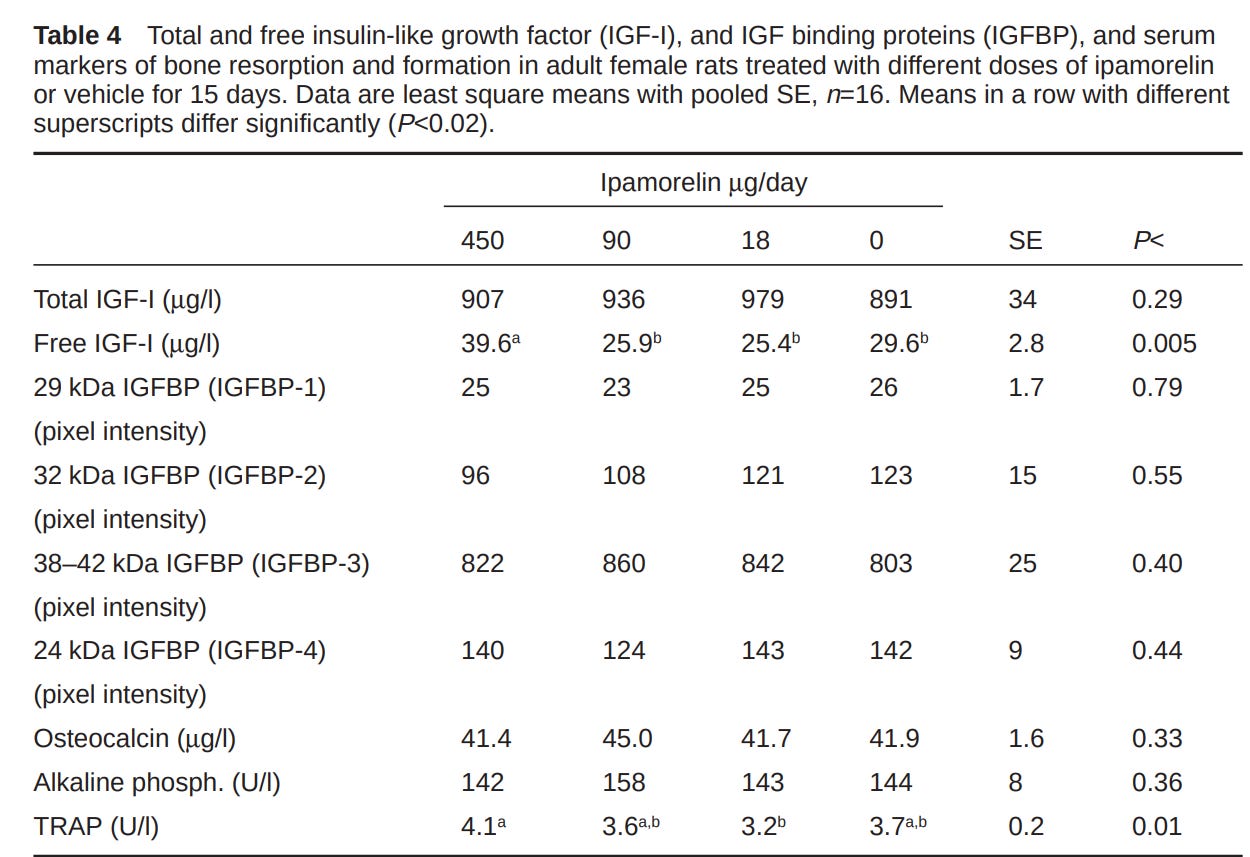
The half-life of ipamorelin is also shorter in rats (30-60 mins) than humans (120 minutes), so it’s not clear if the results can be cleanly ported over. My intuition is that the devil is in the dosage.
The specter of European nihilism haunting peptides
The question people want answered is “does X work?”
The answer the internet gives is usually something along the lines of “this drug failed Y trial so it does not work” or “this drug was approved to do YZ so it does it better than other drugs of its class”. None of these claims follow from their premises. Tesamorelin, for example, was trialed for visceral fat loss, but that’s a general feature of any drug that increases GH and/or IGF.
The way these drugs work is by increasing the frequency/peak of GH pulses. Which then increases IGF, which is what does most of the heavy lifting in terms of physiological changes. Demonstrating that a drug increases IGF, or even GH, in my opinion, means that it almost certainly works — the devil is in the dosage, after that point. 100mcg of ipamorelin might spike GH, but maybe for not enough time to elevate IGF enough to produce physiological changes.
People have different thresholds of evidence when it comes to rating GH alternatives; the yardstick I use is whether they improve IGF, which is the most important thing that GH does. When it comes to instutitions and scientific consensus, it’s FDA trials + status or bust.
I’ve heard that the GHRH receptor reaches saturation at 1mcg per kg of body weight. Regardless of whether this is true, this does not mean that diminishing returns kick in around 50-100mcg. High doses also increase the amount of time that the human body is exposed to the peptide. This is particularly relevant for these drugs, as they are functioning by increasing GH, which rises and falls in spikes that can’t be cleanly predicted from the dose itself.
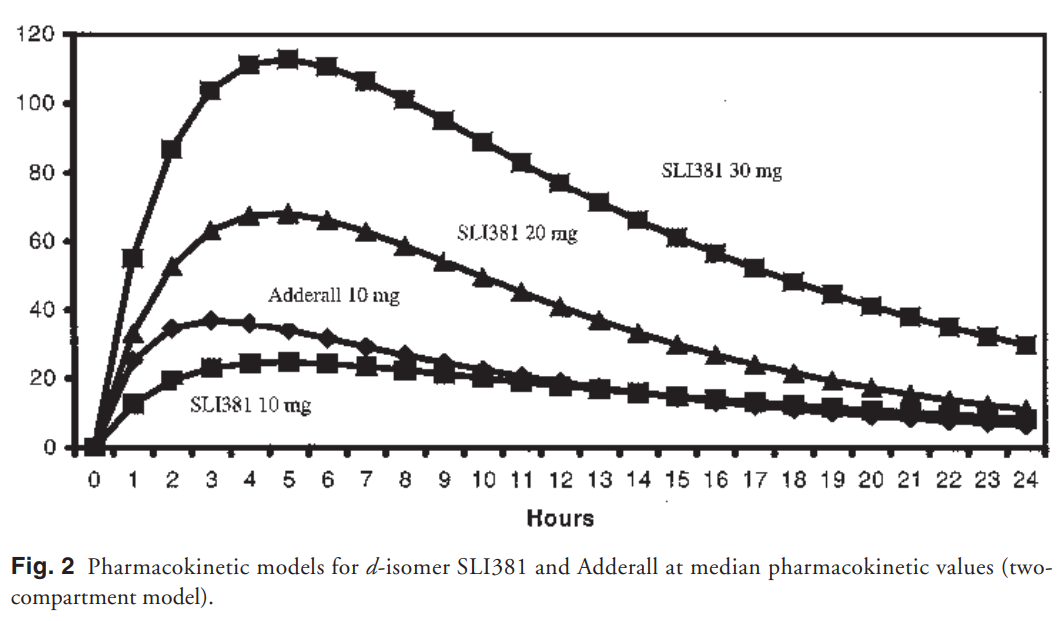
Using adderall as an example: